




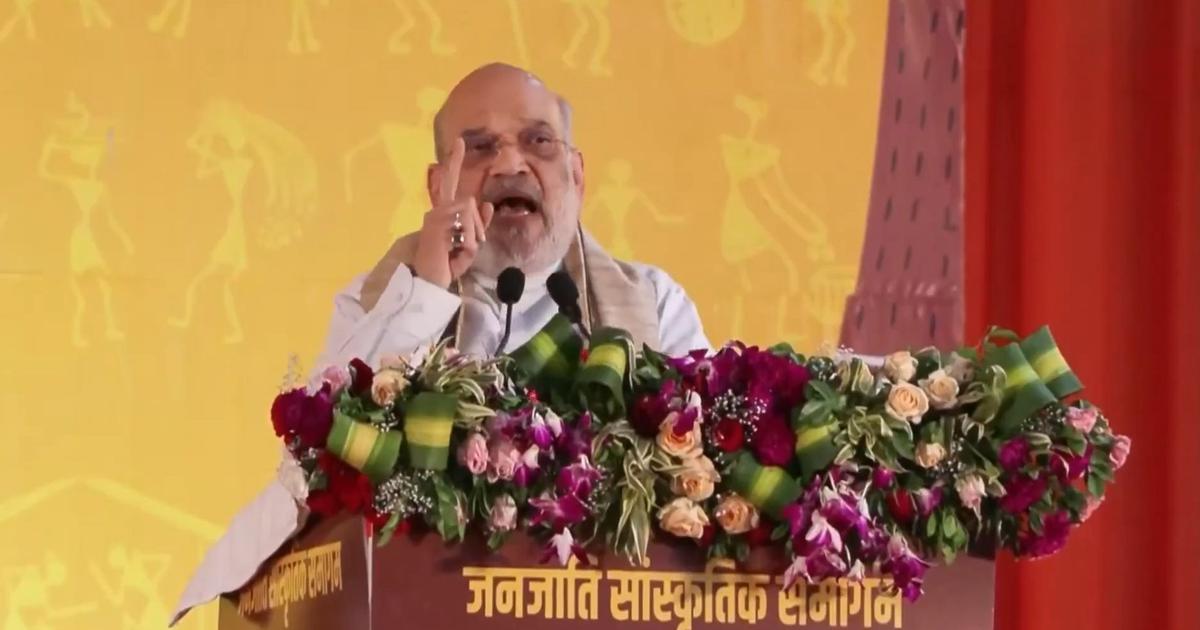
On May 24, lakhs of members of Scheduled Tribe communities from across India gathered at the Red Fort in New Delhi. They were there for the Janjati Sanskritik Samagam, or “tribal cultural confluence”. It had been organised by the Janjati Suraksha Manch, or “tribal protection forum”.
The event was ostensibly being held to celebrate the 150th birth anniversary of the revolutionary Adivasi leader Birsa Munda. Publicity material also stated that it was intended to call for the preservation and protection of tribal culture and identity.
That the event had the Indian government’s approval was apparent from the fact that its chief guest was Home Minister Amit Shah. In his speech on the occasion, Shah likened the event to the Ulgulan, Birsa Munda’s revolt against exploiters from outside the region to which he belonged, in present-day Jharkhand. “This andolan will connect us to the earth, save our culture and unite our religion,” Shah said.
What had not been spelt out in promotional material was the specific demand at the heart of this call for protection: that tribals who converted to Christianity should lose their status as tribals.
Organisers that Scroll spoke to admitted this plainly, as well as the fact that they chose not to centre this agenda in publicity material. “We couldn’t have an event at the Red Fort with delisting as the main focus, so we gave it the name Janjati Sanskritik Samagam,” said Megha Oraon, the Jharkhand spokesperson of the Janjati Suraksha Manch. “But our main agenda was delisting.”
Five days after the gathering, on May 29, a delegation of 25 tribal representatives from the Janjati Suraksha Manch, from across India, met Prime Minister Narendra Modi and presented him a memorandum listing their demands.
It was perhaps the most visible week for an organisation that was founded 20 years ago, and is affiliated to the Akhil Bharatiya Vanavasi Kalyan Ashram, a Sangh Parivar organisation whose stated aim is to work for the welfare of tribals. The Janjati Suraksha Manch, too, falls under the umbrella of the Sangh Parivar.
Megha noted that the organisation began planning for the event almost two years ago. “Tribals from every state in the country belonging to over 500 communities attended the event,” he said. “Our estimate is that over three lakh people attended it.”
The central demand, of delisting converted tribals, is a controversial one with a complex background. Organisations like the Manch claim that when a tribal person converts, they essentially give up their traditional way of life. Thus, they argue that they should be denied access to benefits that tribals receive, such as reservation in government jobs.
Many activists, however, argue that this demand, particularly since it is spearheaded by bodies linked to the Sangh, represents an effort to subsume Adivasi identity into the Hindu fold.
The Manch and other right-wing tribal outfits also argue that tribal Christians gain benefits from both their minority status and their Scheduled Tribe status. I asked the co-convenor of the Manch, Dr Rajkishore Hansda, what these benefits were. He added, “They are educated in minority institutions and then they take Scheduled Tribes’ reservations for government jobs. They take half the benefits from their religious status and the other half from their Scheduled Tribe status. This becomes a double advantage.”
The high-profile event and the government’s tacit support of it suggests that, going forward, the Manch will play a key role in the Bharatiya Janata Party’s efforts to shape tribal policy across the country.
The Adivasi writer and activist Gladson Dungdung noted that while “the Manch has been active for a while”, they had thus far met with limited success in Jharkhand. The key reason for this, he argued, was that apart from demanding the delisting of Christian tribals, the group also opposed the popular demand among many Adivasis for a separate code for the indigenous Sarna faith.
But, he added, “The demand for delisting will come up repeatedly until the next set of elections in 2029. And if a bill is introduced in the parliament, then we will have to wait and see what happens.”
The organisation and the demand
The Janjati Suraksha Manch was established in 2006 in Raipur, Chhattisgarh, a state where more than 30% of the population comprises Scheduled Tribes. Oraon noted that since then, it has opened branches or affiliates in all states that have a significant tribal population.
The Manch took its first major step in 2009, when it submitted a signature campaign to President Pratibha Patil, with their demand for delisting converted tribals. It has kept up a steady pressure on such matters since then. For instance, it has played a key role in persuading converted tribals to give up Christianity, and in carrying out ghar wapsi ceremonies. It has also mobilised to deny Christians burial rights and put in place other forms of social ostracism in villages.
The central demand has a history that goes back several decades. Among those who most prominently raised it was the Oraon Adivasi leader Kartik Oraon, whom the Manch lists on its website as an “unsung hero” of the Indian freedom struggle.
In 1962, Kartik Oraon stood for the Lok Sabha election from the Lohardaga constituency, then in Bihar, which was reserved for candidates from Scheduled Tribes. He lost to a Christian candidate, while another Christian candidate secured the third position.
Kartik Oraon challenged the result in an election tribunal, which ruled against him. He then appealed this decision in the Patna High Court.
The crux of his argument, as the judgement went on to note, was that his opponents had “nothing to do with the animistic faith and tribal way of life”, that they did not “follow the manners and customs of the tribes”, or have any “affinity nor any common interest, defence or aspirations with or for the tribal people”. Thus, he argued, they should be prohibited from contesting elections under seats reserved for Scheduled Tribes.
The Patna High ruled against Kartik Oraon, stating that it found “no merit in the appeal”.
In its reasoning, it noted that many Christian Oraons observed certain “tribal festivals not in conflict with Christianity” and maintained “tribal ways of life”. Further, it observed “non-Christian Oraons treat the converted Oraons as tribals”, calling them “Christian Oraons”. This demonstrated that Christian Oraons are “Oraons first and Christians next”, the court held. It also noted that the winning candidate had worked for the upliftment of both non-Christian and Christian Oraons, and that “both kinds of Oraons” considered him “to be one of them”.
Overall, it stated, “Christian Oraons are Oraons in spite of their conversion, and are entitled to the rights and privileges of the tribals”.
A contentious bill
Kartik Oraon’s involvement in this question did not end there. In the next Lok Sabha election, held in 1967, he won from the Lohardaga constituency and entered parliament. In August that year, the government introduced the Scheduled Castes and Scheduled Tribes Order Amendment Bill to revise the lists of these groups across India. The bill was referred to a joint committee, of which Kartik Oraon was a member.
Among the amendments the committee debated recommending were that “no person who has given up the tribal faith or faiths and has embraced Christianity or Islam should be deemed to be a member of Scheduled Tribe”.
Many members opposed the suggestion. For instance, the member of parliament Emonsing M Sangma, from the Garo community in then Assam, argued that Christian tribals did not automatically become “advanced, civilised and rich” by forfeiting their tribal religion. The committee’s final report records his argument that the improvement the lives of these tribal people had seen were a result of the “special care and attention” provided by the Union government, and that taking away that care would become “a strong barrier for the Christian tribals to proceed on in their efforts towards progress and development”.
Sangma also argued that religion could not be the singular criterion for determining whether a community qualified as a Scheduled Tribe. Rather, he said that, as the 1965 Lokur committee had suggested, these criterion should include “primitive traits, distinctive culture, geographical isolation, shyness of contact with the community at large, and backwardness.” These traits, Sangma argued “abundantly existed” in both Christian and non-Christian tribal communities.
The proposed amendment did not secure adequate support within the committee. Its report noted, “After discussing the various aspects of the issues involved in the proposed amendment at considerable length, the Committee decided to put it to vote as a result of which it was lost.”
In his interview to Scroll, Megha Oraon claimed that the 1967 committee had conducted an assessment of the religion of government officials in reserved posts for Scheduled Tribes and found that a large majority of the posts were occupied by converted tribals. However, Scroll examined the report and found no mention of such a study or findings.
In fact, Sangma had addressed such claims in his arguments, stating, “If one, on the spot, studies carefully and learns the actual fact correctly, one will be glad to know that this sort of allegation against the Christian tribals is very unfair and not correct.”
Arguments and criticisms
One of the foremost critics of the demand to delist converted tribals has been former Jharkhand minister Geetashree Oraon, Kartik Oraon’s daughter.
In interviews to various news outlets, Geetashree has been reminding people that her late father wrote a book named “Bees Varsh ki Kali Raat” (Dark Night of Twenty Years), in which he categorically stated that Adivasis practice Adi Dharma, an animistic faith that predates Hinduism. Furthermore, she has noted, while her father did demand that Christian tribals be delisted, he also recommended that the government initiate a new category of reservations for backward Christians.
In contrast, the Manch blurs arguments about religion and tribal identity.
On the one hand, its leaders argue that major religions pose a threat to tribal identity and tribal religions. “When tribals convert to Islam and Christianity, they have to obey the Quran and the Bible respectively,” said Hansda. “If they continue to follow tribal customs, then they are betraying both their own religion and the Adivasi religion.”
At the same time, they exclude Hinduism from this list. “Hinduism is a way of life,” Hansda said. “Whoever is born in India, their nature and culture are one and the same.”
This is a key argument that critics of the Manch focus on. In Jharkhand, for instance, a mixed group of activists and leaders from various communities, including Adivasis of different faiths, put out a public appeal to boycott the May event. The appeal stated that organisations such as the Manch believe that “Adivasis are Hindu and part of the caste system”. This, they noted, is why they typically use the term Vanvasi rather than Adivasi. Many activists reject the former term, arguing that it reduces the description of Adivasis to just “forest dwellers”, whereas the term Adivasi foregrounds their indigeneity and their rights over land as first settlers.
“On one hand these organisations are working to destroy the independent existence of tribals by promoting the term Sarna Sanatan,” the appeal stated, referring to a term that conflated an indigenous Adivasi faith and a word used as synonymous with Hinduism.
Activists also argue that this line of thinking erases the long fight of Adivasi and tribal communities for their own religious code. The appeal added, “On the other hand, they are working to break the collective identity of tribals by demanding the delisting of Christian tribals from the tribal list.”
Another major concern among activists and members of tribal communities is that if Christian tribals are delisted, land that they own will lose protections afforded to tribal-owned land in areas listed under the fifth and sixth schedules of the constitution – for instance, the sale and transfer of such land to non-tribals is restricted. Many fear that delisting Christian tribals would leave these lands vulnerable to being taken over by outsiders, through legal and illegal routes – this, they fear will also gradually lead to a dwindling of the Scheduled Tribe population of these areas.
Hansda dismissed these concerns. “If people are concerned about this, then they should think, which will be more advantageous?” he said. “Remaining a religious minority or a Scheduled Tribe? If this amendment is made, we are expecting there will be mass drives of ghar wapsi across the country, so there should be no threat to land.”
While the debate has largely been centred on central Indian states like Jharkhand and Chhattisgarh, critics also note that if converted tribals across the country are delisted, northeastern states like Mizoram, Nagaland and Meghalaya which are Christian majority states, would be plunged into massive administrative confusion. According to the 2011 census, Christians comprised over 87% of the population in Mizoram and Nagaland and close to 75% of the population in Meghalaya.
Hansda dismissed these concerns also. “The Christians in these states will remain religious minorities,” he said. “If they wanted to retain the Scheduled Tribe status, then they should do ghar wapsi.”
