




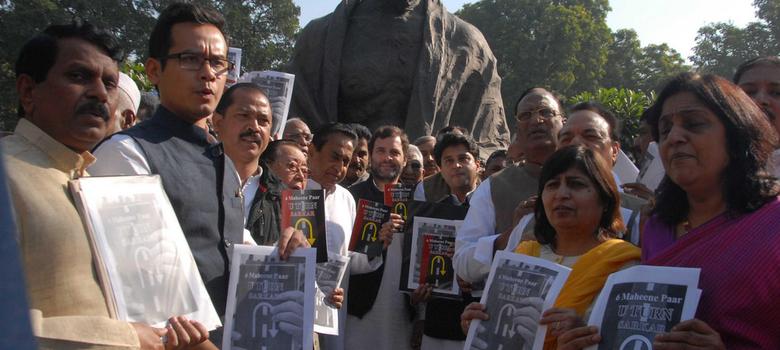
Twice last week, the usually disinterested Congress vice-president Rahul Gandhi took the plunge and led a party protest outside Parliament House.
On one day, he joined other Congress MPs and opposition members, who covered their mouths with black bands, to protest the vitriolic statements made by Union minister Sadhvi Niranjan Jyoti at an election rally in Delhi. He later followed it up with a combative speech against the Bharatiya Janata Party-led National Democratic Alliance government at a Youth Congress event.
Two days earlier, the Nehru-Gandhi scion was at the forefront of a dharna organised by the Congress to protest the NDA government’s U-turn on key policy matters.
Rahul Gandhi’s decision to shed his reticence and lead the party from the front surprised and delighted Congress members, who had been feeling directionless after the disastrous Lok Sabha results. Their only hope is that his proaction will not prove ephemeral once again.
Rare initiatives
Their elation is understandable as Rahul Gandhi had not evinced any interest in Parliamentary proceedings in the past decade. He was a rare visitor to the Lok Sabha, and on his rare visit he was always seen chatting with other young MPs in the back benches. Never did he make any make any meaningful contribution to Parliamentary proceedings.
“It was high time he became politically proactive…this is a good sign,” remarked a senior Congress office-bearer, glad that Rahul Gandhi had finally responded to the demands of party cadres that he step up his engagement in party affairs.
The Congress rank and file was devastated after the party’s humiliating defeat in the May general election but their woes were compounded when both Congress president Sonia Gandhi and Rahul Gandhi virtually withdrew into a shell after the poll debacle, making no effort to discuss the reasons for the electoral rout or chart out a strategy to enthuse the helpless cadres.
“I can handle a defeat in elections – after all, it is part of political life,” a former Union minister had said despondently when Rahul Gandhi shied from getting back into the battle. “But I can only fight back if I see my general leading the battle from the front. Today, I don’t see my leader anywhere.”
Open dissension
Not only were Sonia Gandhi and Rahul Gandhi incommunicado, there was also growing uneasiness in the party that the Nehru-Gandhi scion had proved to be an uninspiring leader, who just did not possess the qualities or the temperament to rejuvenate the Congress or energise its workers.
As frustration rose, the voices of dissension in the party became louder. Congress leaders did not hesitate to criticise the party vice-president publicly, while others like Digvijaya Singh and P Chidambaram went on record to say that Rahul Gandhi should be more communicative and play a more active role in party affairs.
Then there were periodic demands from the ranks that Rahul Gandhi’s more charismatic sister Priyanka Gandhi Vadra should be handed the job of reviving the moribund party, a clear vote of no-confidence in the Congress vice-president.
Congress cadres felt particularly low when Rahul Gandhi had refused to head the parliamentary party in the Lok Sabha and instead entrusted the job to senior Congress leader Mallikarjun Kharge. This was read as a sign that he was either not interested or did not have the courage to take on a formidable opponent like Narendra Modi.
Disappearing acts
While admitting that Rahul Gandhi had so far displayed little interest in Parliament since he was first elected to the Lok Sabha in 2004, Congress insiders felt a leadership role in the opposition benches would have been a good training ground to spearhead the long and tough battle against the BJP.
While Rahul Gandhi’s hands-on approach in Parliament last week has got Congress members smiling once again, there are lurking doubts whether he will be able sustain such a campaign.
The Congress vice-president is not known for his consistency and has the habit of disappearing after putting in a “guest appearance” at a party function or campaign. Former Union minister Salman Khurshid had once famously described Rahul Gandhi’s role in the party as a “cameo performance”.
Short attention span
Party insiders cite the example of Rahul Gandhi’s grand deceleration after the 2012 Uttar Pradesh assembly elections that he would not abandon the people. But except for his trips to his constituency Amethi, Rahul Gandhi barely visited the state.
Congress leaders privately admit that Rahul Gandhi has no staying power. They also bemoan that he is often unavailable at critical moments and is unable to focus on an issue and follow it through.
In 2011, Rahul Gandhi had stirred up a controversy when he made a midnight dash to Bhatta and Parsaul villages in Greater Noida to protest against the Uttar Pradesh government’s land acquisition policy. But the Congress failed to get any political mileage from these dramatic protests as Rahul Gandhi failed to build on the campaign.
Congress members are hoping that Rahul Gandhi has learnt some lessons after the party’s poor showing in the elections and will change his style of functioning. “Now that Rahul Gandhi has decided to lead from the front, we hope it will not be a one-off affair…we need to run a sustained campaign against the government,” said a former Congress minister, adding that Rahul Gandhi should also become more accessible to party workers.
For the present, though, Congress members are just glad that Rahul Gandhi made the effort to lead the party protests against the ruling alliance in Parliament which, they said, was the crying need of the hour.
We welcome your comments at
letters@scroll.in.
On one day, he joined other Congress MPs and opposition members, who covered their mouths with black bands, to protest the vitriolic statements made by Union minister Sadhvi Niranjan Jyoti at an election rally in Delhi. He later followed it up with a combative speech against the Bharatiya Janata Party-led National Democratic Alliance government at a Youth Congress event.
Two days earlier, the Nehru-Gandhi scion was at the forefront of a dharna organised by the Congress to protest the NDA government’s U-turn on key policy matters.
Rahul Gandhi’s decision to shed his reticence and lead the party from the front surprised and delighted Congress members, who had been feeling directionless after the disastrous Lok Sabha results. Their only hope is that his proaction will not prove ephemeral once again.
Rare initiatives
Their elation is understandable as Rahul Gandhi had not evinced any interest in Parliamentary proceedings in the past decade. He was a rare visitor to the Lok Sabha, and on his rare visit he was always seen chatting with other young MPs in the back benches. Never did he make any make any meaningful contribution to Parliamentary proceedings.
“It was high time he became politically proactive…this is a good sign,” remarked a senior Congress office-bearer, glad that Rahul Gandhi had finally responded to the demands of party cadres that he step up his engagement in party affairs.
The Congress rank and file was devastated after the party’s humiliating defeat in the May general election but their woes were compounded when both Congress president Sonia Gandhi and Rahul Gandhi virtually withdrew into a shell after the poll debacle, making no effort to discuss the reasons for the electoral rout or chart out a strategy to enthuse the helpless cadres.
“I can handle a defeat in elections – after all, it is part of political life,” a former Union minister had said despondently when Rahul Gandhi shied from getting back into the battle. “But I can only fight back if I see my general leading the battle from the front. Today, I don’t see my leader anywhere.”
Open dissension
Not only were Sonia Gandhi and Rahul Gandhi incommunicado, there was also growing uneasiness in the party that the Nehru-Gandhi scion had proved to be an uninspiring leader, who just did not possess the qualities or the temperament to rejuvenate the Congress or energise its workers.
As frustration rose, the voices of dissension in the party became louder. Congress leaders did not hesitate to criticise the party vice-president publicly, while others like Digvijaya Singh and P Chidambaram went on record to say that Rahul Gandhi should be more communicative and play a more active role in party affairs.
Then there were periodic demands from the ranks that Rahul Gandhi’s more charismatic sister Priyanka Gandhi Vadra should be handed the job of reviving the moribund party, a clear vote of no-confidence in the Congress vice-president.
Congress cadres felt particularly low when Rahul Gandhi had refused to head the parliamentary party in the Lok Sabha and instead entrusted the job to senior Congress leader Mallikarjun Kharge. This was read as a sign that he was either not interested or did not have the courage to take on a formidable opponent like Narendra Modi.
Disappearing acts
While admitting that Rahul Gandhi had so far displayed little interest in Parliament since he was first elected to the Lok Sabha in 2004, Congress insiders felt a leadership role in the opposition benches would have been a good training ground to spearhead the long and tough battle against the BJP.
While Rahul Gandhi’s hands-on approach in Parliament last week has got Congress members smiling once again, there are lurking doubts whether he will be able sustain such a campaign.
The Congress vice-president is not known for his consistency and has the habit of disappearing after putting in a “guest appearance” at a party function or campaign. Former Union minister Salman Khurshid had once famously described Rahul Gandhi’s role in the party as a “cameo performance”.
Short attention span
Party insiders cite the example of Rahul Gandhi’s grand deceleration after the 2012 Uttar Pradesh assembly elections that he would not abandon the people. But except for his trips to his constituency Amethi, Rahul Gandhi barely visited the state.
Congress leaders privately admit that Rahul Gandhi has no staying power. They also bemoan that he is often unavailable at critical moments and is unable to focus on an issue and follow it through.
In 2011, Rahul Gandhi had stirred up a controversy when he made a midnight dash to Bhatta and Parsaul villages in Greater Noida to protest against the Uttar Pradesh government’s land acquisition policy. But the Congress failed to get any political mileage from these dramatic protests as Rahul Gandhi failed to build on the campaign.
Congress members are hoping that Rahul Gandhi has learnt some lessons after the party’s poor showing in the elections and will change his style of functioning. “Now that Rahul Gandhi has decided to lead from the front, we hope it will not be a one-off affair…we need to run a sustained campaign against the government,” said a former Congress minister, adding that Rahul Gandhi should also become more accessible to party workers.
For the present, though, Congress members are just glad that Rahul Gandhi made the effort to lead the party protests against the ruling alliance in Parliament which, they said, was the crying need of the hour.
