

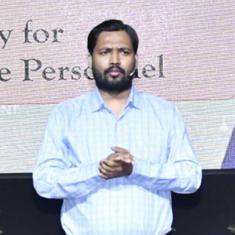



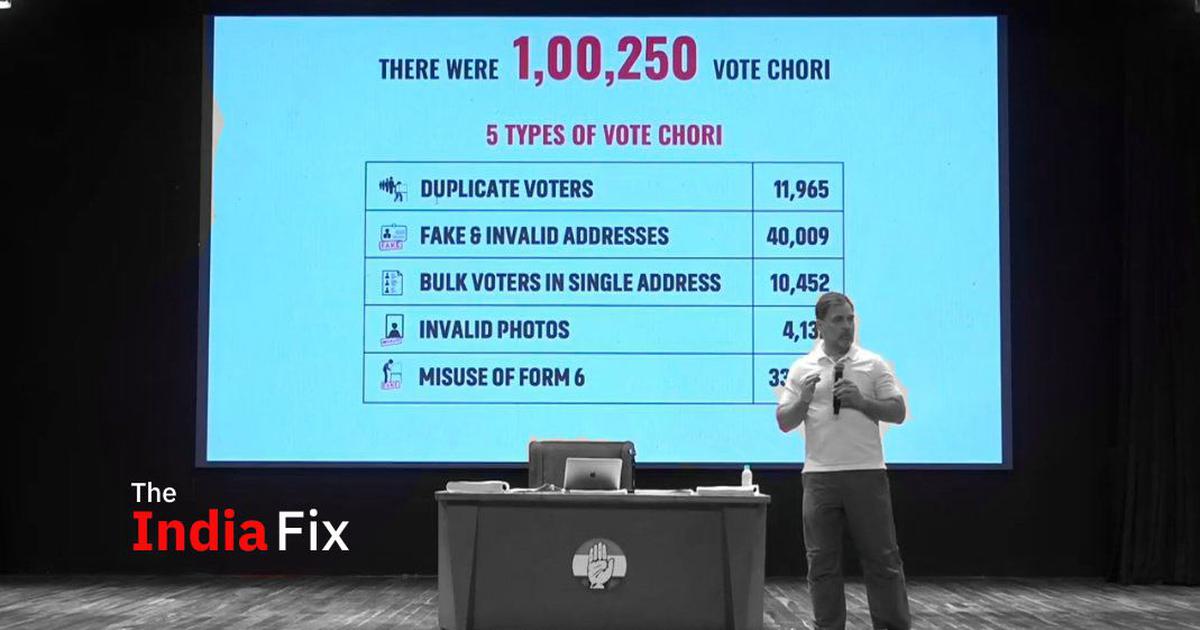
Rahul Gandhi’s press conference on Thursday started off poorly: his slides suddenly disappeared from the screen even as he stood there, his face taut with anger. But once these technical glitches were sorted, what Gandhi disclosed was shocking. The leader of the Opposition alleged that his party had found more than a lakh bogus voters in the Mahadevapura Assembly constituency in Bengaluru.
The press conference detailed five types of bogus entries in the electoral roll: duplicate voters, voters with fake addresses, bulk voters with the same address, invalid photographs (which made identification impossible) and enrolling fake first-time voters (using form six).
The examples Gandhi brought up were striking. Gurkirat Singh Dang, for example, appears four times in the roll with the exact same address. Another gent, Aditya Srivastava, can vote across the country: Mumbai, Lucknow and in two booths in Bengaluru.
One address in Bengaluru, a single-room house, has 80 voters registered to it. Other voters have strings of gibberish for address and father’s name (one was a Mr dfojgaidf). A 70-year-old woman called Shakun Rani enrolled as a new voter too, which meant that she was able to vote twice.
As striking as these examples were, even worse was the Election Commission’s response – or lack of it. A few hours after Gandhi’s press conference, it put out a tweet with the tag #ECIFactCheck. Except there was no fact check: it did not actually rebut Gandhi. In fact, it said it would only take action if Gandhi swore an oath.
It is unclear why the Election Commission does not think that errors in the voter roll deserve urgent action. Or why it has not agreed to demands by the Opposition to provide machine-readable voter rolls, which would make identifying errors a cinch.
Fact-checking is a process through which one determines the authenticity, or lack thereof, of information that has been put out in the public domain. This is done by presenting facts that either contradict the original claim or support it. Only after such a process is followed… https://t.co/7IUV2mEsO5
— Pratik Sinha (@free_thinker) August 8, 2025
Rising doubts
Given that this is not the first time doubts have been expressed about the integrity of India’s voter rolls, the Election Commission’s non-response was doubly troubling.
Reporting by Scroll has found numerous complaints about voter roll exclusions. In 2023, the India Fix broke down a detailed research paper that flagged several statistical anomalies with the 2019 Lok Sabha elections, part of which could be traced back to allegations that the rolls had been corrupted.
In March, the Trinamool Congress complained that Election Photo Identity Card numbers used in voter cards were not unique. Different voters across the country somehow had the same number. Again, the Election Commission was unable to explain the error even as it said that it would fix it going forward.
Even as the Election Commission is unable to explain how these errors are appearing, it is not holding back from even more drastic changes in voter lists. At present, it is conducting a Special Intensive Revision of the rolls in Bihar. However, it seems that women and Muslims are being especially excluded.
The design of the Special Intensive Revision, a de facto citizenship test that has placed enormous powers in the hands of the lower bureaucracy, makes it highly amenable to political pressure.
Betraying a legacy
The widespread doubts about voter rolls stand in stark contrast to how universal adult franchise was introduced in India: the creation of a voter roll that included all Indian voters was one of the first administrative tasks taken by independent India.
India had had elections under the Raj but they were limited to elites. In 1937, the Raj’s biggest election ever, with Indians electing state governments, saw around a sixth of Indian adults qualify to be voters.
Within a few months of Independence, the Constituent Assembly Secretariat, headed by bureaucrat BN Rau, was drawing up new rolls based on universal adult franchise. The political will for this was solid: the Congress had been asking for the vote for all adult Indians since 1928.
The roll was drawn up before the Indian Constitution was drafted and adopted. The result was, as Ornit Shani points out in her remarkable research on independent India’s first electoral roll, Indians became voters first and then citizens.
“An electoral roll on the basis of universal franchise prepared and maintained as accurately and up-to-date as possible, was the plinth upon which the institutions of electoral democracy would rest,” Shani writes.
Unsurprisingly, this was a major factor for the Constituent Assembly as well. While moving an article which would lead to the formation of the Election Commission, BR Ambedkar, chairman of the drafting committee, was clear that no Indian should be excluded from the rolls “on the whim of an officer”.
Elections are the guts of a democracy. And voter rolls, in turn, are the guts of an election. Seven decades later, the widespread impression that the whims of officers – and politicians – are now deciding voter rolls is severely damaging to the idea of Indian democracy.
