






No one was more startled than my father when I came first in my class in the Matriculation exam. The poor man, in the faint hope of spurring me on to some kind of academic achievement, told me, “If you get a First Division in the matriculation, I’ll buy you a gold watch.” I telephoned him at the Pakistan Times when the results came in. “Abba, I got a First Division, and I’ve come first in my class.” There was a very audible “Heh?” at the other end. I myself have no idea how I managed it. I had absolutely no interest in what marks I would get. I just wanted to get through and have done with it. But true to his word, when he got home, he called up from the landing on the stairs, ‘Tumhari ghadi le kar aaya hoon [I have come with your watch].’ I don’t know how he could afford it, but he had bought me a gold watch. I treasured it for a long, long time.
I was shy and retiring, though a bit pampered, and from the day I started school it was a nightmare. I never ever went willingly. As a little girl, I went to a nursery somewhere off Racecourse Road where we lived straight after coming from India, probably early 1947. We were only there for a few weeks. I cried. Then my mother put me in the Convent of Jesus and Mary. I cried. My only respite came when my English grandparents would spirit me away. But in any case, my mother didn’t like the nuns, and I was then put in what was a posh school at that time, Queen Mary College. It’s not posh any longer, but that was where the children of the upper class went. I cried. All the time.
One girl there “befriended” me. When I got to school in the morning, she would stand me outside and say, “ab ro [now cry]”, and I used to oblige with tears pouring down my cheeks. Every morning was torture. Outside my own world I was very introverted, and home was so much more fascinating than school. I never paid any attention to what was happening in class. My mother was exasperated with my morning excuses for not wanting to go to school and occasionally she would say, “Go to your father!” hoping for a bit of patriarchal input from that quarter. I would stand, head bent, in front of Abba, who would look up and ask why I didn’t want to go to school. I would say I had a stomach ache, and he would wave his hand and reply, “Mat jao [don’t go to] school.”
Then, when I was in second or third grade at Queen Mary’s, my father went to jail and it was too expensive for me and Mizu to High School, a much cheaper mission school. I was past the crying age, but I hated it with great intensity. By the time I was about nine or thereabouts, I started concocting repetitive excuses, a bad throat, a bad stomach, a bad throat again, anything to avoid attending classes. This pattern continued until I finished school. My mother worried that I’d be taken off tests and she eventually called me “a malingerer”. Of course, by the time I was in the 9th and 10th class, I had to go to school, but I considered myself a total misfit and a complete dimwit. It was not that I did badly; it just never meant much to me.
Because school to me was like a straitjacket and I loathed it, I was very benign with my own children when they didn’t want to go to school. I just said, ‘Okay, don’t go if you don’t want to.’
But of course, along the way, there were inspiring teachers. I fell in love with physics in class 9 because I had a really good science teacher, Miss Quirk. Sikander Rizvi from the Qizalbash family was a brilliant Farsi teacher. I had no particular interest in the language but she succeeded in making me understand it. She taught both Gulistan-e-Sadi and Bostan-e- Sadi, and that later helped me in reading Urdu. I give her credit for that because she was very passionate – quite a scary lady but a great raconteur – so she could make the language interesting. Her daughter later became my student at the National College of Arts, and her husband actually treated my father when he was in the hospital. There was also a Miss Wilson who taught history very well. These three teachers made the agonising days at school bearable for me.
I was good at things that interested me. I must have been in class 10 when I was chosen along with another girl to represent Kinnaird High School in a declamation contest. I won the first stage for Lahore schools and then went on to the all-Punjab stage which was for boys and girls. I was really nervous, and my mother made me practise my speech over and over again. To my own amazement as well as that of the boy who came second, I won. He never forgave me. He was a Punjab champion in badminton, Naqi Mohsin, and was supposed to be the champion in declamation as well, but I beat him. The prize was 100 rupees worth of books, a huge amount of money at that time, like having 10,000 rupees now.
I was thrilled and went to the bookstore and bought all these art books that were sent to the school. My mother was then summoned by the headmistress of the school, Miss Nixon, the dragon. “These books have not been chosen by Salima. You must have chosen them, and they are very unsuitable for a child.” She was a missionary, and she thought the nude ladies in the art books were pornography. Back came the outraged response, “I had nothing to do with it, this is her choice.” I was grilled by the headmistress, and she asked me why I wanted those books. I told her I was very interested in Cézanne and Renoir and the rest of it, and she sat there with a very annoyed expression. In the end, she had to give in, and I was allowed to keep the books. I still have one or two of them which say “Declamation Prize Salima Faiz”.
I was a daydreamer, lost in my make-believe world. I was very reticent about making friends at school and my mother told me I always had imaginary friends. She was forever pushing me into doing certain things which she thought would help my shyness. This was before my father went to jail.
Abba once took me to a mahoorat (the first shoot) of the film Beli, which was released in 1950 and starred Shahina Ghaznavi, Sabiha Khanum and Santosh Kumar. It was the directorial debut of Masood Parvez. He must have been a friend of my father to have invited him. My father took me along because I was mad about films. I believed that I was going to grow up to be Suraiya, the film idol of the time. I’d never actually seen any of her movies, only photographs, and I listened to film songs on the radio. And then I saw Shahina with her large, soulful eyes and rosebud mouth – I thought she was the most beautiful creature I’d set eyes on. I was transfixed.
I wanted to see Barsaat, the legendary 1949 film with Raj Kapoor, Nargis Dutt and Nimmi. It was showing at the Rivoli Cinema, near the railway station, and my father promised to take me. He bought the tickets. But he was always late home from work, and I got all ready to go and time dragged on, and he still hadn’t arrived. I started crying, thinking he had forgotten. Then he appeared and we dashed to the cinema. We were a bit late and as we walked in. I remember the first song was playing, “Hawa main udta jaey mera lal dupatta mulmul ka [my red muslin dupatta is flying in the wind].”
I forgave my father for being late because I got to see the whole of the movie. He kept asking me, “Acchi hai, film acchi hai [is the film good]?” And I replied, “Bahut acchi [very good].” That’s my most vivid recollection of my father indulging my passion for the movies. Then, of course, he went to jail. Bali also liked the movies. She promised to take me whenever she went and I latched on to her. We saw Balraj Sahni’s movie Hum Log which starred Nutan, and we both wept copiously throughout the movie.
Films and stories and music were what fascinated me. Mizu and I learnt to be attentive listeners when we lived opposite Radio Pakistan and my mother sent us to the Children’s Programme on Sunday mornings.
I accompanied my father to several mushairas after he came out of jail, in Lyallpur and Sialkot and two or three others. Uncle Sufi came along as well. That’s where I first heard Zehra Nigah, and I hadn’t known she was a poet. When Abba was in jail, she came to Lahore and took me with her to where she was staying, the Islamia College for Girls. She was very kind to me and told everybody, “Mein Faiz sahib ki beti ko saath le kar aayee hoon [I have brought along Faiz sahib’s daughter].” I remind her now of that time and she doesn’t really recall it, “Ha ha, tumhey lekar gayee thi kahan pey [where did I take you]?”
Men and women used to sit separately at mushairas and there was a purdah in between. Once when Abba’s turn came, they went into this long eulogy in the introduction, praising him profusely. I was sitting at the front and he caught my eye. He looked so embarrassed. Afterwards, I said, “Badi aap ke taareffain ho rahi thi [they were praising you a lot].”
And he replied, “Pata nahin kis key barein mein keh rahen the [I don’t know who they were talking about].” Flattery always made him uncomfortable. He never thought he really earned it. We used to pull his leg about that a lot. I also used to dance to music on the radio. By myself, never in front of anybody. Except this one time at one of my birthday parties. Agha Babar, a writer friend of my parents who started the Rawalpindi Arts Council, had two daughters who were real live wires and danced à la Indian movies. My father had been given a present of a gramophone and another of my father’s friends, the film distributor Ismail Noor whose wife Shaista doted on me, had given me some records, all the songs from the film Mahal which was very popular. The music was playing, and these girls were dancing to it. And suddenly I abandoned my shyness and joined them and then I noticed that everybody was looking stunned. It was sort of my debut, and they were all asking, ‘Where did you learn to dance?’ Of course, I had secretly taught myself from watching movies. Later, my mother got me a formal dance teacher and I learned the kathak with my cousin Mariam. We did this for a year or two, enough to understand and to enjoy it.
I kept a diary and used to write letters but never stories, never anything that could remotely be considered imaginative. I have always thought it was because “the word” was paramount in our house, you had a sense of the weight of the word. I had a go at it once, making a kind of copy of one of Iqbal’s poems, because my mother used to send for this Urdu magazine called Taaleem aur Tarbeeat. Before that, we would get Phool Akhbar, and I read them all through my childhood mainly because she was very keen that I should read Urdu. I think I shied away from writing anything in Urdu, subconsciously not wanting to go to a place where there was so much veneration and excellence already in the house. My Urdu tutor Nizam sahib introduced me to prose. While I absorbed all of it and enjoyed it, I think there must have been a very clear understanding of that space already being occupied and therefore not mine to venture into.
Once I went to college it was very different, and I found I could be my own person which I never could be in school.
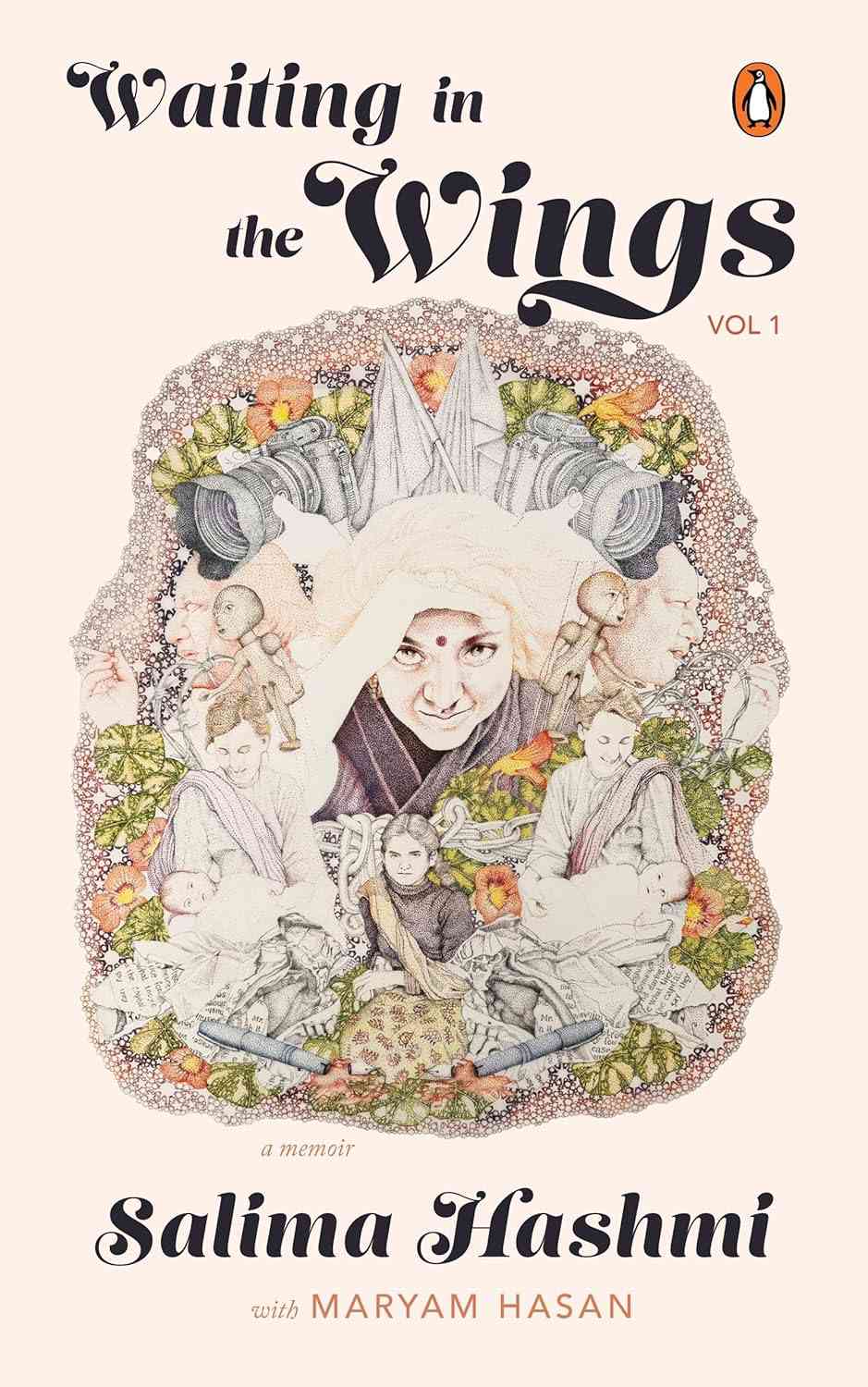
Excerpted with permission from Waiting in the Wings, Salima Hashmi with Maryam Hasan, Penguin India.
