








I have little expectations of autobiographies and memoirs of young-ish people (if you are old, I can excuse your self-indulgence). So, when I picked up The Outsider, Vir Das’s memoir, I wondered about the name, because why was Das calling himself an outsider despite having had a fairly privileged upbringing? Secondly, I was sceptical at the very idea of its being in existence. Now that I am done with the book, I am glad to say I was wrong on both counts.
Meeting the world
The Outsider is Das’s narration of his life to us, and the book starts right at the beginning, when his parents take the family to Nigeria, where his father worked, along with the hordes of Indians who were signing up for upper management and technical jobs on the African continent. Even before we reach the point where the country eventually forces them to leave, you know what is coming.
Indians being asked to leave Africa overnight wasn’t an isolated incident in one country – it carried the burden of the history which had built up to that moment. Yet, Das narrates it with a wistful look at the past, acknowledging the pain but also the class divide which led to this expulsion. He is aware of his privilege, hurt by it, crippled by its being taken away, and also aware of the social divides which allowed him to have that privilege in the first place. And this forms the underlying tone for the rest of the book. It feels like you are listening to a friend recounting their life at a cosy house gathering (and it did help that I was reading the book at the very end of the year, the season of cosy house parties).
As Das talks about his childhood in Africa, he juxtaposes fragments from it with his growing-up years in a premier boarding school in North India, and the lived realities of both. Even as we come across the hundreds of people he will meet in life later, we are never given a simple black-or-white impression of them. They do a lot of good things, they do a lot of bad things. Das doesn’t take sides, paint himself a victim, or see these people only as right or wrong. The reading he puts up of people around him surprisingly became my takeaway from the book – the acknowledgement of flawed humanity.
So, when he talks about his parents sending him away to boarding school, we are presented with both sides of the story – the emotional toll it took on a young kid to be sent to a whole different continent than his parents, and the parents who are trying to ensure their kid has as good a life and upbringing as they know and can afford. Throughout the book, as Das goes from his childhood, schools, parents, grandparents, girlfriends, jobs, failures, cancellations, and an Emmy, there is a constant sense of awareness he maintains, a knowing nod at us, the reader, who has most likely followed this journey from before, by account of it being in public. The book feels more like a friend laughing at themselves than a famous, award-winning comedian gloating about his life and achievements.
On the move
The book plays out almost like a stand-up set. It starts suddenly, with Das being stranded on a small Mexican island, completely broke and with an expired visa.
“So, you know how it feels to be deserted in Mexico with no money and no visa, right? No? Must be me.” Cue laughs.
From this, we go on and forth to Nigeria, Solan, Delhi, Noida, the US, Mumbai, and Goa. I found myself excitedly grinning at references of unglamourous Delhi places that don’t usually find mention in pop culture anywhere, like Chitra Vihar and Charmwood Village, and Das’s lived-in descriptions of the places add a sense of familiarity to a book that sometimes goes dangerously too close to being a travelogue.
I would argue, though, that it is more of his own willingness and acceptance to be constantly on the move which is sold to us through the book. Das talks about the failed gigs, the many attempts at kicking off a comedy slash acting career, falling in love and getting emotionally kicked, cheated on, being broke, being heartbroken, with the same enthusiasm as he affords his successes, his marriage and wife, his wins. There is a childish and understandable excitement when he talks about Amitabh Bachchan mentioning his name on Kaun Banega Crorepati, or Shah Rukh Khan calling him up. As someone who grew up in the 1990s and 2000s in India, you know it can hardly get bigger than this. The earnestness in the language is endearing and wills you to like the book.
I will say this on record: I have not been a big fan of Vir Das the comic. His standup does not appeal to me much, which is less a question of his comedy and more a matter of my difficult tastes. Vir Das, the writer, however, is consistently funny and dedicated. Just like the friend narrating his life, you can feel Das checking in to ensure the reader (listener) is having fun. After some rather heavy vignettes, there would come something casually funny to lighten the mood, to make you chuckle, to take the edge off.
It is almost as if Das himself peeps out of the pages and says, “Hey, this is funny, right? Haha!” Even if you weren’t invested in the story so far, you are bound to agree, this was funny. And sometimes, in the middle of everything, Das drops a line that really sticks with you, and makes you realise why he is where he is.
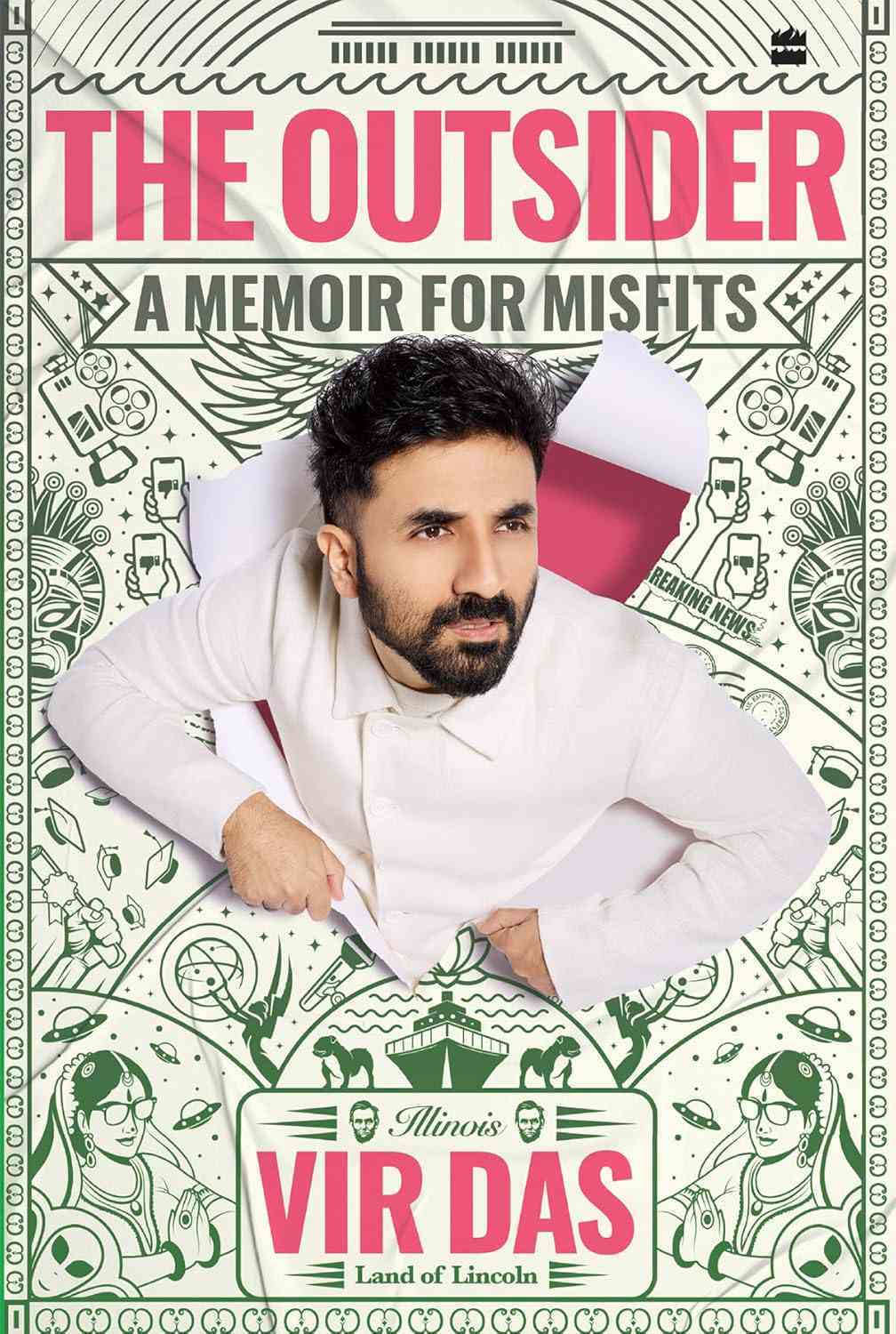
The Outsider: A Memoir for Misfits, Vir Das, HarperCollins India.
