










The noise coming from the parlour when George Reed left was extraordinary. Even for a house full of young women, it was loud, and it was a good thing we had finished for the night as such a commotion would drive away all but the bravest of customers. Sydney, our ever-present doorman, tall and sleek, was perched on a stool in the hallway with his fingers rammed into his ears. He saw me and rolled his eyes; the disapproval of a sophisticated foreigner stretched over his dark face. I pushed open the door to the dimly lit room. Curiosity has long been my curse.
A young girl sat howling, arms flung across the table in front of her, a pile of fair curls on her head glimmering in the candle light. She was around 15 or 16, possibly older. It was rather difficult to tell while she sobbed so extravagantly. Where had Ma found her?
Ma Farley was sitting across the other side of the table, arms folded under her enormous bosom. Lucy, elegant, poised, but blessed with a voice like a screech owl, was shouting something at Ma – I couldn’t hear what it was. Emily, whose hatchet face had earlier been painted to perfection but was now smeared from the night’s graft, was demanding answers. Ma was yelling back at them, ignoring the crying, and Polly was gently trying to hug and shush the girl. No wonder Sydney had closed the parlour door behind me.
I tugged off a shoe and banged the heel on the table. The room fell into shocked silence as they turned to gawp at me.
“Thank you,” I said, brandishing the shoe. “Now, who is our friend?”
The shoe, still in my hand, cracked down on the table again as they all began to speak at once.
“Sydney thinks he’s gone deaf, you know. Ma, would you introduce me, please?”
Mrs Sarah Farley, Mother or Ma to those who knew her well, stood up and straightened her soft cap, tucking a loose strand of greying hair behind an ear. Once, she had been a real beauty, but now, long past forty-five, her body was overused, overripe and overhanging. Her natural face had hardened with lines, so she filled in the cracks with powder and rouge. She pulled the young girl to her feet, not unkindly.
“Miss Lizzie Hardwicke, this is Miss Amelia Blackwood.”
The girl was nicely mannered. As we curtseyed, I saw that her face – underneath the blotched cheeks and red eyes – was extremely pretty.
“Miss Blackwood,” I nodded my greeting and raised an eyebrow at Ma as the girl resumed her place at the table. “A new companion?”
Amelia started bleating over Polly’s shoulder again, but more quietly this time. Ma sighed and sat down heavily.
“It’s not what you think, Lizzie.”
I hoped not. Brothel keepers, bawds like Ma, had a reputation for forcing innocent young girls into a life of sin and they were rightly hated for their procuring. There were plenty of stories: unblemished lambs arriving in London from the country, flattered or tricked into bawdy houses, their virginity sold to the highest bidder. Mrs Farley was not above such devices when it came to supplementing her funds, I was sure of it, but it wasn’t her regular style. I waited for an explanation.
“She’s been thrown out of her home,” Ma said. “I found her at Charing Cross. Good job I was there: I’d just caught sight of her when Mrs Hamble and Mrs Bull came around the corner.”
Polly shivered. Miss Polly Young, our prettiest housemate, had golden hair and the sort of countenance that fell into effortless smiles, but her own career in town had been launched by Mrs Hamble, and the memory still made her lip tremble. She had been 14 at the time.
“What do you mean ‘she’s been thrown out’?”
“Her father is an alderman. She fell in love with the local farrier’s son and he caught them kissing in the yard. Threw her out on the streets.”
“That’s a bit harsh for a fumble,” I said.
“He’s got a reputation to maintain, apparently,” said Lucy, arching an immaculate eyebrow. “Although I’m quite sure I’ve never heard of him.” Lucy knew many men of reputation, as she was often fond of telling us.
“At least he gave her some money and allowed her to collect some clothes,” said Ma. “Not all girls are so fortunate.”
Indeed, they are not.
“It’s still a bit tough. She’s barely 15, by the look of it.”
“I’m 17.” Amelia raised her head from the table. “And it wasn’t a fumble; Tommy and I are in love. We want to marry.” She started to sob in great shaking coughs. “I’ll never see him again!” Her head flopped down and Polly stroked her shoulders gently. Eventually, she stopped sobbing.
“So, what are we going to do with her?” Emily asked Ma. “Is she staying here?”
If she were going to stay, she was going to be working.
“I think we can leave her for a little while.” Mrs Farley was not devoid of sympathy, even if she was running a business. “Let’s give her some food and a soft bed and see whether she wants to join us. It’s quite clear that her father doesn’t want her at home.”
“What about her beau? Thomas, is it?” Polly asked.
“Tommy,” came a newly muffled sob.
“Tommy. What about this Tommy? Do we know where he is? Does he really want to marry her?” I asked.
“He told me he loved me.” Her little voice quivered.
Lucy’s mouth puckered at such naivety.
“Of course he loves you.” Polly played with the girl’s curls. “But if he’s not here to marry you, then that’s not much use, is it?”
The girl looked at Polly. “Not much use…?”
Polly spoke gently. “If your father has disowned you then none of your friends or relatives will care for you. If Tommy is not going to marry you then you are alone.” The words were beginning to register somewhere in Amelia’s mind as Polly went on. “You have no home, no good name and no one to protect you. London is a dangerous place for a girl on her own.”
She looked at each of us in turn, trying to make sense of what Polly had told her. We all nodded at what was obviously true. Whatever respectability she had once possessed was gone.
“Can I stay here? Mrs Farley, you … you’ve all been very kind to me. Can I live with you?”
Eyes the colour of summer sky implored us. She was really very pretty – young and sweet, the way the rest of us were once. I could almost hear the coins jingling their way into Ma’s strongbox.
“I can work,” she said. “I mean, I’m not very good, but I can do my best.”
She had no idea.
“Do you know what we do here, Amelia?” I asked.
“Why, you’re milliners. That means you make hats.” She glowed at her cleverness.
We made hats. That’s what the painted sign over the front door said. In a respectable street that was home to craftsmen and shopkeepers, we suggested that we too plied a decent trade. No one was fooled. Half of London’s prostitutes said they were milliners – well, those who operated indoors, at least. Lucy began to shake her head in disbelief.
“You do make hats? That’s what milliners do, isn’t it?” Amelia’s voice was high and anxious.
Poor sweet idiot. I laid a hand on her arm, catching Ma’s warning glance. “Well, even Lucy has been known to sew a feather onto straw once in a while.”
There was a silence.
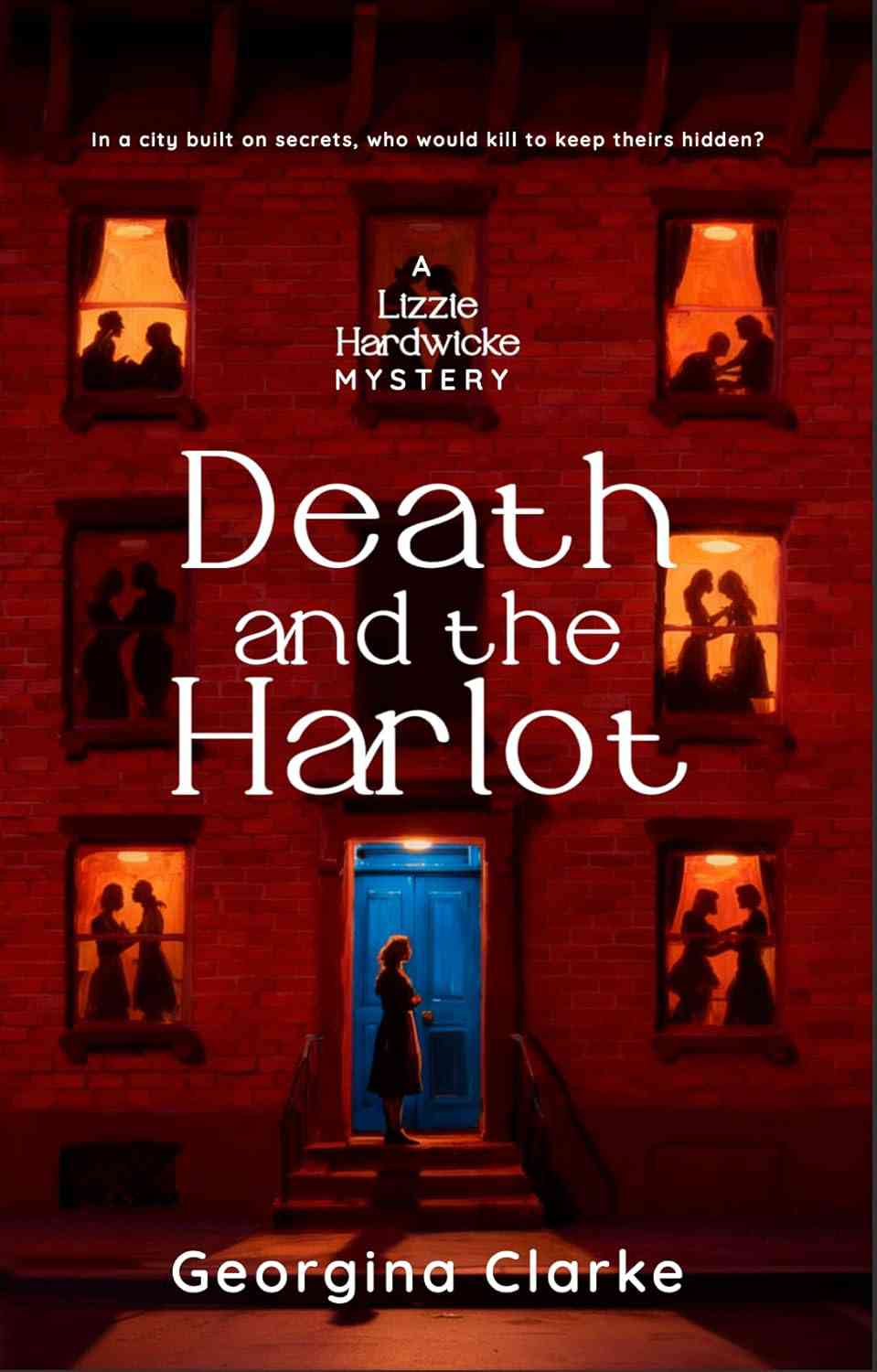
Excerpted with permission from Death and the Harlot, Georgina Clarke, The Bombay Circle Press.
