





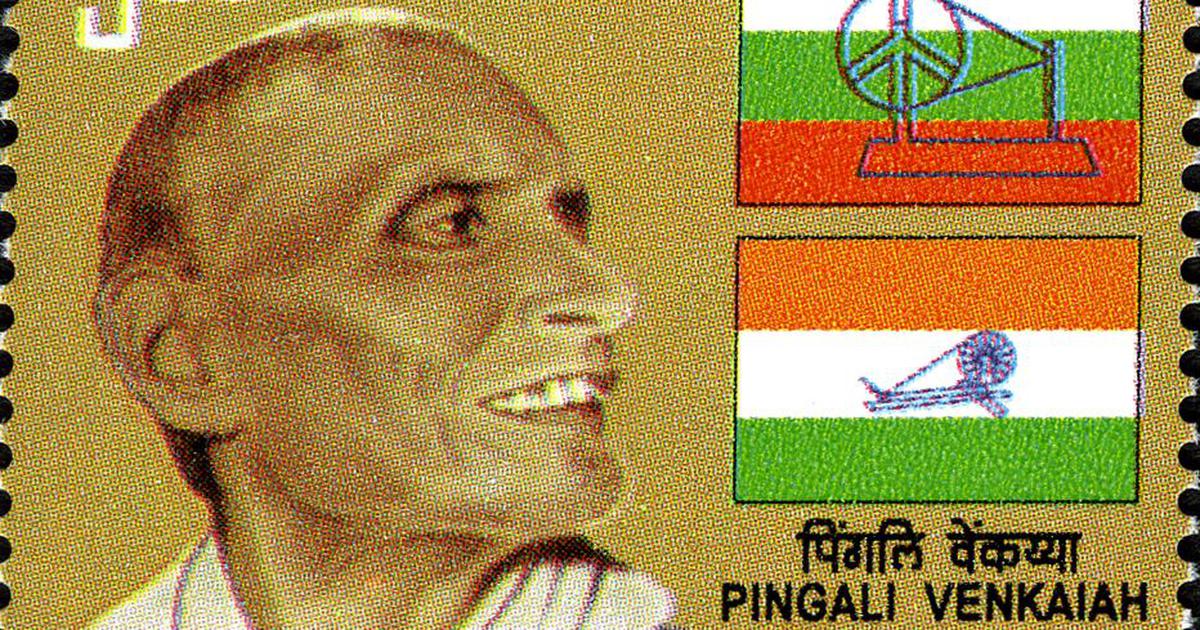
A true hero in the story of India’s national flag was the remarkable Pingali Venkayya. Born in 1878 in Pedakallepalli village of Krishna district in Andhra Pradesh, he spent some childhood years in the home of his maternal grandparents in Bhatlapenumarru, a small village 40 kilometres away from Vijayawada. For his higher schooling, he was sent to “Hindu High School” in Machilipatnam, where he mastered many things, among them the art of growing good cotton. At the age of 19, he joined the British Indian Army and fought in the Boer War (1899–1902) in South Africa, where he met Mahatma Gandhi who was then fighting for equal rights for Indians in that country. Venkayya soon developed a worldview and a passion to fight for India’s freedom. On returning home, he threw himself into the nationalist movement, even as he made his living doing odd jobs as diverse as those of a plague inspector and a railway guard. His was clearly a restless and curious mind; he learnt Sanskrit, Urdu, and even Japanese, which gave him the sobriquet Japan Venkayya; he developed an indigenous hybrid variety of cotton with the use of imported Cambodian cottonseed and this in turn gave him the name of Patthi (cotton in Telugu) Venkayya and earned him an honorary membership of the Royal Agricultural Society. In his later years, he added Diamond Venkayya to his bouquet of names after working in diamond mines.
But what earned this freedom fighter, agriculturist, lecturer, and “scientist without a degree” a postage stamp – though belatedly – in his honour in 2009 and (another one in 2022 as part of the Azadi Ka Amrit Mahotsav celebrations) was his burning desire to design a national flag for India; the honours however came too late and Pingali Venkayya died in penury, victim of a nation’s forgetfulness, on July 4, 1963.
Venkayya, as he said himself, had an “inborn fancy for flags” and this fancy took concrete shape when he attended the 22nd session of the Indian National Congress in 1906, where Dadabhai Naoroji hoisted the Calcutta flag. Pursuing his vision to develop a national flag for India, Venkayya published a slim volume entitled A National Flag for India in 1916 (funded by the well-known lawyer, administrator, and later member of the Viceroy’s Executive Council as well as dewan of Travancore, Sir CP Ramaswami Aiyar) in which he proposed no less than twenty-four designs for a national flag. While working as a lecturer in the Andhra National College, Venkayya continued to relentlessly advocate the cause of a distinctive national flag for the next four years and urged the Congress to organise a “national flag exhibition” and invite more designs from the public.
Venkayya’s designs underlined the centrality of religion in the nation’s life and assigned, in his own words, “the seven colours of the rainbow in the heavens to the seven religious sects in this country, with a pure white space for the Jains”. In addition to the colours – for the allocation of which he did not put forward any specific justification – he used several traditional symbols, mostly from the Hindu religious traditions and mythology – the lotus, Lakshmi, Saraswati, Kali, Bhishma, Arjuna, the trishul, the peacock, the bow and arrow, Mount Kailash, the vajra or thunderbolt, and so on. A small Union Jack was included in each design, thus indicating that the political ambition of the times was limited to a demand for Dominion Status; 19 stars represented the significant 19 languages of the country.
Initially, despite Venkayya’s persistence and their long association, these designs did not impress Mahatma Gandhi or the Congress. But the idea of a national flag for India was slowly coming to the fore. By the time World War I came to an end, there was a clear change in how India was being perceived in the world. A separate identity of India was affirmed by her contribution to the war effort as well as her membership in the League of Nations. India was represented at the Imperial War Cabinet and was also present in her own right at the Paris Peace Conference. Indian candidates also participated in the annual sessions of the International Labour Conference.
In these international representations, there was a felt need for an Indian flag on international platforms, as distinct from the colonial “Star of India” flag. Added to this backdrop was the increasing use of visual symbols by Mahatma Gandhi to project his message. Khadi, the Gandhi cap, and the charkha were making their appearance as the Gandhian symbols of nationalism. Finally, at the special session of the All India Congress Committee that was held along with a session of the Congress Working Committee in Bezwada (Vijayawada) from March 31 to April 1, 1921, Gandhi turned to Pingali Venkayya and asked him to give him a flag design that contained a spinning wheel. The sequence of events is best described by Gandhi himself in Young India on April 13, 1921, the second anniversary of the Jallianwala Bagh massacre
Whilst I have always admired the persistent zeal with which Mr Venkayya has prosecuted the cause of the national flag at every session of the Congress for the past four years, he was never able to enthuse me; and in his designs I saw nothing to stir the nation to its depths. It was reserved for a Punjabi to make a suggestion that at once arrested attention. It was Lala Hansraj of Jullunder who, in discussing the possibilities of the spinning wheel, suggested that it should find a place on our Swaraj Flag. I could not help admiring the originality of the suggestion. At Bezwada, I asked Mr Venkayya to give me a design containing a spinning wheel on a red (Hindu colour) and green (Muslim colour) background. His enthusiastic spirit enabled me to possess a flag in three hours. It was just a little late for the presentation to the All India Congress Committee.

The delay was fortuitous. Gandhi took the design with him and on deeper thought realised that other religious communities, besides Hindus and Muslims, should also be represented. A white strip, representative of all other faiths, was added to the red and the green. The white, representing the numerically smallest, was first, or on top, followed by the Islamic colour of green and the Hindu red, “the idea being that the strongest should act as a shield to the weakest”. Equality was emphasised by making each band of the same size. Gandhi’s belief was that Hindu–Muslim unity was symbolic of the unity of all faiths in India. “If Hindus and Muslims can tolerate each other, they are together bound to tolerate all other faiths,” he wrote. This thinking was reflective too of current political compulsions with the launch of Gandhi’s noncooperation movement in 1920, which was to proceed in solidarity with the ongoing Khilafat movement. In representing different religions through colours of the flag, Mahatma Gandhi’s intention was not to create a division among them, but rather the opposite, to give to all Indians, “a common flag to live and to die for”. The Swaraj flag, as it soon came to be known, represented the unity of the country, while recognising the separate identity of each community.
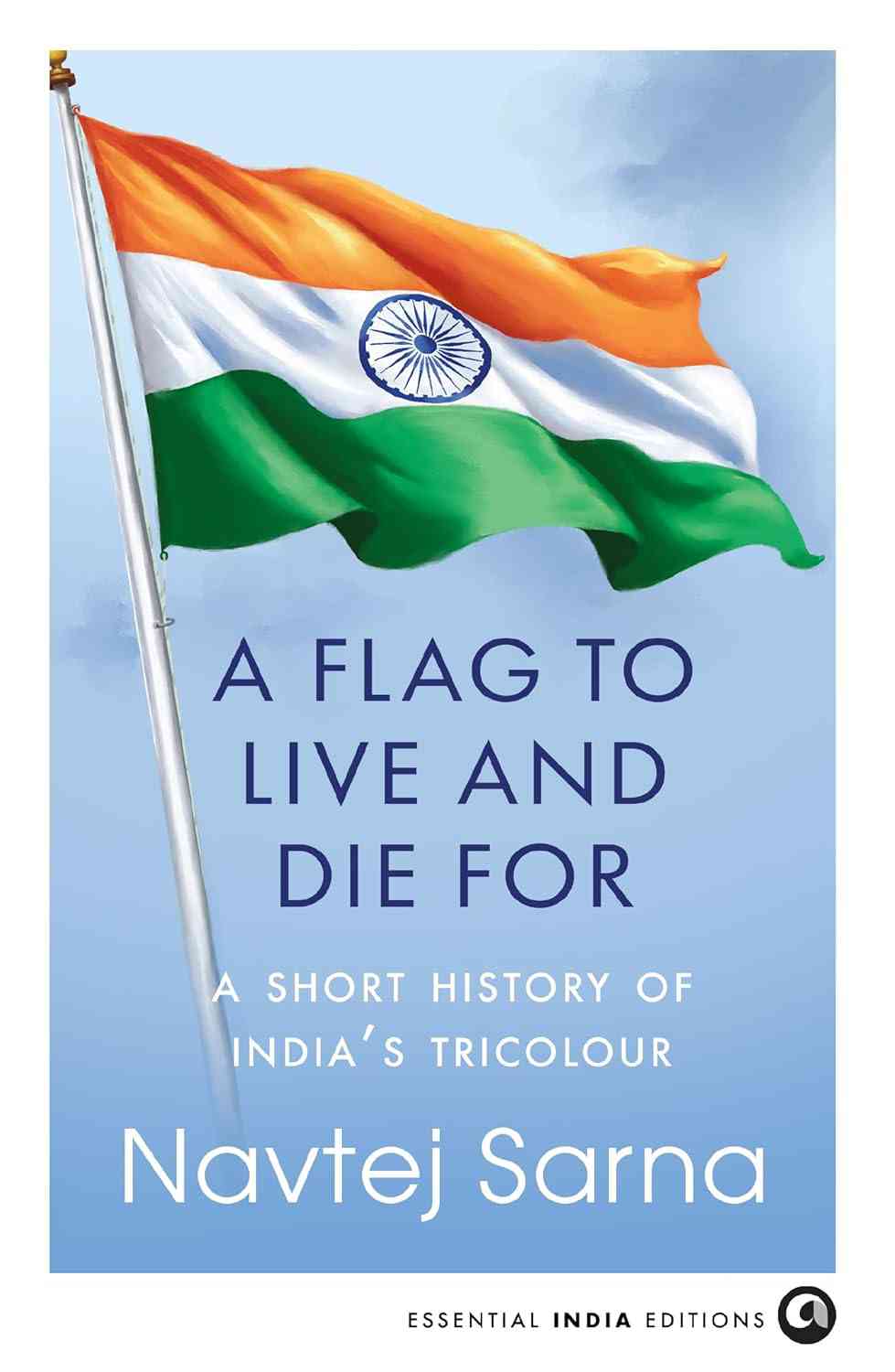
Excerpted with permission from A Flag to Live and Die For: A Short History of India’s Tricolour, Navtej Sarna, Aleph Book Company.
