





Daniyal Mueenuddin’s first short-story collection, In Other Rooms, Other Wonders (2009), won the Commonwealth Writers’ Prize and was a finalist for both the Pulitzer Prize and the National Book Award in the US, effectively establishing him as one of the living masters of the form. That collection was a peek into “what life is like for both the rich and the desperately poor in Mueenuddin’s country”, as one reviewer put it, a kind of “miniaturised Pakistani human comedy”.
This Is Where the Serpent Lives, Mueenuddin’s first book in 17 years, and his first novel, is an extension of that thought – this time in interconnected novellas, slightly longer than the stories, but similarly spanning generations and geographies and the lives and times that shaped them.
The real story of our lives
It begins with “The Golden Boy”, the story of Bayazid, aka Yazid, an orphan plucked off the streets by Karim Khan, a tea and curry stall owner in a bustling Rawalpindi market who trains him to manage his stall and make it into a haven for travellers, which Yazid does with more than some amount of flourish and success. This section is Mueenuddin stretching his muscles, readying himself and us for what lies ahead; it is also a careful character study of a person who we will continue to meet throughout the novel, like a fellow traveller who is both familiar and distant – their past open to us, and yet their present undecipherable.
For much of Yazid’s section – and for much of the book, in fact – the characters skirt around tensions, but the tensions never come to the fore and instead burn away into a thin line of smoke. That is well enough – it seems as if, story by story, novella by novella, this is what Mueenuddin seems to be saying: that this is the real story of our lives; of tensions and dramas that threaten to materialise and then never do. But when they do, as in the case of Yazid and his friend Zain and Zain’s sister Yasmin, things go very south very fast, as they do in the final pages of “The Golden Boy.”
Then we are put into the mind of a boy born with the proverbial golden ticket, Rustom, also an orphan who, nevertheless, has inherited wealth and who, after his return from the West, is trying to adapt to the ways of his home country. If Yazid’s journey is of a boy who rises from the streets on which he once slept – “under the stars, a fan to cool him in summers, and his clothes hung on nails in the filthy toilet that leaked sewage…” – to becoming one of the most respected servants in one of the most powerful families of the Pakistani elite, Rustom’s story is of a Pakistani elite boy trying to make out of himself a man by figuring out the roughened ways of the Pakistani streets. Yazid and Rustom, two golden boys, stare at each other across pages.
It is in the third section, however, that Mueenuddin changes gears and immerses himself completely into the story that he is trying to tell. Throughout the book, but especially here, you see Mueenuddin’s gift for language, and his ability to wield language like a brush, painting the streets and the gullies and the mountains and the bypasses right into our souls. It is extraordinary – but it is not, like with many writers, at the cost of something. Even as he writes about the geography of a particular time and a particular place, he keeps glancing over at the people who he is populating those places with. A sharp dialogue here, a well-placed observation there.
All this will not be new to readers of In Other Rooms, Other Wonders, which showed Mueenuddin’s enviable control over his craft: everything humming along to a meditated chaos. But it is also true that he is, perhaps, at his weakest in the beginning: I remember being quite unimpressed by the first story in his first collection – “Nawabdin Electrician” – and then being utterly devastated and hazed-out by the time the second story concluded (that story, “Saleema” is unlike anything you would have ever read, both in its intense telling and in its emotional force; a little masterpiece that I keep going back to often).
But in This is Where the Serpent Lives, Mueenuddin takes a couple of pages more to hit the stride: it isn’t until the near-end of this third section, concerning a love triangle between Rustom’s cousin, Hisham, his wife Shahnaz and Hisham’s sibling brother, Nessim, that you begin to understand what Mueenuddin is trying to do. Which, I suppose, is for the better, because it is the titular fourth section that takes up most of this novel.
In other room, similar wonders
This section brings together all the people Mueenuddin has been introducing to us over the past couple of pages – pulling their vastly distant yet unavoidably close social orders together, with the quiet force of familiarity. This meshing of classes is something that Mueenuddin does very well, primarily because he has a keen grasp of power, hierarchies and dynamics that play out both silently and violently in both these worlds. It is incredibly difficult to write about clashing classes and the inequity of power and privilege in Sub-continental fiction without slipping into moral platitudes or romanticisations and condemnations – a criminally underrated recent book that did this well was Shah Tazrian Ashrafi’s The Hippo Girl and Other Stories – but Mueenuddin is too much of a master to fall into that kind of trap.
Saqib, who is the protagonist, so to speak, of this final novella, is the son of Hisham’s gardener, and a boy on the rise – quick-witted, silently observant, obedient and fastidious to fault, his “mind older than his age”. His transformational moment in this novel, a change in perception and therefore association, a secret seen and understood in the dark of the night, is some of the best writing Mueenuddin has done: it is telling rather than showing, but in its telling it manages to show so much more.
From here, the story traces the “larger game” that Saqib plays with his mentors and masters, a tale of ambition, loyalty, greed and deception. It’s meandering, not as tightly-controlled as it should have been, but thrillingly alive nevertheless, primarily because you see Saqib – yet another golden boy, by the way – coming into his own as a person and a man, stepping out of the shadows of Yazid, himself an entrepreneurial man but with controlled desires. In all of this, it is also true that while there are a couple of memorably written female characters making cameos, most of this book is about boys becoming men and men trying not to behave like boys. A coming-of-age across decades and different young men, if you will, but at the cost of a stronger and sturdier female presence.
And there is yet another quibble, admittedly personal: This is Where the Serpent Lives is indeed an extraordinary novel, but it trudges along the same dusty paths as Mueenuddin’s previous book. That in itself is not a bad thing, if what you find along this trudging is other wonders – but in its moral breadth, and what it is trying to say, the novel is simply an extension of what Mueenuddin was already probing 17 years ago, and had, indeed, probed very well at that time.
The stories are different, but they circle around similar concerns, and this might not be disappointing for many – which is why I said this is merely a personal quibble, and may be dismissed as such – but to me when a writer of Mueenuddin’s perceptive powers comes back with new work, it beckons the hope of something fresh being uncovered, analyzed, made to realize; of thought and creative impulses stretched into the unknown. But this is simply a matter of expectation, and not, I repeat, a shade on the quality of the novel Mueenuddin has written.
In a previous, very old interview, Mueenuddin had spoken at length about his new novel, titled I. Want. You. To, which, by the looks of it, had entered a different territory. I don’t know what happened of that novel, but until it, or another one, or a story collection, or even a single story is offered up to us, This Is Where The Serpent Lives – easily one of the best of the year, and it’s only January – is enough to keep us preoccupied for quite some time to come.
Atharva Pandit the author of Hurda, published by Bloomsbury India in 2023.
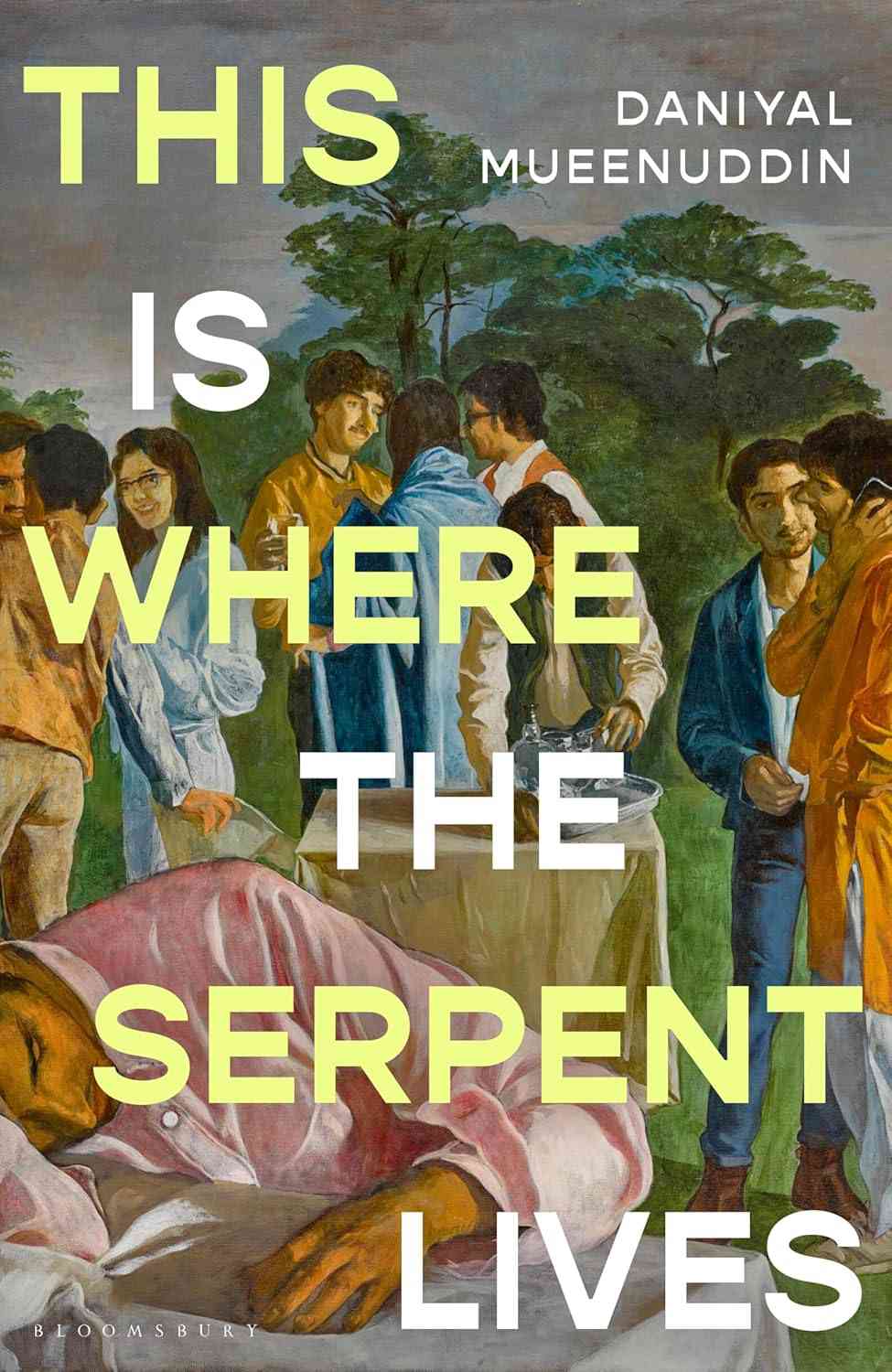
This Is Where the Serpent Lives, Daniyal Mueenuddin, Bloomsbury.
