



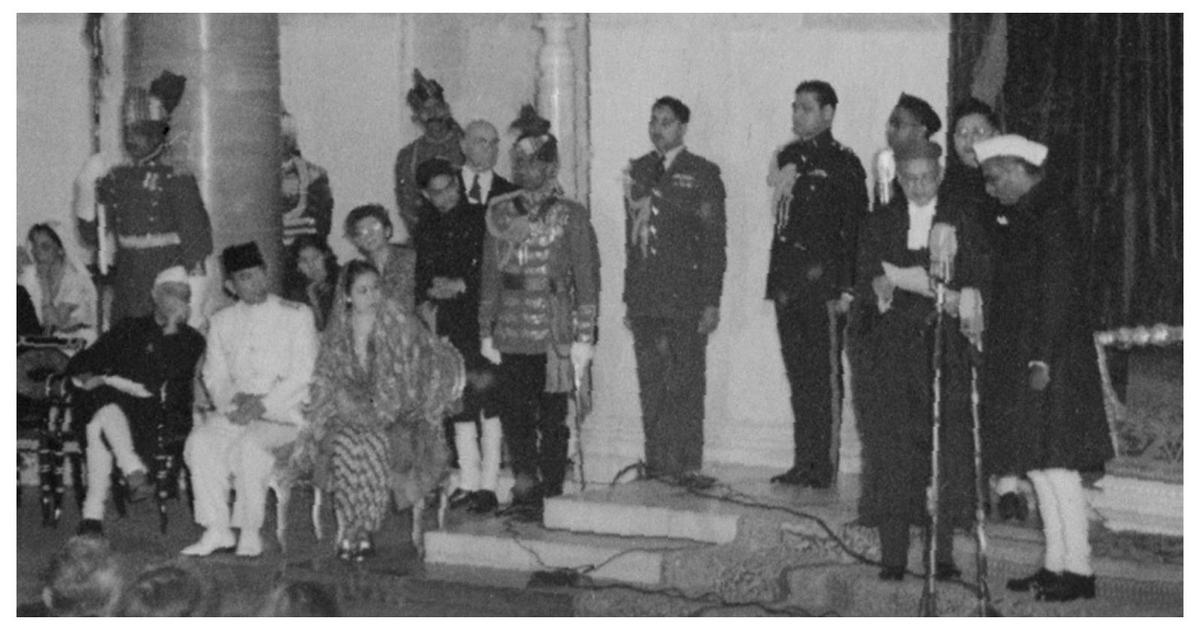
At precisely 10.18 am on Thursday, January 26, 1950, India formally completed its transition from a British Dominion to a Sovereign Democratic Republic. In the high-domed Durbar Hall of Government House in New Delhi, the outgoing Governor-General, C Rajagopalachari, read out the proclamation announcing the establishment of the Republic of India.
Shortly thereafter, Rajendra Prasad was sworn in as the first President of India, while Jawaharlal Nehru continued in office as Prime Minister under the new constitutional order.
In his address after taking the oath, Prasad drew attention to the historical weight of the moment, observing that the country was entering “a new phase of our national life” in which authority would henceforth flow from the Constitution and the people. He reminded the nation that independence had now been placed on a firm legal foundation, stating that the Constitution was intended to serve as “the instrument through which the will of the people shall find expression”.
The choice of January 26 was deliberate. The date marked the twentieth anniversary of the Purna Swaraj declaration of 1930, when the Indian National Congress had proclaimed complete independence as its goal. While August 15, 1947, marked the end of colonial rule, January 26, 1950, marked the commencement of self-governance under a Constitution framed by Indians themselves.
The ceremonial transition
Following the swearing-in ceremony, President Rajendra Prasad set out in a ceremonial procession through the streets of the capital. He travelled in a 35-year-old state coach drawn by six Australian horses, escorted by the President’s Bodyguard. The 8-km route from Government House to the Irwin Stadium – now the Major Dhyan Chand National Stadium – was lined with large crowds. Citizens filled the pavements, balconies, rooftops, and trees to witness the first public procession of the head of state of the Republic.
Speaking earlier in the day, Prasad had emphasised the collective nature of the new political arrangement, noting that the success of the Republic would depend not only on institutions but also on civic conduct.
“Whatever the Constitution may or may not provide,” he said, “the welfare of the country will depend upon the way in which the people and those in authority conduct themselves.”
At the Irwin Stadium, the celebrations took on an international character. The chief guest was President Sukarno of Indonesia, symbolising India’s engagement with newly independent nations of Asia and its interest in fostering cooperation among countries emerging from colonial rule.
The ceremony included a 31-gun salute, the unfurling of the national tricolour by President Prasad, and a march-past by the three wings of the Indian Armed Forces. The parade was limited in scale, consisting largely of infantry units and mounted regiments, reflecting the character of the early Republic’s armed forces rather than the mechanised displays of later years.
Constitutional mandate
Underlying the day’s public ceremonies was the coming into force of the Constitution of India at midnight. Drafted by the Constituent Assembly, with BR Ambedkar as chairman of the Drafting Committee, the Constitution established India as a sovereign, democratic republic and defined the framework of governance.
In his address, President Prasad underlined that the Constitution was not merely a legal document but a guide for public life. He stated that it sought to secure “justice, liberty, equality and fraternity” for all citizens, and cautioned that these ideals would acquire meaning only through their faithful application in everyday governance.
One of the Constitution’s most significant provisions was the adoption of universal adult franchise. By granting the right to vote to every adult citizen, regardless of literacy, property, gender, or social standing, the new Republic extended democratic participation to nearly 300 million people.
1950 :: First Republic Day Parade of India
— indianhistorypics (@IndiaHistorypic) January 24, 2023
(Photo - Homai Vyarawalla ) pic.twitter.com/Rimpb2qAgs
First evening
As evening descended, New Delhi was illuminated to mark the occasion. Public buildings, including the North and South Blocks of the Secretariat, were lit up, and the capital remained crowded well into the night. In his first message to the nation as president, Prasad reiterated that the Republic was founded on responsibility as much as on rights, reminding citizens that “democracy depends upon the capacity of the people to govern themselves”.
January 26, 1950, thus marked the operational beginning of the Republic of India. With the Constitution in force and the first President installed, sovereignty was vested in constitutional institutions and, through them, in the people of India.
Hasnain Naqvi is a former member of the history faculty at St. Xavier’s College, Mumbai.
