



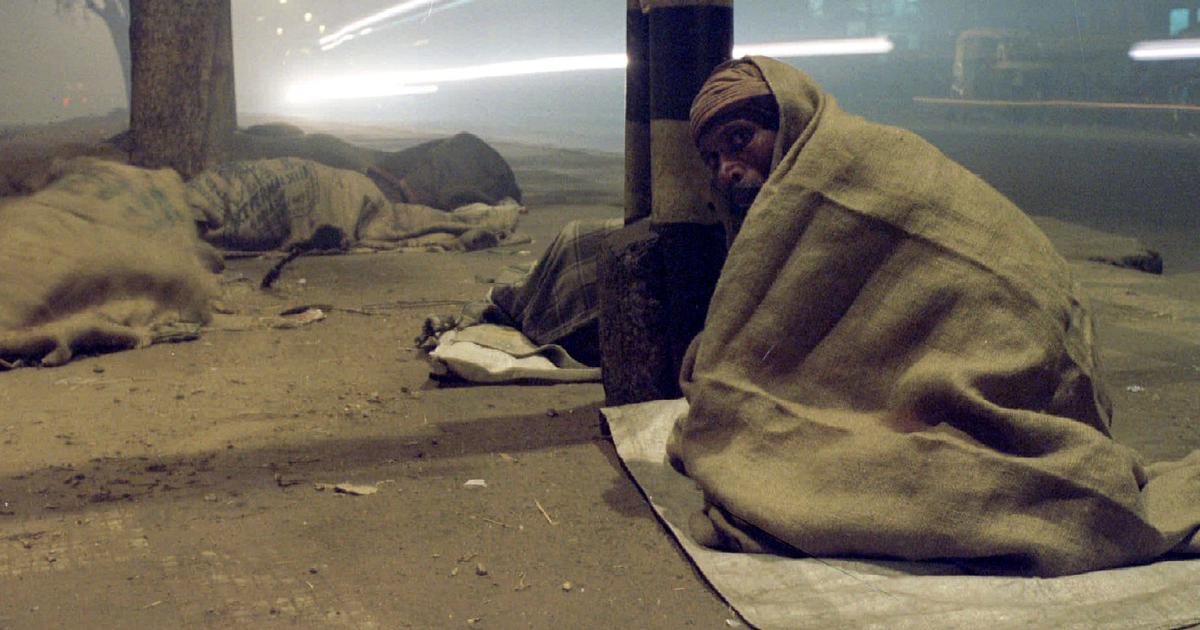
The city has turned into a battlefield where the strong wrestle down the weak and the rich exploit and tyrannise over the poor.
— Kahlil Gibran
Delhi is no exception to what Kahlil Gibran says about cities. Compared to other cities of India, Delhi actually fares the worst in terms of the way the poor are treated. Among the poor, the homeless (which includes children, women, the elderly, destitute, disabled, mentally challenged, men, etc.) – i.e., the people who sleep on pavements, rickshaws, handcarts, rehris (carts), railway platforms, flyovers, in parks, under bridges, etc. – are really in a vulnerable position.
This is not to say that slum dwellers fare any better. But from the point of view of a homeless person, slum dwellers at least have a place to sleep in – good or bad, small or dingy, doesn’t matter too much. Also, in contradistinction to the homeless, slum dwellers do form a constituency for political parties, whereas the homeless have no ration card or voting rights in the city. Which is why they are in a condition of extreme deprivation and neglect, and are facing social ostracisation. And this has given rise to the myths and misconceptions about the homeless, spawning and abounding. Little wonder why the gap between the homeless and the rest of society has increased manifold. We all know that the lack of social interaction is what generates fear, inhibitions, prejudices, hatred and contempt. The homeless are the worst victims of this process of marginalisation (pushed out from the rural economy to the urban economy), leading to social apartheid.
Politicians, bureaucrats and economists don’t tire of repeating, day in and day out, that the glamour and privileges of metropolitan cities like Delhi pull people from the hinterlands. Their blinkered perception is far removed from the reality.
The homeless in Delhi are migrants, mainly from UP, Bihar, West Bengal, Rajasthan, MP, etc., who left their homes in the village due to extreme distress. They are pushed out of the rural economy, as there is no work for them; they are redundant as their skills, of weaving, crafts etc., do not fetch a living, and they have no or little landholding. Recurrent droughts and floods, too, have made agriculture impossible. Some are also socially persecuted, divested of property – by their relations or dominant castes.
So, there are a host of personal and economic reasons for this migration. Our villages remain starved of any tangible development, with much of the investment going into scams of all kinds. Everybody has been a beneficiary but the poor. Such is the condition in villages that even the primary health centres have operating theatres that aren’t operational. The education situation is bleak.
So, most of the homeless are basically the rural poor, who are pushed out of their villages and reach the nearest city in order to address their poverty. The homeless are not a monolithic category. They have their unique problems, and in order to solve some of those, they are compelled to lead a precarious life, be they children, women, men, elderly, disabled or destitute. The Covid-19 pandemic particularly highlighted the pitiable condition the so-called migrants, the homeless, live across the nation.
Many men are engaged as labourers: handcart pullers, loaders, rickshaw pullers, casual workers, etc. They are paid below the minimum wage. While both labouring men and women contribute to the growth of Delhi and subsidise our costs of living (by providing cheap labour), they get nothing in return, except insults and indignities heaped on them day in and day out. Few are able to save and send money back home.
Most of the children are engaged in rag-picking, pushing handcarts, working at street eating joints, etc. Women, the disabled and the elderly are mostly destitute, with no one to take care of them. Many have been thrown out by their kindred, while others have grown old living on pavements. Dhanetri of Bihar was thrown out by her sons after the death of her husband. And at seventy years of age, she is left with no option except to beg at railway stations. Women and children are the most vulnerable among the homeless. While men can sleep anywhere they are able to, women have to watch out – they either sleep on the busy pavements of Paharganj or at railway platforms, temples, mosques, gurdwaras, churches, etc. Most children and women end up as victims of sexual exploitation, which is very common.
Among the myriad problems encountered by the homeless, the most brutal is regular police beatings. We ourselves have witnessed this and have challenged the police over this. Govind, a seven-year-old child in a night shelter, is nursing the dream (or nightmare?) of growing up to be like Hitler (he said so when asked what he wanted to be when he grew up). When asked why he wanted to be like Hitler, he remarked angrily, “I was beaten by belts and boots by a Delhi Police constable. I couldn’t walk and speak for over a week. I want to be Hitler and kill all the policemen. They beat us every now and then.” One fails to understand what our police personnel are trying to do. And who has given them the authority to beat children and other homeless people mercilessly? Are the police above the law, or is there a law that governs them as well?
If Govind grows up to be what he wants to be, that would justify the myth spread by the police – that criminals live on pavements. But nobody is born a criminal. Who will punish the constable who has ruptured the sensibility of a seven-year-old child? No one knows how many more children might become victims of this cop’s brutality and nurse similar ambitions as Govind.
Whatever the police might say, we have a different reality to highlight. During our rapid assessment surveys, on countless night-outs on Delhi’s streets from 7 pm to 6 am, from 2000 onwards, we have had women volunteers and colleagues with us. We went to all the so-called crime pockets of Delhi – be it Dholak Walon ki Basti, Majnu ka Tila, Yamuna Bazaar, ISBT, Anand Parbat, Inderpuri, etc. We didn’t face any untoward incident. While Delhi tops the entire country in criminality, definitely the criminals are not the ones living on the pavements of Delhi. Delhi Police should go beyond its most comfortable paradigm of solving crimes by arresting the homeless. And the homeless neither have identity cards nor any guarantors nor any advocates who can represent them. Remember the 2008 blasts in Delhi? One blast was averted due to the sense of responsibility and exemplary courage shown by a balloon-seller child near the Regal Cinema. He was awarded the Child Bravery Award in 2007–08. We are in touch with his family, who stay in Rajiv Chowk, New Delhi. This boy, who is an adult today, is still homeless, with his family staying in the DUSIB Shelter Complex, near the Bangla Sahib Gurudwara, Baba Kharak Singh Marg.
In 2000, we counted 52,765 (estimated over 1 lakh, assuming that for every one homeless person we counted, we missed one) homeless people in Delhi; in 2008, a study done by the Indo Global Social Service Society (IGSSS) numbered the homeless at 88,410 (estimated over 1.5 lakh). The census figures are underestimates.
The above figures show how the census underestimated the figures. We were not just witnesses to the 2001 census, but rather we provided training to the charge officers under whom the enumerators operate. The 2001 census was a total farce in this regard. We and the media reported about it in great detail. The same was the case in 2011, in many cities: Delhi, Mumbai, Chennai, Hyderabad, Kolkata, Bengaluru, Patna and Lucknow, among others. The next census, which was supposed to happen in 2021, got delayed due to the Covid pandemic. But we have to be vigilant in the next census and ensure that the exact numbers of the homeless, across the country, are captured in the data. We are also part of the Global Homelessness Data Initiative (GHDI) of the Institute of Global Homelessness (IGH) with UN-Habitat. The exact numbers are crucial for any planning and intervention.
The issue is glaring. Can we keep disputing the numbers of the homeless? The rampant evictions going on in Delhi and across the country (whether in the name of beautification, world-class city, erstwhile JNNURM, Commonwealth Games or the 2020 railway line clearances, environmental purges [Khori and others]) have increased homelessness. We are required to address it. Can we remain mute spectators or will we join the homeless in their fight for their right to live and work with dignity?
Thankfully for us, the Delhi High Court intervened suo motu in 2010, and that changed the course for us in Delhi, with a large number of shelters coming up in the city. Our petition, WP 572 of 2003, filed in 2003, along with WP 55 of 2003, filed by ER Kumar, got activated in 2013. Owing to that, shelters have been coming up across the country.
We had our urban poverty group in the National Advisory Council, 2011–12. The National Urban Livelihood Mission (NULM) emanated from the deliberations of this group. Now, the specific criteria of 50 sq. ft living space per person is the bare minimum ensured in all the 24/7, all-year shelters for the homeless.
The 24/7 free shelters in Delhi are for everyone – pregnant and lactating mothers, chemically dependent women and men, families, children, women, men, disabled, elderly, people with mental issues, recovering patients, etc. Shelters for transgenders is the desiderata. The same should be made available across the country. In 2000, the government allocated Rs 1 crore for shelters (these were called night shelters; we clamoured for these being 24-hour shelters, which they have become now) for the homeless for the whole nation. Today, under the NULM, we have Rs 1000 crore. We have come far but still have a long way to go.
We need to have shelter complexes (shelters for families, women, men, children, chemically dependent [for de-addiction], recovery shelters) like the ones in Delhi near the side of Bangla Sahib Gurudwara, Jama Masjid and Sarai Kale Khan. And the shelters have to be in the concentration areas of the homeless, not far away from the hub of activity, food points, amenities, hospitals/health centres, source of livelihoods, etc. We need a policy for the homeless.
It’s time that all schemes and master plans are converged to empower the CityMakers, rather than pauperise them. And all the government departments should work with a missionary zeal to ensure human rights to all, especially the deprived, destitute, marginalised, stigmatised, excluded and exiled people and communities. Let them, too, belong to India, rather than decay in non-India.
The work that we have done with the homeless, since 1999, makes it amply clear that courts have an important role in proffering justice. Courts are the last resort to put the Constitution of India to the greatest use. Yes, there is inordinate delay in getting justice. But once a verdict is given, the governments have to abide by it. The same bureaucrats who would have done nothing to address homelessness were perforce made to deal with it with the intervention of the Supreme Court of India and the Delhi High Court. When laws are non-existent or are silent on certain matters, courts using their jurisdiction and jurisprudence can usher in justice, especially when all other institutions of governance have failed. The law indeed is a potent tool to decimate poverty; it can be a harbinger of development and good for all, leaving no one behind.
Today, we are seeing the blatant misuse of governance by the Union government and the governments in states run by the Union government’s party. On the slightest pretext of any protest, bulldozers are used to bring down the homes of ‘protestors’. This is against the Constitution of India and the laws of the land, as well as the Universal Declaration of Human Rights, 1948. The National Register of Citizens (NRC) and the Citizenship (Amendment) Act (CAA) are tools that turn large numbers of Indians homeless. Over two decades since 1999, we have tried hard to create homes for the City Makers/homeless residents, with the support of civil society, media, judiciary, some proactive governments (like the one in Delhi) and the CityMakers themselves. We all need to resist the move across the world to generate homelessness by laws, wars, Islamophobia, lynchings, killings, etc. Organizations like the Institute of Global Homelessness, Chicago, are playing an important role in raising advocacy to end global homelessness and are taking the issue to the portals of the UN, UN-Habitat and other international bodies.
Gandhi, Martin Luther King Jr and Nelson Mandela have taught us that our lives are intertwined, and we need to work for the common good of all, especially the marginalised, oppressed, exiled, poor – people confined to the fringes of our country’s policies and schemes. Now is the time to bring them centre stage.
Join us! To transform Delhi and the country, and the world – to build caring and happy cities. To create homes for the homeless.
Excerpted with permission from ‘On Homelessness’ by Indu Prakash Singh in City Limits: The Crisis of Urbanization, edited by Tikender Panwar, Penguin India.
