





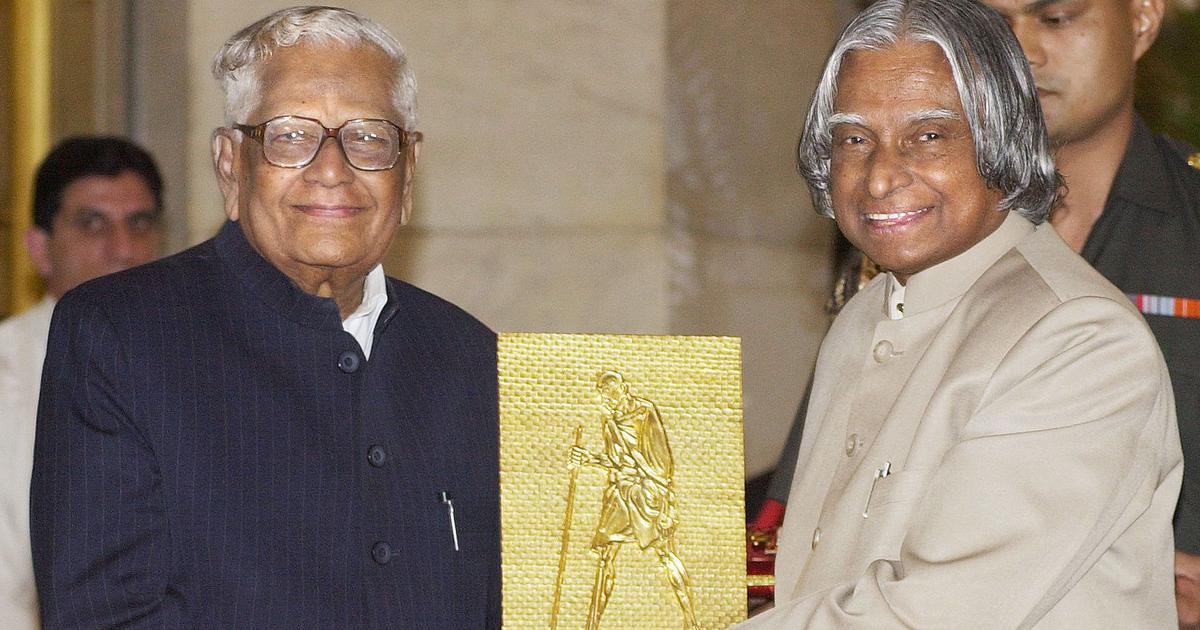
In the excerpts from the book We, the People of India: Decoding a Nation’s Symbols published in Scroll (“‘Every execution chips away at the nation’s moral fibre’: TM Krishna on the death penalty”, TM Krishna addressed the death penalty in his characteristic manner – with eloquence and emotion. But erudition does not always inform or provide insights into complex matters, such as the role of presidents in mercy plea petitions.
He characterises presidential decisions on capital punishment as “inclinations”, starting from my father, President R Venkataraman’s decision in the case of Indira Gandhi’s assassin Kehar Singh, to subsequent presidents – KR Narayanan, Abdul Kalam, Pratibha Patil, Pranab Mukherjee and Ramnath Kovind.
Contrary to Krishna’s assertion, Venkataraman, who was widely known as a “copybook President”, strongly believed that a Head of State should not be guided by mere inclinations but must strictly adhere to the rule of law. Lest one concludes that he was propagating a formulaic approach, Venkataraman in his memoirs, My Presidential Years, writes in depth about his thoughts while tackling the difficult case of Kehar’s Singh mercy plea:
“First, should not the President have the discretion to examine any extenuating circumstance and alter the death sentence without the advice of the Government? Absence of such a power unnecessarily brings blame to the President. In the public mind, there was an impression that the President in person decides mercy petitions and whether the accused lives or dies is in one man’s hands…
However, I stuck to my view that in law and in fact, the President has to accept the advice of the council of ministers”, Venkataraman opined.
So, “how must a president, who is a constitutional head of state, express his approvals and disapprovals?”, asks the legal luminary Fali S Nariman in an essay in the book R Venkataraman, a Centenary Tribute. Referring to the Constitution of India, Nariman says, “If the President is inclined to disagree with the initial advice of the Council of Ministers, the President may require the Council of Ministers to reconsider such advice, either generally or otherwise and the President shall act in accordance with the advice tendered after such reconsideration”.
Venkataraman, did exactly that in the case of Kehar Singh. “I referred the whole matter again to the Home Ministry for a thorough examination of all the facts”, Venkataraman wrote in his memoir. He further goes on to give his considered opinion on what the role of the judiciary and the executive could be to better address such complex issues in the future.
In his prescient manner, President Venkataraman documented his views in 1993 so that there may be some enlightened discussion on them. While we can and should continue debating the true principles that underlie our democracy and seek to change the way we are governed, we must also acknowledge that the president of a parliamentary democracy, as a constitutional head, “cannot desecrate the rule of law”, in President Venkataraman’s words. – The daughters of President Venkataraman, Padma, Vijaya, Lakshmi
