





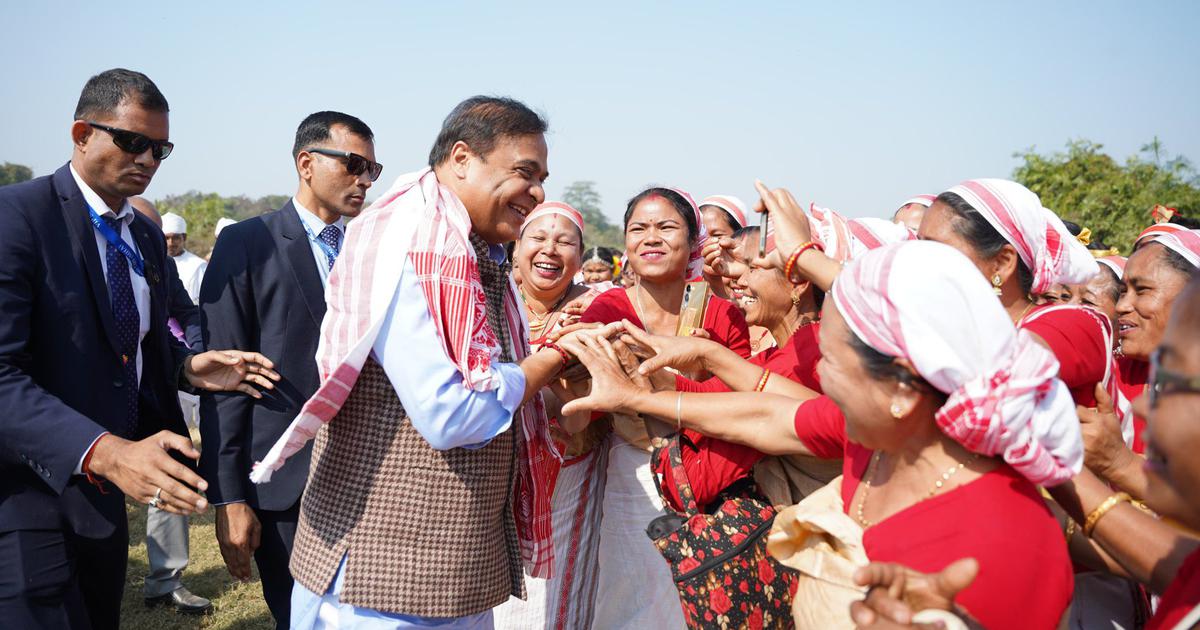
A spectacle is playing out in Assam. Let’s call it Himanta Biswa Sarma vs the Constitution of India. In the last seven days, the Assam chief minister has repeatedly – one should say brazenly – declared his hostility to a third of his state’s population.
“My job is to make the Miya people suffer,” he said on January 27.
The “Miya people” Sarma speaks of so contemptuously are the state’s Muslims of Bengali origin, many of whom arrived in Assam in the early 1900s and who are often vilified as “illegal immigrants” or Bangladeshis.
A few days later, Sarma urged the people of the state to do “whatever they can to trouble Miyas”, including paying them less for their honest labour.
This was in response to a question about allegations that workers of the Sarma’s Bharatiya Janata Party were actively trying to subvert the Election Commission’s special revision of Assam’s electoral rolls.
As Scroll reported, thousands of bulk applications were filed across Assam, seeking to strike voter names off the draft roll – largely Muslim voters who had just been confirmed by the Election Commission’s door-to-door verification. In many cases, the complaints were forged, signed by people who claimed to have no knowledge of them. BJP workers were named in several complaints filed by angry voters.
The chief minister said “there was nothing to hide”.
“Yes, we are trying to steal some Miya votes,” he told reporters, who gamely chuckled along. “Ideally, they should not be allowed to vote in Assam. They should be able to vote in Bangladesh.”
Indeed, Sarma doubled down, saying that BJP workers had filed five lakh bulk applications against “Miyas” on his instructions, just so they were “troubled” and “kept under pressure”.
Perhaps, no one expects statesmanlike speech from Sarma anymore. He has, after all, accused Bengal-origin Muslims in his state of conducting a “flood jihad” and a “fertiliser jihad” for simply going about their lives. But even by those abysmally low standards, a chief minister of a state directing the extraordinary harassment of Muslim voters – and owning it with pride – is a red line crossed.
Sarma’s statements make a mockery of the Constitution, which bars discrimination based on religion, race, gender or caste, which guarantees everyone equality before law, no matter what his or her identity. By directing his party workers to file false complaints against legitimate voters, he is in dangerous breach of the law.
Many have argued that Sarma’s performative communalism is aimed at pleasing the apparatchiks of the Rashtriya Swayamsevak Sangh – and climbing the grease-pole of India’s post-2014 politics. But it is important to remember that he is drawing on a deep well of suspicion against Bengal-origin Muslims in Assam.
For decades now, the community has repeatedly stood trial in Assam’s politics. Brought to the region because the British needed hard-working peasants, Bengal-origin Muslims tried to disprove allegations of being a threat to Assamese society by adopting Assamese as their language, opening Assamese-medium schools in their villages and providing the hard labour on which much of Assam runs. That strategy did not work.
Bengal-origin Muslims were routinely reported to the state’s foreigners tribunals, notorious for stripping residents of citizenship because of minor errors in documents and even spelling mistakes. In 2019, the community surrendered to the inquisition of the National Register of Citizens – and the majority survived, producing the documents that prove their Indianness. Most of the 19 lakh Assam residents who did not make it to the NRC were Hindus.
Sarma’s calls to make “Miyas” suffer and disenfranchise them is an attempt to erase that history and to cast all Bengal-origin Muslims as illegal foreigners. By exhorting the people of Assam to harass fellow citizens as a way of “resistance”, he casts Assam’s politics into a perpetual conflict between communities – the ultimate othering experiment.
The provocative speech is not only meant to harvest votes. As Scroll has documented, Sarma has made “troubling Miyas” a doctrine of governance, using law and procedure against the community to create a regime of exclusion and punishment, calling for their economic and social marginalisation, backed up by majoritarian support.
With the judiciary and the Election Commission refusing to stand up to Sarma, or offer even a mild reprieve for what is evidently hate speech, Assam will continue to be goaded down a path of divisiveness. The Constitution of India is still awaiting its defenders.
Here is a summary of last week’s top stories.
A shocking death. Maharashtra Deputy Chief Minister Ajit Pawar was among the five persons killed in a plane crash in Baramati. The small aircraft crashed near an airstrip in the town during its second attempt to land. Two pilots, an attendant and a security officer were the others who died.
The cause of the crash was unclear. The Aircraft Accident Investigation Bureau is probing the incident.
The Nationalist Congress Party leader, in his sixth term as the deputy chief minister, was flying in from Mumbai for a political rally ahead of civic elections.
Opposition leaders demanded an independent investigation into the crash. West Bengal Chief Minister Mamata Banerjee said that a few days ago she had come across a claim by an unidentified leader of another party on social media that Ajit Pawar was “willing to leave” the Bharatiya Janata Party-led National Democratic Alliance. “And now what happened today…” she said, demanding a probe supervised by the Supreme Court.
Ajit Pawar’s uncle and NCP founder Sharad Pawar said that his nephew’s death was an accident and requested that the matter not be politicised.
University equity rules stayed after backlash. The Supreme Court stayed the University Grants Commission’s 2026 Promotion of Equity in Higher Education Institutions Regulations. The provisions were “prima facie vague and capable of misuse”, the court observed, asking the Union government to redraft the regulations. Until then, the operation of the rules will be in abeyance.
The bench verbally raised questions about why “caste-based discrimination” had been separately defined when the definition of “discrimination” already covered all forms of discriminatory treatment.
The regulations, notified on January 13, led to protests by upper-caste students, who have argued that the framework could lead to discrimination against them. The protesters have contended that the rules are biased against students from the general category as they do not provide for measures against “false complaints”.
The state of the economy. India’s real gross domestic product is expected to grow between 6.8% and 7.2% in the financial year 2026-’27, the government’s annual Economic Survey projected. The cumulative impact of policy reforms in recent years appeared to have lifted the economy’s medium-term growth potential closer to 7%, the Department of Economic Affairs said.
“With domestic drivers playing a dominant role and macroeconomic stability well anchored, the balance of risks around growth remains broadly even,” it said. “The outlook, therefore, is one of steady growth amid global uncertainty, requiring caution, but not pessimism.”
The document, tabled in Parliament ahead of the Union Budget on Sunday, details the state of the country’s economy and suggests measures to boost growth.
Also on Scroll last week
- Son declared Indian, but father, uncle and aunt pushed into Bangladesh
- Why experts say AI tool to detect Bangladeshis will be open to misuse
- As Maoists retreat, why many fear security forces in Chhattisgarh villages
- Five reasons why activists say Kerala woman’s arrest in bus incident needs a rethink
- ‘Pakistani’ taunts in office, rebuffed deliveries on apps: India’s Muslims face prejudice at work
- Refusal to see caste discrimination, not ‘false complaints’, is the real crisis on campus
- Why a 19th-century king’s music still provokes doubt and dispute in the Carnatic world
- In the devastating legacy of Dogra domination are the roots of Ladakh’s anxiety for autonomy
- Arundhati Roy talks movies: ‘Every person who reads my book has their own film in their head’
- ‘Mayasabha’ review: Atmospheric visuals trump a convoluted tale
Follow the Scroll channel on WhatsApp for a curated selection of the news that matters throughout the day, and a round-up of major developments in India and around the world every evening. What you won’t get: spam.
And, if you haven’t already, sign up for our Daily Brief newsletter.
