










Evolution takes time, more time than humanity has. Our brains remain calibrated for a world that no longer exists, a world with small communities, limited information, limited conflicts, and desires shaped by the people you could see and touch. And then we built platforms optimised to exploit every evolutionary shortcut, every cognitive bias, and discovered – too late – that we had no defences prepared.
This mismatch between what we’re built for and what we’ve built explains the inescapability of the Internet. The French philosopher René Girard identified mimetic desire as fundamental to human psychology. “We desire what others desire because we imitate their desires,” he wrote in Generative Scapegoating. When those models of desire were limited to your immediate community, mimetic desire operated within natural constraints. But when the model became an algorithmic feed engineered to show you an infinite number of examples of what others want, desire itself became an object that could be scaled and monetised.
Indian Gen Z is the first generation to experience this at an unprecedented scale: socialised into digital life immediately, completely, with increasingly no memory of a world where desire wasn’t mediated by screens. Ria Chopra’s Never Logged Out: How the Internet Created India’s Gen Z documents this socialisation in eight essays, combining cultural analysis with personal anecdotes to show how identity, love, memory, and knowledge get rewired in an algorithmic ecosystem.
Digital routines
Today, you wake up and check your Instagram notifications (after snoozing those pesky alarm tones on your Clock app). Perhaps you check your Snapchat and add to your long streak. Tap tap tap swipe swipe swipe. You book cabs through an app. You send money through an app. You book movie tickets, hotel rooms, train seats, and reserve a table at a restaurant through an app. You even search for love on an app. Your life resides within the clustered clouds of your phone screen, amidst the multicoloured icons and notification tones.
Chopra encapsulates this phenomenon well: “Modern platforms aren’t designed to let you go; they’re designed to keep you hooked. Infinite scrolling, algorithmically recommended content, and hyper-targeted ads mean that the internet is no longer a destination – it’s a default state of being.”
Each of her essays covers a specific aspect of the internet and our evolving relationship with it, but the organising principle remains consistent in that the internet doesn’t just change how we do things; it fundamentally rewires what those things are. Identity becomes performance, love becomes a constant test.
In one essay examining the “tote bag economy,” Chopra tracks how an object made for carrying ice blocks mutated into a system of cultural signalling. Over 80 years, totes turned into “billboards to signal our cultural influences and proclaim our interests, a dog whistle for people who regard the symbolism on the cotton sacks hanging over our shoulders as an indication that we are one of them.”
I’m guilty of subscribing to the New York Times primarily for their tote, a cotton billboard announcing taste and allegiance to anyone who recognises the font, and I’m not alone in my vanity. Drawing on Baudrillard’s hyperreality, Chopra argues that symbols of a lifestyle (like carrying a bookish tote) have superseded the reality of living the lifestyle. You don’t become interesting by reading; you become interesting by being seen with the right bag.
In another essay, she recalls the Ask.fm era and her brief stint at trolling. This was the platform that set the template for short-lived engagement and normalised hatred. The platform demonstrated what could happen when accountability was removed and anonymousness implemented: “That when given the opportunity, and the tools, and the gift of anonymity, some of our basest human impulses come out in full force – the need for approval, the loss of politeness, the free rein of hate, and always, always, the creation and maintenance of social hierarchies.”
The platform didn't “create” cruelty, Chopra argues, but it certainly industrialised it and taught a generation how scandal was the best currency for attention.
In her essay on modern romance, “It’s Complicated”, Chopra analyses how algorithms have gamified romance. Viral trends like the “orange peel theory” or “bird theory” reduce love to checklists, binary evaluations of “red flags” and “green flags” where partners get assessed like data points rather than real people. Chopra writes, “Think of the relationships where you feel most loved. Perhaps they are with your parents, or your siblings, friends, or a partner. Do you feel the need to constantly ‘test’ them? Do you pretend to cancel plans with your friend, trying to see if they respond ‘correctly’ or ‘incorrectly’?”
By defining compatibility through algorithmic definitions, a generation risks losing the ability to develop their own romantic taste, losing the radical potential of love for the fickle safety of validation.
These essays work well alongside Vauhini Vara’s book Searches: Selfhood in the Digital Age, a book I read recently, which scrutinises how the internet evolved into the surveillance apparatus we are trapped in. While Vara looks at the technology – the founders’ motivations, the corporate decisions – Chopra looks from the technology – what it feels like to grow up inside this reality, to have your identity formation, romantic life, and memory shaped by platforms optimised for profit.
The two books complement each other – while one maps the architecture, the other maps what it feels like to live inside the building. Together, the pair offers a complete diagnosis: how we got here and what it costs.
The knowledge of being trapped
Humans evolved to forget. Memory fades, softens. Memory allows us to move forward. Chopra philosophises it thus: “Human memory is relational. We remember in context. We remember differently depending on our mood, our needs, and the stories we tell ourselves about who we are. Memory is reconstructed every time it is recalled; both fragile and elastic, it is shaped by new information and fresh emotions.” But what about a world where anything and everything is permanent? “Digital memory is static. It preserves information in its original form, unchanged by time or interpretation. A photo does not grow fuzzier with nostalgia,” she explains.
This, naturally, creates a species-al incompatibility. “We are creatures built for memory shaped by forgetting; we now live in a world shaped by memory without forgetting.”
This permanence extends beyond memory. Everything is preserved, archived, resurfaced, and monetised, including the performance of selfhood. This mismatch – between what humans need and what platforms provide – repeats across platforms and mediums.
But Gen Z, Chopra claims, isn’t naive, for they know they’re being manipulated. They understand Instagram rewards performance over authenticity. That dating apps gamify intimacy. That platforms are created to hook them rather than serve a purpose. They have the critical vocabulary, from “attention economy” and “doomscrolling” to “parasocial relationships” and “algorithmic feeds.” Yet the knowledge changes nothing. Tote bags are collected knowing fully well that it’s a part of a “curation”. Romantic partners are tested knowing that these “tests” are unscientific. Doomscrolling is part of life despite knowing this addiction has been engineered.
The sophistication of our online lives makes the trap more visible. Existence is highly digital, and when the digital space constantly demands curation, authenticity becomes impossible. As Chopra said, “We hope that by proving to other people that we are a certain kind of person, we get to prove it to ourselves.” The performance continues even after it has been caught red-handed being so. “The difference between authenticity and inauthenticity, then, is simply a matter of how convincingly the illusion is designed, curated, and upheld,” she further notes.
Never Logged Out gives in to neither despair nor naïve optimism. Yes, the ecosystem may be inescapable; yes, an entire generation was socialised into it without choice. But awareness itself is a form of resistance.
You’ll wake tomorrow to notifications again. Tap tap tap swipe swipe swipe. The platforms will still be there, engineered to keep you hooked. But there is also the possibility of conscious consumption, i.e., participating in the performance while knowing it is not meant to be innocent. The generation that never logged out may not have chosen the system, but they can certainly choose how they inhabit it.
This may not be freedom. It sure as hell is not nothing either.
Also read:
‘Searches’ by Vauhini Vara: A wonderfully experimental book about how the internet shapes selfhood
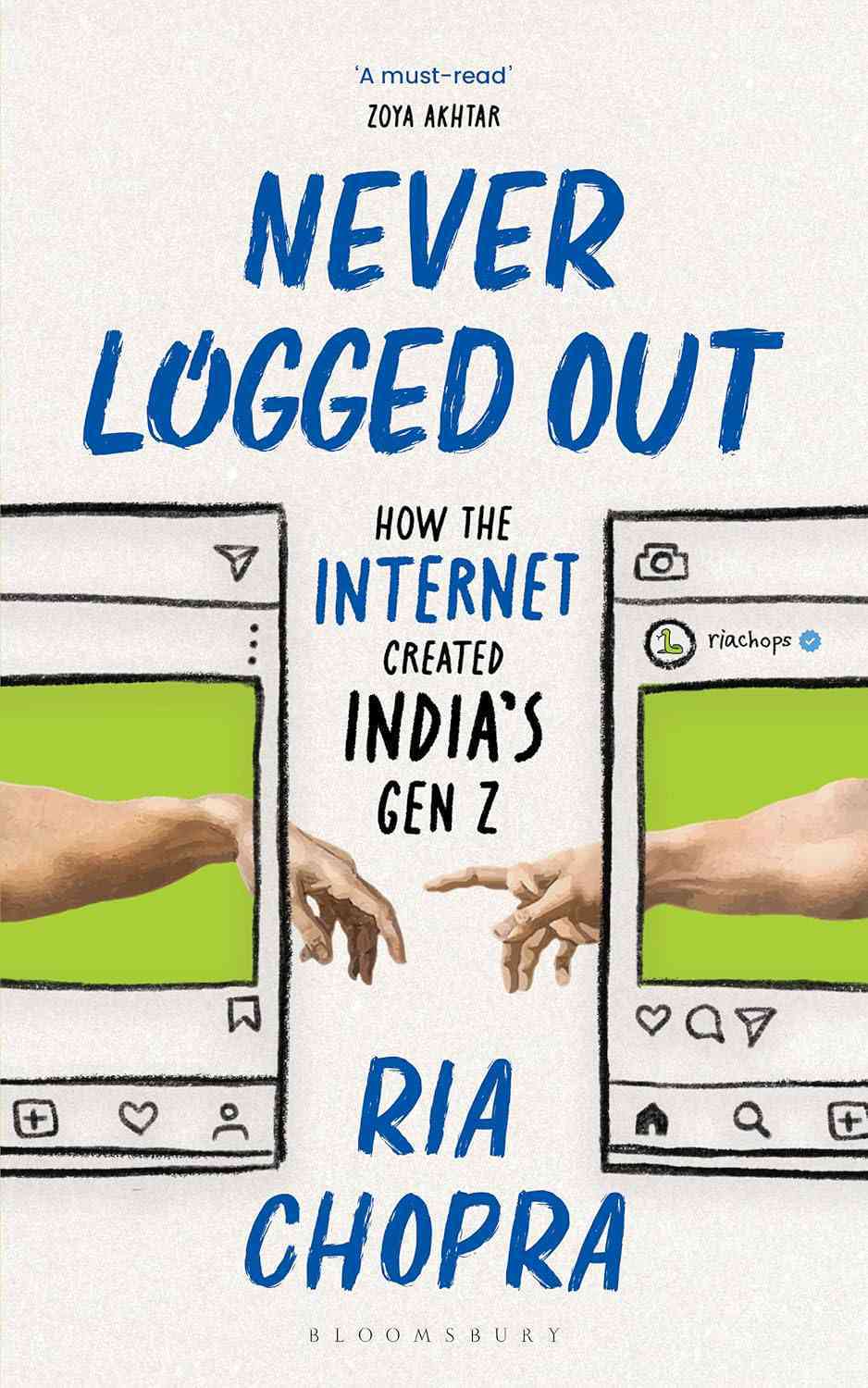
Never Logged Out: How the Internet Created India’s Gen Z, Ria Chopra, Bloomsbury India.
