







Words … and the controversies they create! It’s all a matter of semantics, really. The change that words bring about comes over years and across continents – by the changing of their spellings, pronunciations and, most of all, the way they tend to be used. As time goes by, a word can have several connotations.
One such word is “Azadi”. Personally, it has meant different things at different times and stages of my life.
When I was in school, it meant the freedom to choose the time to go there, the choice to call every day a Sunday, and to wear the clothes I chose each day, oblivious to the hard reality that curbs were already in place, a long time before I was born or even conceived. The stars were in motion, deciding my fate, my religion, the weight of the burden I had to bear in my life journey, even the time and season of when I would be born.
My mother was a simple and affectionate woman who was married into a family from the landed aristocracy. She suffered in silence all her life, her only relief being my tricks and boisterous laughter. There were no choices in her life; everything was pre-decided, even her right to reproduce or not. At a certain point, doctors advised her against having any more children because of her frail constitution, including a weak chest. But that was not to be; her standing in that household would be threatened had she not produced a male heir. She was the first victim I knew of (the lack of ) Azadi. What ought to have been her choices – to pursue her studies, to watch movies and to do all that a normal 18-year-old would love to do – were denied. The right to protest when abused – mentally, emotionally, and even physically – was non-existent.
Seeing my mother’s wet eyes and sad smile made me protective towards her. Helping her was my first attempt at activism: standing up for her the umpteen times she needed some support; going to movies together, on the sly, of course; laughing at the same jokes; singing her favourite songs; listening to her childhood stories. She was my friend, confidante and support system, and I, hers.
I went to a prestigious English public school, which had its own set of strict rules, which were, of course, in complete contrast to my liberal way of thought. Pin-drop silence and my hearty laughter were two things that could never go hand in hand. At this school for the elite, the focus was on grooming socialites to adorn the drawing rooms of the rich. Education was merely a side dish. Feeling stifled, my only peace came from visits to the church, which was located within the imposing limestone school building – with a clock tower to boot!
I envy the freedom that today’s schoolchildren enjoy. If only I had been born three decades later …
Girls lived with constant restraints; the list is endless. As soon as we reached our early teens, we were made to wear tight-fitting homemade blouses to give us a flat-chested look, like our sisters in China whose delicate feet were stuffed into tiny shoes lest they grow beyond the required length. Make-up was taboo. I had seen my cousins wiping off their lipstick when they came across an elder of the house. Hair was oiled and tightly plaited, and our movements were monitored by an old aunt or trusted servant. Wearing Western dresses was simply not allowed, and we had to cover our heads with a dupatta and walk with a lowered gaze. Arguments, no matter what they were about, were never allowed. In fact, we had no personal choices, be they to do with eating, dressing up or even being able to opt for our favourite school subjects.
Then came college, housed in the erstwhile residence of the widowed Dogra queens: Women’s College on MA Road in Srinagar. Everything about it was prim and proper, and there were rules for everything. We did have a students’ council, but who was talking about rights? This was, after all, a prestigious educational institute that showcased all that was beautiful in our part of the world. It was administered by a beautiful and dynamic visionary – Mehmooda Ali Shah – who had her own set of stringent rules, which she implemented with the help of her highly educated staff, and the institution’s gatekeepers. Strict timings were enforced, and so were crisp white uniforms. No way could you play truant. The subjects I “opted” to study were chosen by my father. I merely had to work hard to excel.
Then came the University of Kashmir, amid a sprawling apple orchard on the banks of the Dal Lake, surrounded by majestic mountains. Huge Chinars, the leaves of which changed colours with the passing seasons, would be the delight of any scholar. It was a free world. Young men and women could be friends; we could bunk classes and spend hours in the university canteen. However, Kashmiris are very close-knit. No matter how discreet I was, news of any transgression would reach my father’s ears before I could mumble an excuse.
Some of my cousins were in committed relationships but these culminating in marriage were out of the question; arranging marriages for all the family’s children was the sole prerogative of my father. There went Azadi, for a toss. Many of my cousins and I got married like we were morons, hardly knowing the groom or his family. The final verdict was that we had to live our lives with them until we died. Huge dowries were given to the in-laws to accommodate us new entrants, and money was regularly pumped into their houses for our upkeep there.
Some lucky ones, like me, could manage to get a decent job. I ended up working double shifts, maintaining my self-respect and dignity. However, it also meant leaving for work feeling guilty and coming back feeling worse. There were unwritten rules at my acquired home and written ones at the workplace. Still, I became a subject of envy for the women who stayed at home because of my financial independence. However, this meant that I was subject to numerous audits and snide taunts. Azadi, then, was an infamous word, particularly if used regarding a woman – it was considered highly derogatory.
Life as I knew it continued, with its clearly drawn lines, never to be overstepped. They were meant to keep you confined to your cramped space, somewhat like Sita’s plight when she had no choice but to remain behind the Lakshman Rekha. Daughters were given strict instructions not to talk to their parents about their experiences at their in-laws’ homes. Daughters-in-law were not supposed to converse with the men in the family. If it was absolutely necessary to talk to them, the women had to look towards the wall, their heads lowered.
I wonder if we ever dreamed of Azadi – freedom from the mundane, from a suppressed life; freedom even to dream of desires. Dreams were just baggage that needed to be shed, if not forgotten. Our minds were straightjacketed like they were chests, dwarfed like bonsais. There was no basking in the sun on Sunday afternoons, no contact with friends, and no “me” time. Most of us were living borrowed lives, where there was no question of personal choices or preferences. Women were the last to eat and the first to rise. Going to work early and returning in time to serve the evening meal was an unspoken but well-understood rule. You had no choice but to listen patiently to taunts.
Then it was 1990. Sounds of Azadi reverberated across the once-silent Valley. Harvest songs were replaced by gunshots; the temple bells fell silent. Homes that had housed generations of families were left forlorn; people were fleeing for their lives, leaving their livestock to fend for themselves, and their fields unattended. The prayer rooms, with the idols of deities and spirits of the ancestors, were left to guard the empty buildings.
On that cold night of January 21, death moved in a macabre dance. As the slogans of Azadi tore through the closed latticed windows, hurried and trembling fingers picked up things to be stuffed into small boxes. No whimpering, no sound except for hushed whispers, while looking longingly at what was left behind, softly closing the latch and looking back with unshed tears in stony eyes. Azadi was a new venture.
Groups of people moved to a new city, where the weather was harsh, the language and the neighbourhood were alien. Slowly, the body acclimatised to the heat and the insane monsoon showers; we survived. Families who had previously lived together, as an inseparable unit, had to be in separate accommodations because of the paucity of space and to honour their landlords’ wishes. Sons were parted and parents were distributed. Daughters-in-law took over the reins of their homes; that transition of authority was smooth. Elders became irrelevant; during humid nights, they looked longingly at the coloured threads that held the keys of their erstwhile homes. The right to a dignified end was denied; the last bath was not to be, and even mourning was muffled.
Azadi had a new dimension. Its spelling was the same, even its pronunciation was similar; its meaning, though, had changed in manifold ways.
But had we Kashmiris ever asked for Azadi? We had supposedly attained it in 1947, at the cost of lives, peace and happiness – all lost. And again, in 1990, the Kashmiris who fled lost their very identity, their name and address. Each day brought new meaning to the word “Azadi”. Rape, arson, murder, kidnapping, looting and plundering, marriages at gunpoint, weapons and stones being used to kill, were the order of the day. The values that were nurtured in our beings were slowly eroded. Families broke apart and our children got their freedom, Azadi, to choose what they wanted: their careers, their partners and their way of life.
However, in this quest for the elusive Azadi, we became poorer. A rich heritage – our language and values – was sacrificed at the altar of Azadi. No one had known that we would have to pay a heavy price for an unattainable utopia – they in their way and we in ours. Bridges were broken and the rivers changed course; a never-before situation, a chasm difficult to fill.
Today, freedom to me is a state of mind, like that famous poem by Tagore. Freedom from fear, from ignorance, from being petty, from anger, from hatred, from poverty, from lies, from greed, and from all that makes us lesser human beings.
If Azadi attains these attributes, this world will be a happier place.
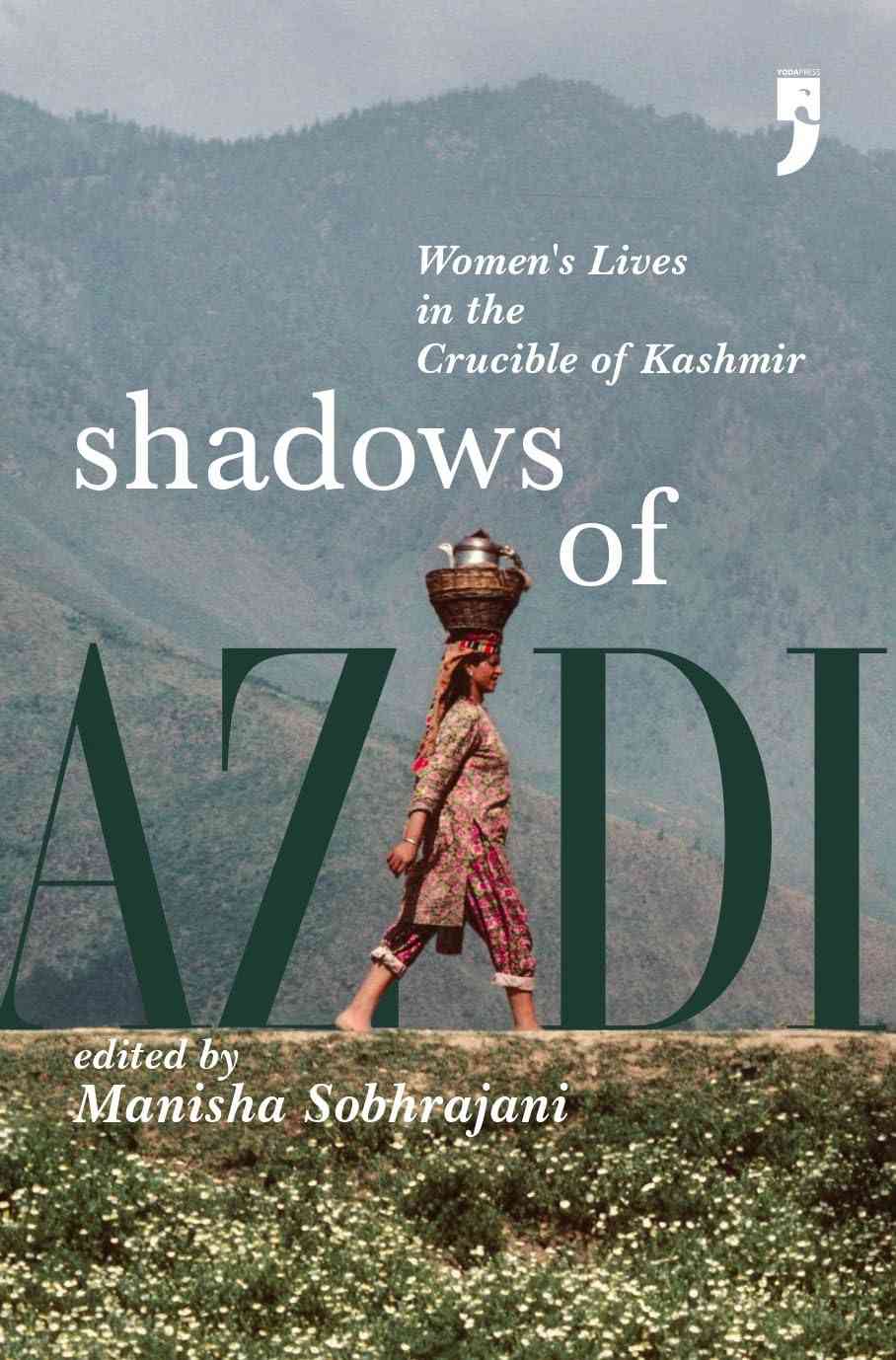
Excerpted with permission from ‘The Controversy of Azadi’ by Indu Kilam in Shadows of Azadi: Women’s Life in the Crucible of Kashmir, edited by Manisha Sobhrajani, Yoda Press.
