

The book was Rajan’s constant companion over the next few weeks. He would wake up with the book by his side. He read it through the day after Lakshmi had left for school, putting it down only when he heard her voice in the evening. And after she slept, the book was again in his hands.
Rajan was a tall man with a good physique, but sloth and alcohol had left their mark on a once-athletic body. As the mind grew keen again, the body strove to keep pace. It started with a walk in the morning and then another in the evening with Lakshmi through the temple.
The temple was large, faced east with several entrances, each with a gopuram on top. One entered into a long passageway flanked by tall pillars, which opened into a courtyard built around the temple pond. The same pond that was believed to have given moksha to devotees over the centuries. On one side of the courtyard lay a sacred grove, while on the other was a shrine dedicated to the very unusual female guardian deity of the temple. She was a fierce guardian, and most hurried past her with a quick bowed head and a salutation. Beyond that lay the garbha griha.
Rajan always felt a brief frisson pass through him as he stood in the sanctum. Like a receptor vibrating to a different resonance. Then, Lakshmi and he visited the other shrines in the temple, some with hundreds of stories associated with them, while others were merely statues on a pillar smeared with vermillion and turmeric, with a small mud diya lit in front. The whole walk would take a little more than an hour and always left Rajan feeling lighter than when he entered.
Back home, he and Lakshmi sat down for their evening meal and spent time hesitantly getting acquainted before Lakshmi went to bed.
Then the book came out, and Rajan sat at his father’s desk poring over it.
It was long – about a foot or so – made of several hardened palm leaves with holes along one end, tied together with a string. The cover itself was made of aged wood covered with what had once been a painting but was now merely some daubs of fading paint.
The book had twelve chapters. The first was essentially verses from the Isha Upanishad, saying that liberation lies not in rejection of the world, but in seeing the eternal presence within everything. One of the verses that Lakshmi loved hearing her grandfather sing was
Om Purnamadah Purnamidam Purnat Purnamudachyate Purnasya Purnamadaya Purnameva Vashishyate Om Shanti, Shanti, Shanti
(Brahman, or the Divine, is complete; the material world is complete. From completeness or fullness comes fullness, and when fullness is taken away from fullness, only fullness remains. Peace. Peace. Peace.)
The second chapter was a bhashyam, or an explanation, of the first, and spoke of the nature of the world – how it was knit together with the Universal Soul and how all souls were connected – and of dharma – acting in consonance with your being and the being of the world, in the full understanding that the same divine pervaded all. The next two chapters explained how balance was maintained when all walked the path of dharma and what would happen if people behaved in an adharmic way. The fifth chapter explained the three social conditions that would act as harbingers of the breakdown of the world – the drivers of the disease, as it were. The next chapter described in detail the physical signs that would ensue when the world tipped into imbalance; it spoke of specific changes in land, air and water – of frozen forests burning, of rains changing, of ice turning to water, of flooding and famine – and contained a couplet from the sage Sattaimuni that was Rajan’s favourite verse in the book, which linked the external changes to what happened within one’s body.
Andatthil ullathe pindam, Pindatthil ullathe andam Andamum pindamum ondre Arinthuthaan paarkkum pothe
(What is in the universe, exists within us. What is within us, is reflected in the universe. We must realize that they are both one.)
The chapter suggested that the working of the body mirrored that of the universe. When balance was maintained in the body and the mind, the universe remained balanced, but when the body/mind became imbalanced – consumed by greed or distorted by fear, for example – the universe tipped into imbalance. When the universe tipped into imbalance, calamity followed, just as when the doshas were out of whack, disease ensued.
Rajan’s father had spoken about this to Rajan many times. “We are not hapless bystanders, Raju, remember that. As within, so without. An ocean in a drop, and the drop becomes the ocean.”
The seventh chapter described the temples Rajan’s family visited on pilgrimage. Rajan clearly remembered how he and his father had visited each of them after Rajan’s upanayana, in a pattern that had remained constant over the centuries.
The eighth chapter was written in code, placing a test that ensured only a few could understand the special signs. The key from the eighth opened up the last chapters that explained what the reader could do to prepare.
Rajan leaned back and let out a breath he wasn’t aware he had been holding. Seeing those verses, written centuries ago, spelling out how shifts in social order were really harbingers of an approaching Armageddon shook him to the core. He felt the bottle beckon. The burning in the throat. He clenched his hands, trying to will that thought, that yearning away. And then he heard his father’s voice in his mind, “As within, so without. We are not hapless bystanders.’
‘What are you doing, Appa?’
Lakshmi’s voice broke into Rajan’s reverie, startling him. The child had woken up and found her father missing. She had seen a light burning in her grandfather’s study and followed it to find her father sitting at his father’s desk with an old book. He looked as if the world were about to end.
“What? Nothing…”
“You’ve never lied to me, Appa. What’s that book? Where is it from? I’ve never seen it.”
Rajan stared at his daughter. Doubts chased one another like rats in his head. Finally, he said, “It’s a book that has been passed down for generations in our family.”
“Why haven’t I seen it before?” asked Lakshmi.
“It’s part of a tradition where the boys learn of it after their upanayana at fifteen,” he said gently.
Lakshmi’s face fell. “Oh.”
Rajan looked at his daughter again and made his decision.
“You’re not fifteen yet. But we can start studying it together.”
Lakshmi beamed.
“What is it about?”
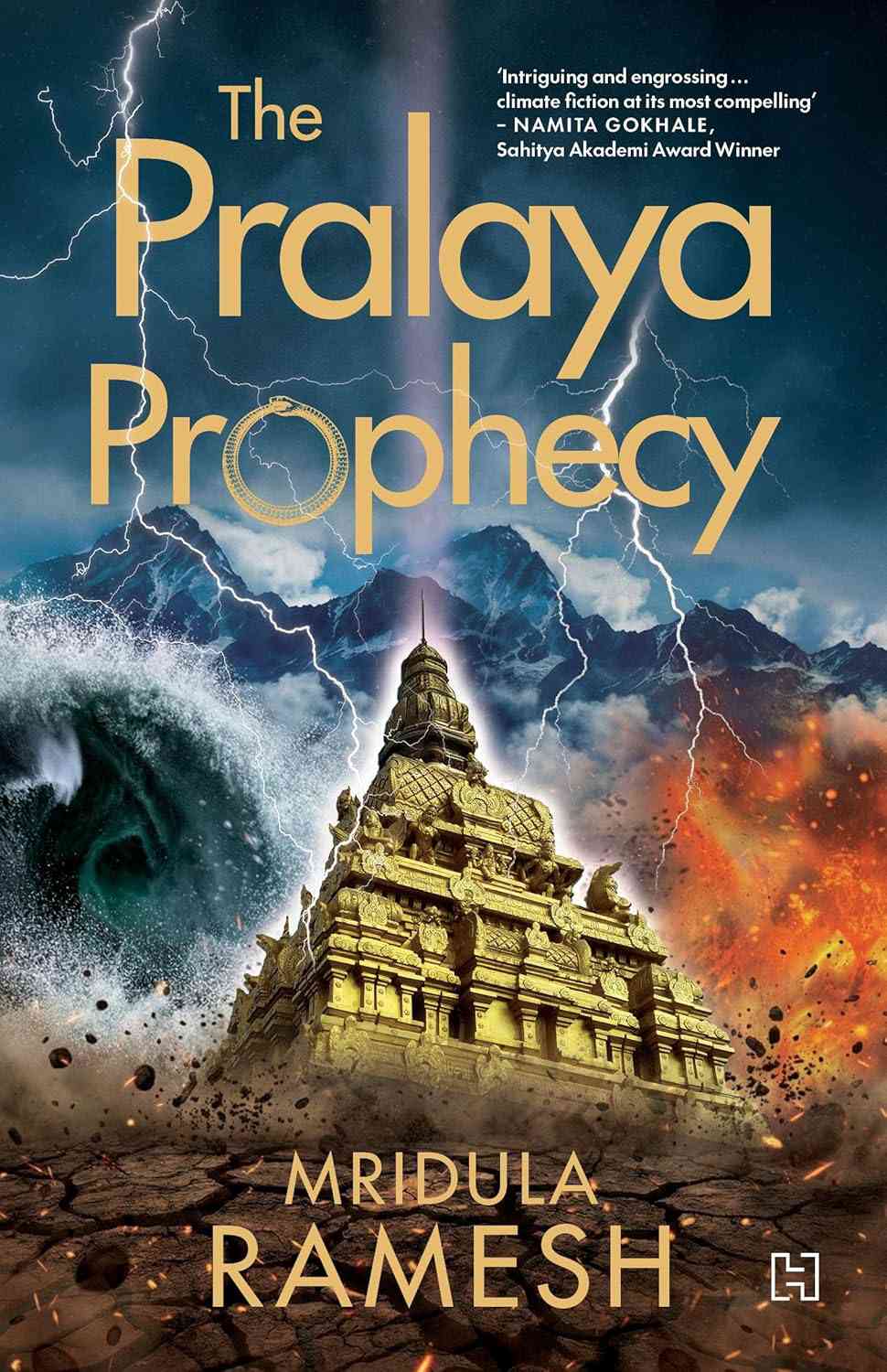
Excerpted with permission from The Pralaya Prophecy, Mridula Ramesh, Hachette India.
