









“Ei, listen. We will only use one torch, one only,” he says. I switch mine off, and someone else puts off her cell phone light. We are walking on a sandy path now, inside the tunnel of darkness, and there is forest on both sides. Our eyes blink. There isn’t enough light to see ahead of us. Nikhil halts. There’s something he is looking at. The single torchlight pools on the ground, the very edge of the pool touching a small black shape that’s moving. Nikhil is fully alert. “No one will step forward,” he hisses. He takes a tiny step ahead. “That’s an Asian palm civet,” he whispers. “And it’s gnawing at the base of the amaltas tree.” We look again. The animal is indeed gnawing at the tree, and it doesn’t seem to mind us.
It raises its neck, its tail like a plume behind it, its movements as graceful as an otter in the water. It has the fuzzy cuteness all small mammals have – the face is like a raccoon’s, the body like a well-set mongoose, the tail swishing and thick like a Madagascan lemur’s. In the greyscale of darkness, it also seems only half-real. Its colour appears predominantly dark. We can make out a clever, masked face and little paws. Civets are able to run on the ground as well as to dart vertically up trees. They have an enviable lack of effort in their bodies. We are looking at a piece of night snatched into a streamlined shape that can cut through tunnels of darkness.
Civets, often colloquially called civet cats (though they are not cats; they may appear catlike in their grace and tree-climbing ability), are nocturnal. The night is a pall, and people don’t like being blindfolded. Perhaps that is why creatures of the night have various superstitions tied to them—be it owls, hyenas or civets. Unlike the rumours about civets – that they are bad omens which dig up graves – they are sleek, harmless mammals that eat a wide variety of things – scavenged dead animals, plants, and as it now appears, amaltas bark. The monsoon has just ended. The air is sultry. Most of the amaltas have finished flowering. People may have lost interest in the tree once its stunning golden blossoms drop. But the tree is irresistible to the civets.
Nikhil is watching, transfixed. “I always stop near this tree. You know, it’s a favourite for the civets. So I have to stop too.” In other Indian forests, I have seen trees gouged by claws of much larger predators – confident two-foot-long marks made by tigers who don’t have to fear a bigger predator, wicked scratches made by leopards with knife-like claws, and zig-zag marks left by the nails of sloth bears, like a game of noughts and crosses. Here, a much smaller animal – the size of a week-old tiger cub – has marked a favoured Indian tree. Somehow, this leaves a deeper impression on me than the tiger did. Perhaps it’s because I didn’t expect to see it in Sanjay Van. Perhaps because it is breaking the taboo of the darkness. The tunnel is widening, the night falling away: it is still dark, but the dark is full of dazzling things. It seems standing in a wood in almost-complete darkness, rainwater fresh on the sand below my feet, soaked in sweat and a desperation to shrug off my fear, I can feel the wild all around me more intensely.
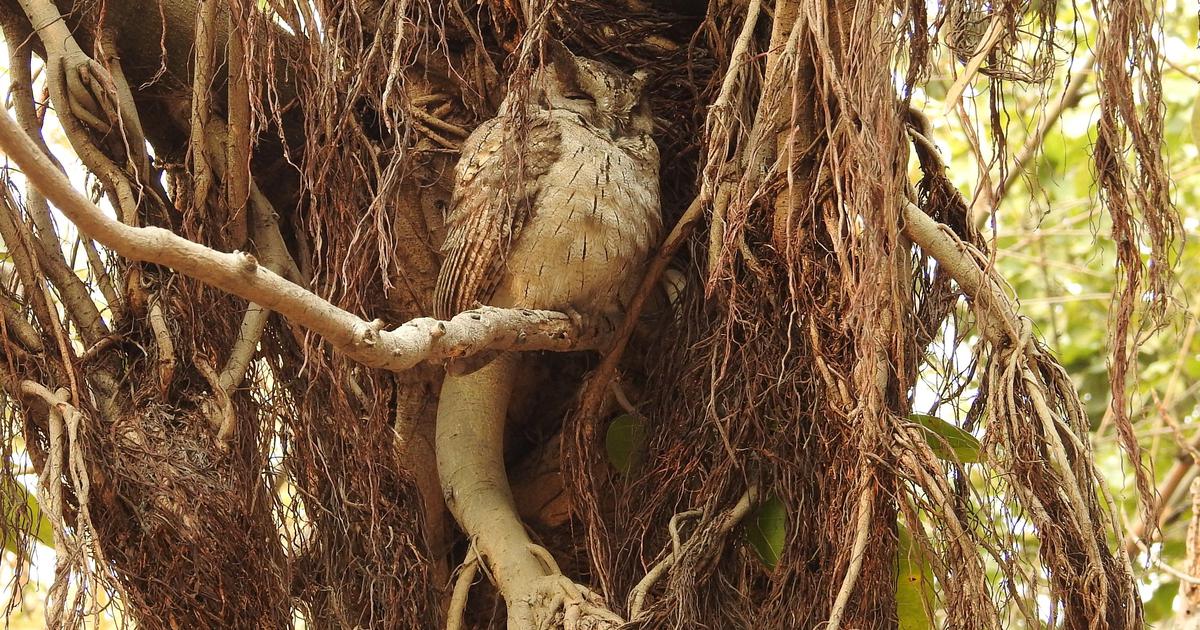
It is uncomfortable, and it is cleansing. We walk forward. A call knocks on the dark. It rises higher, kicking down the door, no longer asking. It is unmusical and onomatopoeic: not a sound but a screech. It is a Spotted owlet calling from a tree. Like the Scops, this too seems to be a declaration, an announcement that there are animals all around us, and they are awake. This is one more torchlight in the dark. I exhale; I am no longer scared.

The world has narrowed to shades of black and grey, plentiful in their variety. Our senses are sharper now; the world becoming clearer as our eyes adjust, ears pricked like that of a wild animal’s. Something loosens in my chest. I can feel the group shedding its urban skin of apathy and numbness, learning to be a little more animal.
There is a very light drizzle coming down, almost like a sodden mist. We are free now, part of this place, our toes dug deliciously in the metaphoric sand. There is a feeling of abandon in moving ahead without being able to see each other well, a freedom which would not have been possible in the studio blaze of sunlight.
What looks like a pile of boulders emerges on the left. These are actually vestiges of the Aravallis. A papdi tree explodes from between the rocks, gigantic, marking itself not just at the spot, but also the inside of my head, like a flagstaff. The path ends in a T-point after this flagstaff, and we take a left. A little ahead of us is Delhi’s oldest fort, Lal Kot. The Tomar kings made this many centuries ago. Now, it is an irrevocable part of the forest. We amble up a gentle slope, going up both rock and worn-down built structures. Now we are on Lal Kot. There is something on a tree close by, giving off a gentle light. It’s the dusky light of feathers, of fur, of fine, closely compacted things. Like a moth wing at twilight, or an owl’s wing at gloaming. It is in fact a Spotted owlet, sitting perfectly still on its tree. Its eyes are trained on something, something far far away, and I know it is looking at what is far beyond our senses. “Two dark, serendipitous orbs gazed down at me, riveting in their serenity,” writes Aasheesh Pittie, on the eyes of the Mottled wood owl in his book, The Living Air.
On top of Lal Kot, a small wind nudges us. The rain has stopped. Nikhil tells me the fauna changes here. “It’s drier here. This is the forest’s highest point. And, it’s a hidden world,” he says with excitement. “The fort is mimicking a rock face, you see. We will find bugs and other animals that we don’t find down in the forest.” Nikhil has seen geckos, nightjars and Delhi’s smallest frog, the Microhyla nilphamariensis, here.
We stand there, some of us sitting, watching the ground. In the horizon, there is a faint, smudged line where the forest ends: light from buildings, the city line. Moths emerge around us. The Spotted owlet, which has moved away, must be having a great time snapping them up. In the daytime, the space around Lal Kot has Grey hornbills flying low. There is also a Sirkeer malkoha that lives here, a large bird with a yellow-tipped red beak so vivid that it’s also called a lipstick bird. The lipstick bird is a resident of Delhi, but it is so shy, most people consider it a visitor.
The night feels completely unknown because none of the familiar birds and animals are here. The hornbills are resting, the Sirkeer has retreated. Instead, we spot something on the ground, near our feet. It’s large and confident, and it is moving. The insect is black, and irrepressibly chic. It has six large white spots on a burnished body which is the hue of a cracked-open amaltas pod. This is the Sixspotted ground beetle, Anthia sexguttata. It has fearsome mouth parts and will spray you with formic acid if you get too close. It moves at a pace that is quick, scurrying, purposeful. It covers a foot in a few seconds. This isn’t a lot for a person, but is a high speed for insects – a high count of body lengths per second. In Greek, anthia means “tyrant”; the rest of the name refers to its six bold spots.
Some beetle eyes change between conditions of light and dark; in the dark, the spaces between eye cells get larger for clearer vision. I look at the large, compound eyes of the Six-spotted beetle on Lal Kot. For a second, I feel he is looking at us with all his eyes.
Excerpted with permission from Wild Capital: Discovering Nature in Delhi, Neha Sinha, HarperCollins India.
