











In her latest book, The Sky Husband, Easterine Kire explores the life of the Naga community through stories that meander through myth, history, and modern life, often silting its banks with the tension of what was, what remains, and what ends. This tension is the soil where identity germinates, often countering the “mainstream” gaze that turns the “periphery” into a seedless husk, lacking nuance.
Reflecting on everyday life, this collection of eight short stories ponders on the most ordinary affair of life – love – while exploring the varied issues that make and unmake the community.
At first glance, a book named “The Sky Husband”, dedicated to “girl readers”, feels like a stereotype. This dedicatory note, reminding of such practice among colonial Indian women writers aiming to awaken the “new woman”, is intended for that group of women who, standing at the threshold of childhood and womanhood, often feel confused about their lives. Kire, visualising love through community myth, history, social and cultural motifs, wants girls to think of love as a possibility, not as vulnerability, as they jostle with expectations from life and the world, both of which can be tremendously harsh.
The many forms of love
In an unnamed, timeless village live three women – Hami, Mimi and Aniya. They get entangled with the mythical Sky Husband, a popular lore of the North East that recounts the marriage of Sedi, the earth, and Melo, the sky. For Aniya, whom Hami has taught to believe in dreams, the Sky Husband is real enough to reject all other suitors. Although Aniya’s persistence worries her mother, Mimi does not force Aniya to marry against her will, despite realising the consequences of such a dream. While allowing the daughter to choose, the mother’s heart worries about losing her daughter to such an unusual union. But when the Sky Husband finally does appear, Aniya’s happiness dispels Mimi’s misgivings. While Mimi typifies every mother’s anxiety for her daughter, Aniya becomes Kire’s cue to inspire her girl readers to believe in the impossible.
For Kire, villages and forests are spaces where faith is intimately experienced, especially through community practices that interweave human and non-human lives. However, such spaces must constantly negotiate with modernity’s urge to eliminate what it cannot comprehend. This back-and-forth drives the story, “Chan and the Blue Forest”, where the narrator travels from Delhi to an unknown Manipuri village to meet Chan, who has a forest-spirit bride. Sitting by the hearth, Noni learns about Chan’s more-than-human bride, the village community’s ordeal as hunters who get lost in the enchanted Blue Forest, and then, after a month, about Chan’s return to his forest bride. Noni grows numb when she realises that Chan’s story would be treated as nothing more than an exotic hearth tale from the North East for readers in the mainland.
Not just myths, periodic wars also dot Nagaland’s history, from which emerge stories of strength. Following a twin-tale structure, Kire’s next two stories are set in wartime – the Indo-Naga war of 1960, which culminated in Nagaland’s statehood, and the Second World War, when Japanese armies forcefully occupied villages in the state, disturbing their peaceful lives.
“The Tracker” centres around Ashi, who has joined the Naga Army training camps, to train herself in guerrilla warfare. Here she discovers her fine sense of smell which makes her the tracker of her outfit, a talent that amazes all men, especially Tuyo, who is struck by her extraordinariness. When the war ends, life returns to normal, and Tuyo forgets about Ashi’s remarkable gift. He realises his neglect as they trek towards their leader, Dukho’s, village for his last rites, almost travelling back in time that vitalised their relationship.
In “Cherry Blossoms in April”, the Japanese lieutenant, Akio and the Naga village girl, Sanuo, meet and fall in love when Akio’s platoon arrives at Sanuo’s village. Despite being pulled into a meaningless war, the Japanese encounter impacted Naga youths in many ways, which narratives of violence often elude. This love story in times of war shows how life inexplicably follows its course despite disruption. Sanuo and Akio part, and he is killed in the trenches. But their dream lives on in Akio’s sketch of Sanuo sitting under a cherry tree. Overturning the convenient perception of the North East as ravaged by insurgency, Kire chooses to tell the softer, everyday tales of the strength of a community that has endured and evolved despite it.
The potential of the mundane
Moving from war to modern lives, we meet Bani and Liam in two separate tales as they try to overcome social-cultural inhibitions to stay together. In the tea gardens of Assam, where the elites still carry the colonial cultural legacy, Liam, the young assistant manager, and Bani, Aunt Nina’s niece, whom she is tutoring into ladyhood, meet only to be separated following a misunderstanding. Years later, when they meet again, Bani and Liam, despite their changed circumstances, decide to give their forgotten love a chance.
In the twin story, Liam and Bani separate as young playmates when Bani’s brother, Shane, is accidentally killed by a bullet, and Liam is accused by Bani’s father. As youngsters, they meet in Shillong, fall in love, but receive vehement opposition from Bani’s father. Bani takes the initiative to untie knots, clear misunderstandings, and reconcile families, so that love becomes a blessing that unites, not mere resistance that isolates.
The last two stories are dedicated to faith. In “ Shambulee”, the creator in indigenous faith is the Christian God here, surrendering to whom defines ultimate love, thus evoking the interweaving of faith and indigenisation of Christianity in the North East, which Kire has also explored in the story “Son of the Thundercloud”. Here she follows Shula’s journey from dilemma to her evolution as the “Shulamite” (the biblical figure depicting pure love; also King Solomon’s beloved) who exclaims- Dodili va’anilo (My beloved is mine, and I am his).
Perfect love stories depict enduring love that goes beyond worldly limits and can only be created by the creator, like that of Uncle Ben and Aunt Nima, who remain bound to each other even in death.
Kire employs ordinariness to counter the expectation for the exotic that the indigenous communities of the North East are often burdened with. Blending cultural anecdotes, myths, and local history with the universal theme of love, Kire insists on telling these quiet stories which remind us of the enduring charm of the mundane, especially in a world that has surrendered to the spectacle of the extraordinary.
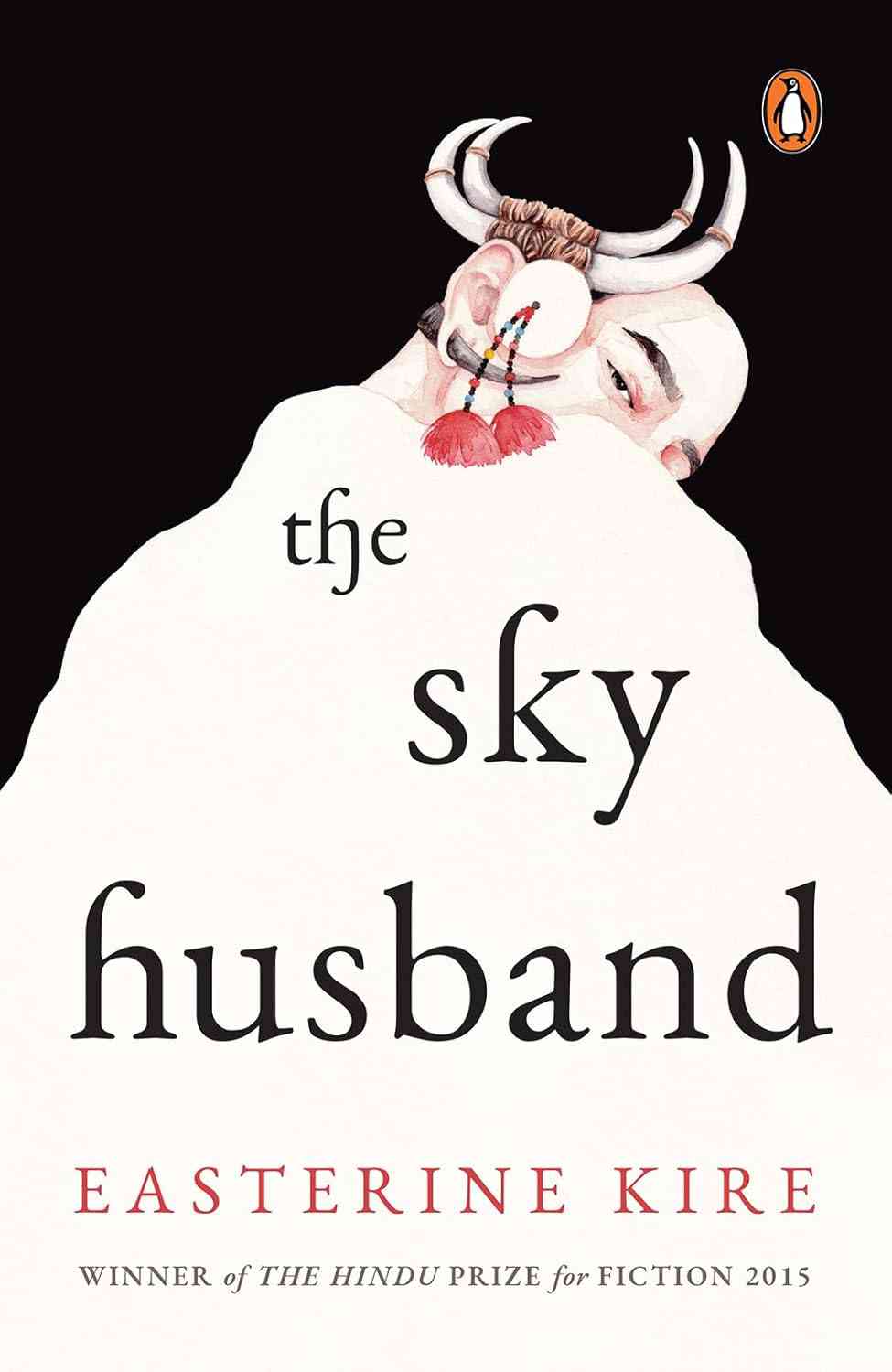
The Sky Husband, Easterine Kire, Penguin India.
