







January 09, 2004. My husband CP reached the hospital early in the morning. So did my dad. One of the interns approached me. “Doctor wants to know if we can record the birth. We’ve never had a quadruplet delivery before this.”
“I don’t mind even if you call the watchman in. Just give me my babies safely.”
That’s when I realised that the operation theatre was full: medical students, interns and resident doctors. Something like the first day, first show of a Rajinikanth movie. The doctor walked in and gave everyone an icy look. Miraculously, the room cleared of more than half its occupants.
Three anaesthetists were present. The procedure was explained to me. When I woke up, I was a mother! I clamoured to see the babies, cleaned myself up as best as I could and was wheeled to the NICU. Sister Lalee, the nurse in charge, let me in. She gently took away the eye pencil I had been clutching in my hand. Just one dot, I begged. She smiled and gave it back to me. As I entered the NICU, the overpowering smell of Sterillium hit me – a smell that, to this day, makes my throat close and brings back memories of my newborn babies.
Sister Lalee took me to one section of the NICU and waved her hand.
“Sangeetha, all the babies in this room are yours.”
I could hear the incessant hum and ticking of the monitors.
“Where is the fourth baby?” I asked.
She pointed to a large incubator with a tiny baby inside, hooked to a ventilator. The kindest thing I could say about the baby was that he looked somewhat like a baby. His face was lined with wrinkles, his head was enormous and his body tiny. So, this was Krishna. My first reaction was one of unmitigated alarm: how am I going to raise this child?
The babies had been named Quadruplet 1, Quadruplet 2, Quadruplet 3 and Quadruplet 4. CP was allowed to bring his camera inside and record the babies. All of us were smiling, laughing, happy. We would not experience this bliss for another decade at least.
Within a few hours, I got my first summons to the NICU. I was encouraged to become physically active after eight and a half months of complete dormancy, and this was when I began going through the strangest of experiences. As long as the babies had been inside me, we had been one unit. Once they came out, I felt bereft. This feeling lasted for at least the first three years of motherhood. Was this postpartum depression? I don’t know.
The feeling of sadness and abandonment persisted. The doctors no longer asked me how I felt. The nurses at the NICU were worried about the babies and would constantly badger me. Not a single person came to examine me. No family member enquired about me. Everyone asked only about the babies. The barefoot trudges to the NICU every two hours, repeated urinary infections because of the catheter, a terrible burning sensation all the time, the overwhelming anxiety for Krishna and the laborious feeding of the babies overwhelmed me.
I stopped talking to CP, my parents, my sister and other relatives. This clamp-on communication went on to the extent that CP asked me, ‘Sangeetha, do you regret the babies?’
The worry and anxiety for Krishna was indescribable. Within two days of his birth, we were told that his renal system had not formed properly and he was not breathing on his own. The girls were drinking ten millilitres of milk every two hours. Krishna was on two drops of milk every two hours, given to him through an ink dropper. I was not allowed to even touch him, but I was taught how to carry the girls securely. Since I had worked with hundreds of newborn puppies, this was no different and I displayed a dexterity that impressed the nurses.
On the sixth day, it was planned that Krishna would be taken off the ventilator. Since I was camping out in the NICU, I got all the inside information by shamelessly eavesdropping when my babies were being discussed. That morning, I strategically positioned myself inside the NICU, but the doctors were having none of it. I was escorted outside and asked to wait, accompanied by a gentle ‘Don’t worry, we will call you.’
The weaning off the ventilator went smoothly, but Krishna did not put on weight over the next few days.
We were told that the babies would be handed over to us one by one, week by week, to help me get used to taking care of them. The head of the NICU had an exacting protocol for looking after babies. She encouraged me to breastfeed but was compassionate enough to realise that it was tough with four babies. However, I dared not try bottle feeding the babies; it was something she was militantly against. I was taught to patiently feed them formula milk through a tiny contraption called a bondula. Pour milk into the bondula and use it to pour the milk into the waiting mouth of the baby, from the side.
The head of NICU was the warrior goddess for the babies. She kept me on my toes. I demonstrated bundling, unbundling, sponging and cleaning before the first baby was handed over to me at the ward. My eight months’ stay at the hospital had created a comfort level in conversing with medical professionals, which would stay with me forever.
The night before we were to receive the first baby, CP got permission for me to accompany him for some shopping. We went to Crawford Market and bought baby mattresses. Red. Blue. Pink. Yellow. Packets and packets of nappies. A ton of white sheets. A ton of napkins. Armfuls of tiny baby clothes.
As CP drove me back to the hospital, my sense of fatigue reached a feverish pitch. I waved bye to him and painfully made my way to the ward. My whole body was burning and consumed by pain. I had never felt so helpless in my life. And then, I got a call from the NICU to feed the babies.
The nurses took one look at me and took me inside a small anteroom. They told me that the pain was because I had not fed my babies for more than five hours, and taught me how to express milk. They were so kind to me that I wept.
The next morning was a happy one. Quadruplet 3, Lakshmi, was delivered to me in my cubicle in the general ward. The nurses at the NICU had nicknames for all four babies.
Lakshmi had been nicknamed Tomato, for her impressive decibel level and her bright red face. I would leave her with the ayah every two hours and go back to the NICU for the other babies. Day three saw the entry of Quadruplet 1, Jayashree, nicknamed Butterfly for her delicate looks. With a stuck-out lower lip that would wobble when she cried, she was a peaceful baby.
I began to feel the pinch of pressure. Two babies in the ward with me, two in the NICU.
Day five. The nurses at the NICU obviously thought I was ready to cope and handed over Quadruplet 2, Jayanthi. From day one, Jayanthi would snuggle onto my shoulder or sleep with her face down in the pillow and her bum high up in the air, all with a smile on her face and a palpable gentleness. This is what got her the nickname Squirrel. Our hopes of Quadruplet 4, Krishna, being handed over to us were growing dimmer and dimmer. The first week passed, then the second, third, fourth, fifth, sixth … we soldiered on. CP would make his granite-faced, back-breaking trips between home in Andheri East, work in Lower Parel, and Bombay Hospital for me. He would see his parents every day, take care of them, see me every day, get me things I needed, take umpteen calls from me on different things related to the babies.
Krishna was finally handed over to us fifty-four days after his birth. There had been fifty-three days of waiting for this boy who had held our entire family in thrall. Fifty-three days of calling the NICU from the general ward intercom at 2.30 in the morning because I knew that was when the nurses began weighing the babies, only to be told, “No, Sangeetha, he has not put on any weight.” 53 days of shedding silent tears, waiting for my son to grow. 53 days of watching and holding his tiny hands as doctors drew blood for umpteen tests, watching his face grow black with terror as the needle sank in. 53 days of the doctors telling me, “We’ve never seen a mother as tough as you.”
We were due to go home the next day. I asked the doctors about scheduling a sterilisation operation to prevent any future pregnancy.
“Just keep your babies alive for two years and show them to us. People go home with two babies and come back with one because something went wrong. You are taking home four underweight babies.”
Before we could take the children home, the NICU doctors called us in for a meeting.
“On your way home, please stop at Dr Parikh’s clinic to get a check-up for Krishna’s heart, and then Nanavati Hospital for his brain.”
“But,” we protested, “let us go home together. We will take him to these doctors tomorrow.”
“No” was the inflexible answer. “He cannot take two journeys. You must do this in a single trip.”
So CP sent our daughters home with a woman colleague, while the two of us escorted Krishna out of Bombay Hospital. We were given an emotional farewell by the matron and nurses of the general ward, the NICU staff, who felt proprietary towards the babies, and even the security guards at the gate.
We left for Dr Parikh’s clinic with a dauntingly tiny Krishna. After getting a clean chit, we moved to Nanavati Hospital.
“His brain is fine; he is an Einstein. Don’t worry about him.”
With hearts singing with joy and relief, the three of us made our way home.
Amma took the aarti and called us in.
The next tumultuous phase of our lives was about to begin.
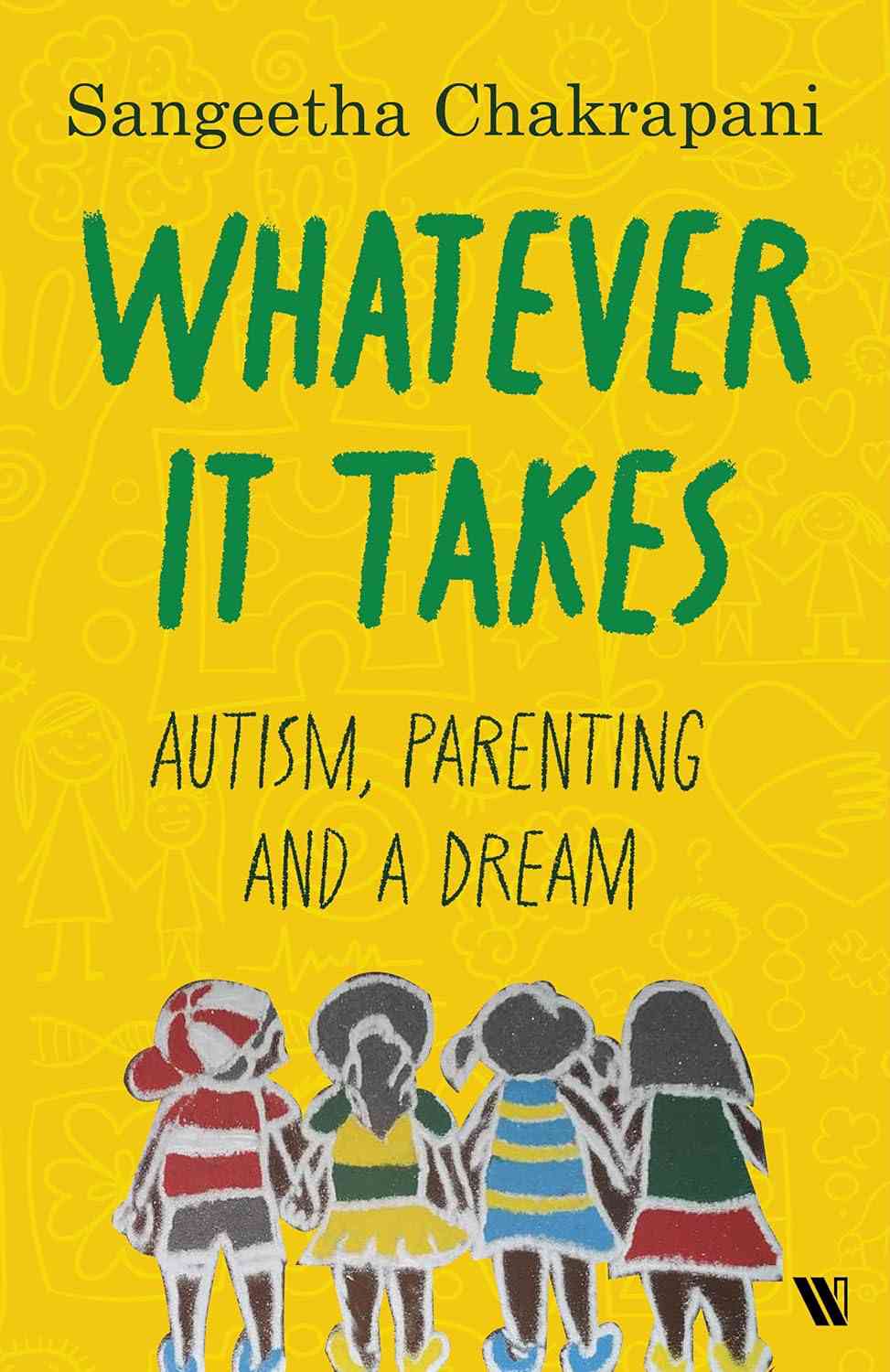
Excerpted with permission from Whatever It Takes: Autism, Parenting and a Dream, Sangeetha Chakrapani, Westland.
