





I would read Homosexual Intifada: A Queer Palestinian Anthology simply for its editor George Abraham’s moving and strangely hopeful “Introduction’, though of course there is much more in the book to recommend it. Abraham places the anthology squarely in its historical context: “We are writing from within the dying days of western empire and racial capital.” And, thus, they note, “the times are brutal”, permitting for the first time in recorded history, among other things, “a live-streamed genocide which is an abominable failure of humanity and dangerous precedent to set for the (failing) international order.”
But if this is dark, as it should be, for the world has become darker than perhaps the days of my youth, there is also hope in Abraham’s words. For instance when they quote a friend telling them of “Southern US-based, homophobic, transphobic Palestinian parents” who are finally beginning to unlearn their prejudices in the light of the remarkable queer solidarity with the Palestinian cause: “These queer siblings in the heart of empire are more our kin than any of these Khalijis, who could stop this genocide with a snap of a finger.”
Queer solidarity
Queer solidarity with the Palestinian cause has been remarkable: it has taken place despite the political homophobia of Hamas and the social and religious homophobia of most traditional societies, including Palestinian and Arab ones. It has sustained attacks by the far right and even anti-Palestinian liberals, who have scoffed at it. Yet it has persevered on the grounds of not allowing warmongers in the West and elsewhere to use Hamas’s troublesome relationship with queerness to “justify” a genocide, an attempt made repeatedly in the West and by Israel. The stories, essays and poems in this anthology provide an insight into this solidarity, as well as an appreciation of the resilience and complexity of Palestinian queer communities.
The first story, “The Fisherwoman”, starts with queering the act of storytelling: “Biiitch, let me tell you this fisherwoman story. Now, in the old days, these types of stories were told by women only, or mainly by women. When a man told them, he was considered niswanji, someone who preferred the company of women. An F-slur, honey.” I will skip the engrossing convolutions of the parable, but it ends with a topical message: “The story I just told you is an old-ass Palestinian folktale that was passed down from illiterate woman to illiterate woman until it reached me and you. Meanwhile, white people are sitting around talking about Humpty Dumpty sitting on a wall. All the king’s horses and all the king’s men will never put Humpty together again. That bitch is broken. And they will never ever break us…”
The next piece, a scholarly essay by Noor Aldayeh, offers an introduction to Arab Lesbianism that Nadin Nader’s TED Talk “Arab Feminism is Not an Oxymoron”, which it refers to, does in a different context. It particularly engages with the Western media’s portrayal, often sensationalist, of homophobia in Southwest Asia and North Africa, noting that such narratives not only erase the lived presence of queer and trans folks in those regions, but also evade the “state of homo/transphobia in the West.” It is a thoughtful engagement with the matter, highlighting both the past of binarism in gender and sexuality as originating in the West, particularly Victorian-era England, and the use of “pinkwashing” as a propaganda tool by Israel.
The contributors approach the double precarity of being queer and Palestinian in different ways and from different angles. The overarching purpose is the Palestinian queer experience rather than just “art” or “literature”, though there is still a great deal of variety in formal terms too. In “Palestinian Dreaming,” Elias Jahshan engages with loss and hope through a collocation and interpretation of dreams, while “Procreating in the Time of Genocide,” by co-editor Hannah Moushabeck, is a sensitive and complex exploration of childbearing and motherhood by a large queer woman – “My local fertility clinic doesn’t in ‘good conscience’ help people of my size get pregnant”. Then the speculative fiction story, “Legacy”, by Eman Abdelhadi takes us into a future where Palestine is free and peaceful, but a Palestinian mother and legendary leftist activist-ideologue has decided to stay on in Chicago, now in a US riven by civil war, because “none of us is free until all of us are free.”
Waiting for the dawn
In their essay “To Be. Dead. Queer. Trans. Palestinian,” Mx Yaffa starts with the statement, “My aunt died two days ago on the 20th of May 2025”, and goes on to engage with the bleak reality surrounding that statement: “To be a trans Palestinian is to be killed without anyone noticing, even other trans Palestinians. I say this with the frustration of knowing dozens of queer and trans Palestinians killed in Gaza, while the vast majority of queer and trans Palestinians I know in diaspora or occupied Palestine know none.”
In the poem, “Phone Call”, Maria writes: “I speak to you of temporalities / as if I ever witnessed a dawn / that I could ever call my own.” And Al Maqdidi’s photo essay, “Body and Space”, based on a photography project of the same title from 2023 to 2025, often gives us desolate landscapes and broken buildings, sometimes framing a naked body, shown from the back, curled into the foetal position.
Through essays, stories, poems, photos and art of this timely anthology, there runs the painful realisation that one freedom cannot be cancelled with or for another freedom. One needs to fight for both – and all – freedoms at the same time. As the last panel of the graphic page by artist Bint Bandora puts it, “We exist here and we exist there. Always. Everywhere. From the river to the sea, we will be queer in a Palestine that’s free.” Or as Eman Abdelhadi puts it in their poem, “Organize! Organize! Organize! / We can only win together! / Collective liberation!”, and appends the nagging doubt, “Do I believe me?”
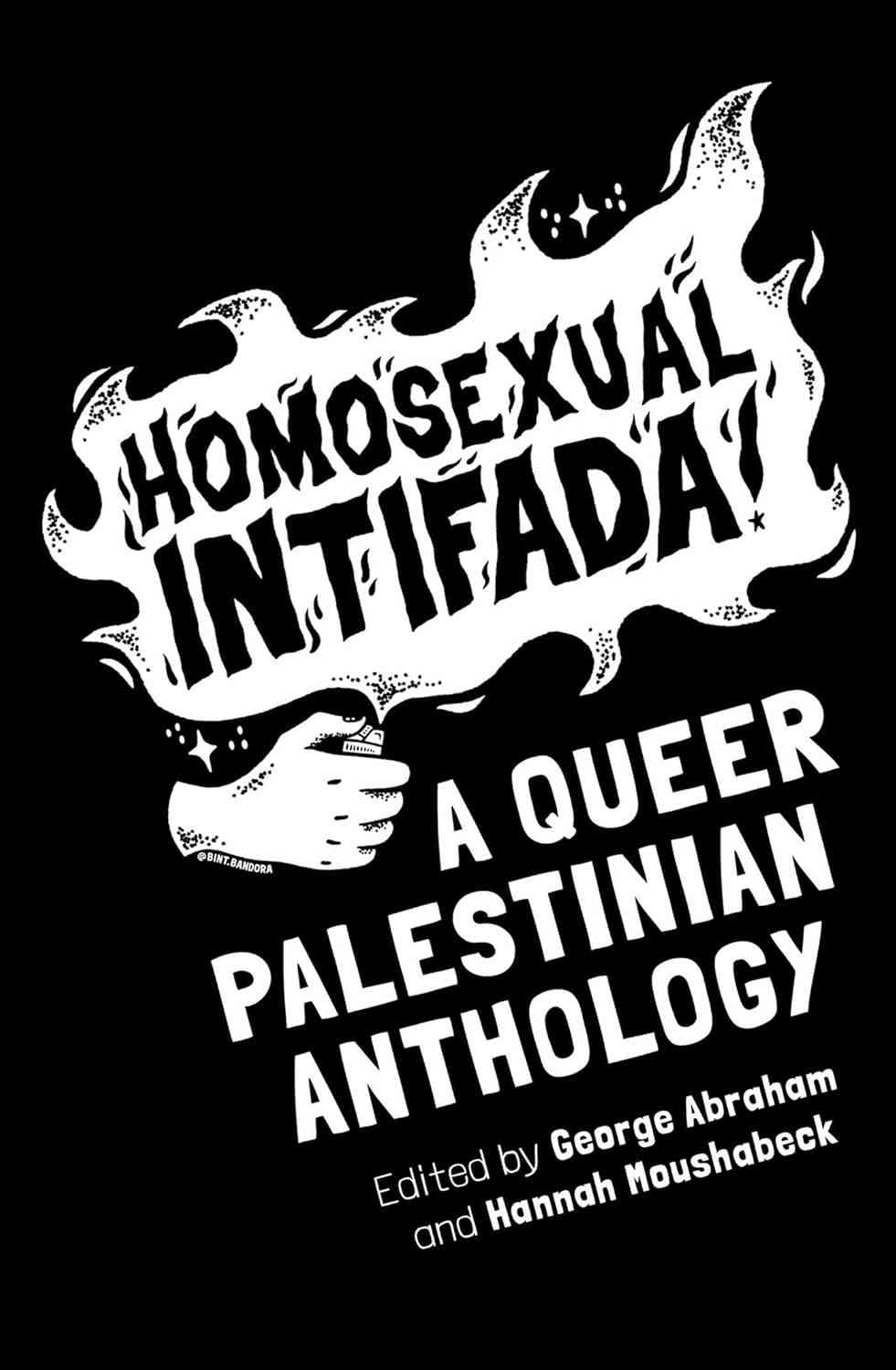
Homosexual Intifada: A Queer Palestinian Anthology, edited by George Abraham and Hannah Moushabeck, Interlink Books.
