






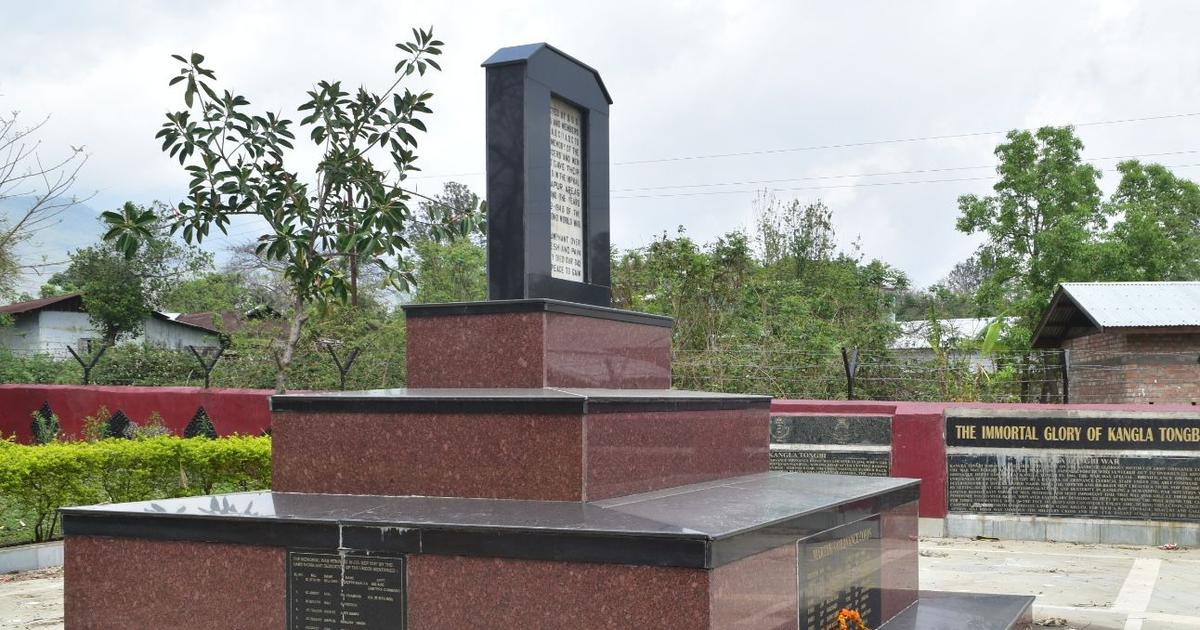
The battle at Kanglatongbi in 1944 was critical in defending the Imphal–Kohima road. After the Japanese 15th Division’s 60th Regiment captured a British supply dump, ordnance personnel fought a fierce action on the night of April 6–7, repulsing Japanese attackers with Bren gun fire. The 63rd Brigade held the sector until the Fifth Indian Division took over in early May, gradually clearing Japanese positions through repeated small-scale actions. Forces from Kohima and Imphal finally linked up at Milestone 109 on June 22, ending the siege. The stand at Kanglatongbi bought crucial time for reinforcements and helped turn the tide of the campaign.
The war in Manipur was not only one of swift advances or bold maneuvers, but also a test of holding one’s ground, of enduring violence and suffering over seemingly endless days and nights. I had arrived as an observer, a hastily commissioned and unprepared Captain, and I soon found myself in the thick of battle.
War changes its actors forever. Instead of the conscientious yet carefree broadcaster I had been, I became something entirely different that I couldn’t recognize. I was not quite a warrior but a man of war, and a brother to the steadfast band who labored without complaint, whether it was fighting, hauling, and manning equipment, clearing roads, managing animals, preparing food, or tending to the wounded and dying.
Among this new family, I began to see that heroism was no more or less than the slow, persistent courage of ordinary men doing their duty in impossible conditions. The victories along the way were measured not only in territory regained but in our refusal to yield. As one ridge or command post gave way and another loomed, there were stories still to come, of silent night ambushes, mules threading impossible roads, officers and medics braving floods and fire alike, and men who turned every small act of duty into a testament of courage. The battles ahead would be won by the quiet bravery of ordinary, hardworking people whose feats remain largely unsung.
Kanglatongbi was a small and otherwise obscure village on the Imphal–Kohima road north of Imphal. It became a key battleground when General Mutaguchi’s 15th Army, specifically the 15th Division under Yamauchi, attacked it in their advance southwards. By early April 1944, General Mutaguchi’s pincers had been closing. The 31st Division reached Kohima on April 4, beginning a siege. Their 15th and 33rd Divisions pressed into the Shenam–Palel sector around Imphal.
At Kanglatongbi, on April 6–7, Allied personnel from the 221 Advance Ordnance Depot, lightly armed but supported by infantry and engineers, repelled repeated enemy assaults with rifles, grenades, and improvised defences. They evacuated or destroyed vital ammunition, keeping the road open.
The troops I encountered were already battle-weary, as they had been fighting all over for weeks. The 17th Indian Division, called the Black Cats due to their badges, had just finished retreating from March 13 to April 4 from their forward position at Tiddim in Burma. It was a gruelling journey of over 120 miles through mountainous terrain north to the Imphal Plain, all the while facing almost continuous attacks from the Japanese 33rd Division. Their trials went unsung, but brought to my mind Xenophon’s Anabasis.
Thirty-five miles to the north, the Battle of Sangshak had raged for a whole week in late March. The 50th Indian Parachute Brigade, including the 152nd Indian and 153rd Gurkha Parachute Battalions, and supported by the 4/5th Mahratta Light Infantry, held an isolated hill against the Japanese 31st Division. Outnumbered and surrounded, they managed to resist for six days, losing as many as 585 men.
Yet even after these harrowing physical and emotional experiences, our soldiers behaved normally. Their movements were businesslike, adjusting wheels, scraping mud off the rifles, lifting stretchers, and, when not too late, diving into bunkers. Around them the fighting was now everywhere, in ditches, under tarps, beside mule trains, among ration tins, and behind mess tents. The uniforms were stained and torn and many of the freshers looked lost, for they were on their first campaign and without adequate training for the terrain. Some of the men were not conventional soldiers but porters, drivers, clerks, and mule handlers. And some were using their rifles for the first time in action.
Improvisation was common, based on the Indian approach of jugaad. A sepoy rewired a truck’s ignition using a metal spoon. Punctures were fixed with slices of worn rubber boots. Shiny ration tins were used to signal landing sites for airdrops. Spent shell casings were used to carry salt, and leftover grease from the kitchen was used to power lamps.
Most of the time people somehow carried on based on courage and common sense. A mule handler guided his animals under fire with quiet murmurs and a stick. I saw a Pathan carry his wounded brother without calling for help. Another soldier dragged a box of mortar shells up a near-vertical incline. There was weariness, and a sense that work needed to get done, and done very carefully and with wisdom. As our Tamil Tirukkural teaches us, true valour lies in restraint born of fearlessness; without it, fearlessness becomes recklessness. I learned a great deal about valour from watching the ordinary labours of our fellow men, as well as their feats of daring.
One evening, I met Sepoy James Elliah, a Madrasi from Visakhapatnam. Dust-caked, his rifle slung low, he offered me a cheroot. He told me about the night several weeks earlier when his unit, where he was serving as a bearer, received orders to evacuate the Kanglatongbi depot. They moved 150 tons of rations, mortar shells, and ammunition by hand under darkness and in complete silence. Once finished, they blasted the bunkers. The Japanese arrived shortly after.
That night, Elliah slept in a trench, pistol wrapped in a filthy sandbag. He snored, keeping me awake, but it was a peaceful sound that rose and fell with an occasional shudder, as if some of the trauma of the day was finally being relieved by the balm of sleep. The war was filled with such small moments, intimate, absurd, often terrifying. But the larger currents moved relentlessly on.
Before the Japanese arrived, an obvious Allied option was to cross the Chindwin and attack the enemy first. Another choice was to hold the Japanese off in the Tiddim region in the Chin Hills to the southwest of Imphal and fight them when they tried to traverse the Chindwin. But in both cases the British would be hampered by the poor lines of communication behind them and the fact that they would be vastly outnumbered.
Slim embodied yet another principle that our ancestors taught us in the Kural: Let decisions come only after deep, repeated thinking. He instead chose to concentrate the 4th Corps in the Imphal plain and fight the enemy on ground of our own choosing. To the Japanese, it looked like yet another Allied retreat, but it was a trap.
Accordingly, the 17th Indian Division or Black Cats, led by Major-General D. T. “Punch” Cowan, guarded the approach from Tiddim in the southwest, though they had to retreat. Major-General Douglas Gracey’s 20th Indian Division oversaw the Kabaw Valley to the east. The 23rd Indian Division under Major-General Ouvry Roberts was based at Ukhrul to the northeast, where the relentless momentum of the Japanese advance was compared by a senior British officer to a colony of ants on the move.
The battles I witnessed were attritional. Hills and ridges changed hands repeatedly. There was firing but also hand-to-hand fighting, at which both Gurkhas and Japanese excelled. The Gurkhas used their kukris for quick chops at the neck or slashing off a raised enemy arm. The Japanese stuck to their bayonets, aiming for direct piercing of the heart or liver. Injuries were often fatal.
The units fought with little rest. The 5th and 7th Indian Divisions held key positions. The Black Cats retreated under pressure from Tiddim, covering 120 miles, mostly on foot. They returned lean and fatigued, but still cohesive. General Slim re-equipped them and sent them back into the field. I often saw him on the frontline, occupied with logistics details and plans.
General Slim was not from the upper classes, and unlike the British officers serving under him, had not been to any of the famous British boarding schools. Being a former commander of a close-knit Gurkha battalion, his concern for his men led to admiration, and some indeed called him Uncle Bill.
Our ranks were linguistically diverse. Orders were translated in real-time, and miscommunication was common. Patrols advanced through thickets. Signalmen repaired communications under fire. Artillery units operated in terrain hostile to heavy equipment. Roads ended mid-slope. Men pulled the heavy guns forward by rope. Mules, many of them American-bred, carried the rest. I heard a handler trying out foreign-sounding commands on the mules, just for a joke.3 We all knew that what mattered most was tone: harsh orders with occasional kindnesses were understood well by both serving animals and men.
Though the Japanese Zeroes enjoyed strafing us, the skies were mostly under British RAF control. Air-dropped supplies from our C-47s rarely landed where intended. Parachutes caught in trees or drifted into ravines, though many were quickly recovered.
The ground was a different story. The jungle threats were quiet, for mines lay carefully concealed beneath leaves, waiting patiently for a single careless step. Knowing that enemy snipers could easily blend into the foliage, we advanced carefully with a peculiar prowling gait. Our bayonets and grenades saw more use than rifles, and for hand-to-hand combat, the soldiers used whatever was at hand. The Gurkhas of course had their kukris, and some of the Sikhs carried kirpans; others made do with bayonets and knives. Razor blades were favored by some of the Scottish streetfighter regiments, who kept the blades ensconced in a potato in their pockets.
The Brits called the INA soldiers Jiffs, meaning Japanese-Indian 5th Column. They were sent in early by the Japanese, and deserted from time to time, in increasing numbers once the fight grew worse.
Their behavior was in marked contrast to the Japanese, who at this stage were extremely disciplined and efficient. At times, the Japanese even called out to us in Urdu, hoping to confuse our lines, but their accents always gave them away. They did manage to capture our men, and the outcome was usually bad. After seizing one of their camps, our soldiers found a mess cook with his eyes gouged out.
Other prisoners had been bayoneted.5 I will not dwell on Japanese atrocities here as they have been described at length elsewhere, but suffice it to say, their cruelty knew no limits, driven by blind obedience to their Emperor. Still, we held to our own code of conduct with our prisoners, most of the time.
General Slim made it a point to visit the men in their trenches. He asked sappers what tools they needed. He stood beside us, noting who was exhausted and who had gone without sleep, and ordered rest and rotations. He was a good man and was friendly during my interviews. It was a sad fact that a few British men who really cared about us sometimes didn’t seem enough. Yet we fought together as one team.
The Indians on our side were not fighting to save the Empire. Many were volunteers, and had joined to support their families. Once inside, they fought for each other, for their fellow men in the trenches and the nullahs.
I fought with them, for a nation not yet born in freedom. I knew that it was destiny and even karma that had brought us to the battlefield. To stand our ground, to hold the line for what might still become, felt like the highest calling. And my own duty was to report on the truth.
Excerpted with permission from Captain Mani’s War, PRS Mani, edited by Inderjeet Mani, Juggernaut.
