









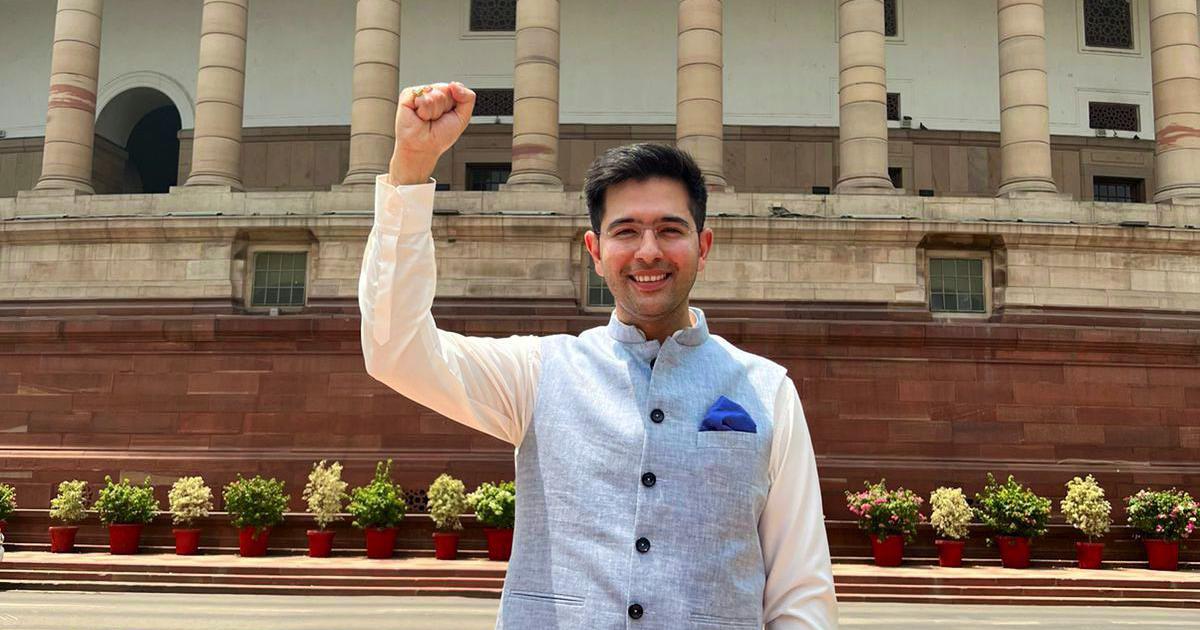
Aam Aadmi Party leader Sanjay Singh on Sunday submitted a petition to the Rajya Sabha Chairperson seeking the disqualification of seven of the party’s 10 MPs in the Upper House who had on Friday announced their merger with the Bharatiya Janata Party.
Singh claimed the seven MPs, led by Raghav Chadha, have violated anti-defection provisions.
The AAP petition will be the most consequential test in two decades of the Tenth Schedule of the Constitution, which lays out the disqualification of legislators and parliamentarians on the grounds of defection.
The Rajya Sabha chairperson faces interlocking issues. A Constitution Bench of the Supreme Court has, in its 2023 ruling on the split in the Shiv Sena, already supplied most of the guidance – mainly, that two-thirds of the members joining another party must also be supported by what is happening in the parent party outside the House.
However, India’s constitutional law has landed in a strange place: a single member who votes against the party whip risks losing their seat, but a group from a party doing the same thing together can avoid any consequences if two-thirds of them in the legislature do so and call it a “merger”.
In effect, what is punished when done alone is permitted when done collectively.
The merger exception under Paragraph 4 of the Tenth Schedule is what allows the wholesale claim. The Rajya Sabha chairperson’s task is to now decide whether the merger claim is genuine or manufactured.
जिस पार्टी ने चुनकर आपको संसद में भेजा, उस पार्टी को छोड़कर दूसरी पार्टी में जाना लोकतंत्र और देश के संविधान के साथ धोखा है। ऐसे सांसदों की सदस्यता रद्द होनी चाहिए।
— AAP (@AamAadmiParty) April 26, 2026
— @SanjayAzadSln जी, राज्यसभा सांसद, AAP pic.twitter.com/cXXwonWDyB
The ‘two-thirds’ requirement
In this case, the first question the chairperson will have to answer is what Paragraph 4(2) demands. The clause states that a merger of the original political party shall be deemed to have taken place if two-thirds of the legislature party agrees.
Read in isolation, the two-thirds figure looks sufficient on its own: gather the numbers and the merger follows.
The Bombay High Court adopted this reading in the 2022 case of Girish Chodankar, where 10 of 15 Goa Congress MLAs had crossed over to the BJP in 2019. The High Court read two sub-clauses of Paragraph 4 disjunctively, or separately, holding that a two-thirds vote of the legislature party was, by itself, enough.
In 2025, it applied the same reasoning to a fresh set of facts, when eight Congress MLAs in the new Goa Assembly crossed over to the BJP in 2022. A Special Leave Petition against the 2025 ruling is pending before the Supreme Court.
The Constitution Bench of the Supreme Court in Subhash Desai vs Principal Secretary (2023) read the clause differently in the case that arose when Eknath Shinde led a faction of Shiv Sena MLAs out of the Uddhav Thackeray-led government and into a BJP-backed coalition.
Strictly speaking, Paragraph 4 was not the issue the court had been asked to decide. The central questions concerned the speaker’s powers and the governor’s role in calling a floor test in the Maharashtra assembly to determine which group had a majority.
The pronouncements of the Supreme Court bench on the merger exception are persuasive observations rather than binding. But since they come from a five-judge bench, they are the most authoritative reading of the clause Indian law currently has.
The two-thirds among legislators, the bench said, is a qualifying condition; the merger must originate in the political party. Reading “political party” to mean “legislature party” would render the Tenth Schedule unworkable, because the entire defection regime is built on the distinction between the two.
To collapse them would be to “sever the figurative umbilical cord”, as the Supreme Court ruling noted, that connects the legislator to the organisation that nominated, financed and elected them.
In the AAP case, therefore, the chairperson of the Rajya Sabha confronts a real choice: on the one hand is the text of Paragraph 4(2) and the Bombay High Court stance, and on the other are the observations of the Supreme Court’s Constitution bench.
The first is not yet wrong and the second is not yet binding. But everything else points the same way as the second.
The AAP-to-BJP merger in the Rajya Sabha faces an obvious problem: the national organisation of the AAP has not merged with the BJP. Its president has publicly disowned the move. The seven Rajya Sabha members cannot constitute the party for the purpose of effecting its absorption into a rival.
The ‘real’ party
The presumption that the legislative-majority test settles factional disputes is not new.
In 1972, the Supreme Court in the Sadiq Ali vs Election Commission of India case approved the Election Commission’s use of numerical strength as the decisive marker of which group was the “real” Congress when the party split in 1969 between Indira Gandhi’s faction and the “Syndicate” led by S Nijalingappa.
The Sadiq Ali case was decided 13 years before the Tenth Schedule existed. Its logic has, for 50 years, shaped how Indian politics understands defection.
In 2023, the Subhash Desai ruling on the split in the Shiv Sena case set limits on the precedent established by the Sadiq Ali case up until then.
When legislators are themselves facing disqualification, the court said, the legislative-majority test is diluted, because the legislators whose conduct is being examined are themselves part of the count being relied upon. To let their numerical strength settle the question would be to let the alleged defectors vote on whether they have defected.
The chairperson of the House, the Supreme Court said, must not base his decision on which faction commands a majority. This is “not a game of numbers, but something more”, said the court. The structure of leadership outside the legislature, the constitution of the party and the rules under which it organises itself are what he must look to.
This has a direct implication for the Rajya Sabha chairperson. The numerical fact that seven of 10 AAP MPs have walked out is, by the standards laid out in the Subhash Desai ruling, the wrong place to begin.
An asymmetry
When a single member wishes to give up their seat, Article 101(3)(b) of the Constitution insists on three things: that the member does so in writing, that they do so before a named officer, and that the Chairperson is satisfied that the resignation is voluntary and genuine.
In a looser reading, Paragraph 4 of the Tenth Schedule permits the collective reassignment of two-thirds of a party’s mandates with no such inquiry. The chairperson who must examine the authenticity of one resignation needs, in the AAP case, only to count seven heads.
Bringing down governments
The Anti-Defection Law was enacted in 1985 to prevent legislators from toppling governments by crossing the floor. The Rajya Sabha cannot topple a government. It plays no role in confidence motions, does not elect the prime minister, and does not sustain the ruling coalition’s working majority.
But the mischief the statute was designed to address does not exist in the Rajya House, which the seven AAP parliamentarians are members of. What does exist, and what the statute now stands to permit, is that the state whose Assembly elected these MPs on one party’s symbol will, for the remainder of those terms, find itself represented by the very party it had defeated at home.
In the 2006 Kuldip Nayar case, the Supreme Court held that the integrity of an MLA’s vote in a Rajya Sabha election was weighty enough to justify abandoning the secret ballot. Twenty years later, the Rajya Sabha chairperson is a constitutional official in a position to give effect to that ruling in view of post-election conduct.
The AAP’s disqualification petition has now placed these questions before the Rajya Sabha chairperson. The pending Supreme Court appeal in the Girish Chodankar case, on the two-thirds of the members being allowed to cross over being a sufficient requirement, will eventually settle the question for good.
Until it does, the Tenth Schedule will continue to do what it now does best: punish the retail act of conscience and bless the wholesale act of departure.
The author is a lawyer and a postgraduate from NALSAR University of Law with a specialisation in Public Law. His dissertation focused on the anti-defection law.
