








Karan Mahajan’s latest novel, The Complex, presents a sticky, claustrophobic world where personal ambition and filial mistrust are always at loggerheads. The glue that binds the Chopra family together is the dead SP Chopra, a “great man”, who was among independent India’s first statesmen. SP’s political legacy is formidable, and despite his foundational role in the creation of the new nation, his nine children have struggled to replicate his success. Cramped in A-19 Modern Colony in Delhi, the family jostles for space and privacy, as each of them remains emotionally distant.
The crisscrossed Chopras
The plot primarily revolves around Gita and Sachin (SP’s grandson and granddaughter-in-law who migrate to the US right after marriage), Sachin’s uncle, Laxman, and his wife Archana, and Sachin’s brother Brij and his wife Karishma. Vibha, Laxman’s sister, divorced young and a widow from her second marriage, tries in vain to pull the crisscrossed strings of the family and establish herself as the family matriarch in her father’s absence. The Chopras, now financially diminished, are proud of their legacy and their privileged upbringing has them convinced that they are meant for great things.
The novel spans a period from the 1970s to the early 1990s – the in-between years when India was finding its footing before it liberalised its economy. Gita and Sachin try to settle down in the US but Gita’s heart is in India and Sachin is overlooked at work. Meanwhile, in Delhi, Laxman is bored with his bobby pin manufacturing business and wants to shake things up but the conservative economy has been of no help to his entrepreneurial ambitions. Tight on funds and ideas, Laxman convinces a traditional healer, Mohan Pahalwan, to sell his recipes for balms to Laxman to manufacture them at an industrial scale and sell them to medical shops. A “medicos” enterprise.
The first section, told from Gita’s perspective, gets off to a clumsy start. The reader is as much an outsider at this point as Gita, who left for the US not long after her marriage. She’s flustered by Laxman’s uncouth, overbearing ways but had not anticipated that he’d assault her in the family home. Much of the section understandably revolves around the incident, creating a deep distrust in Gita about her in-laws. Despite being the opening act, it is not compelling enough to hook the reader in – some sentences were so off-putting that it was hard to believe they made the final draft. The clunkiness bears down on what could’ve been a really sleek novella in itself about a young couple’s life abroad, shocks, surprises, and all.
The second section pivots to Laxman. The reader follows this strange, brutish man as he sets up a business and starts an affair with Karishma, his niece-in-law. The relationship, which was initially only about sex, blooms into love but neither is at liberty to truly be themselves. Karishma’s husband, Brij, is quick to anger while Laxman’s wife Archana pretends to know nothing of her husband’s mischiefs. The four of them go together into the balm business, rubbing dangerously close. For all his tall talk of bravado, Laxman cowers meekly in SP’s shadow. He wonders how the great SP might react to his enterprise.
A looming cloud of boredom hovers over Laxman. Almost everything he does is, in part, an attempt to stave off boredom. He takes over the Jeev Sangathani, a modern sect of idol-free worship, established by his father, and instead uses the temple as a secret meeting place for Karishma and him. Never particularly religious, he fashions himself as a devout Hindu and a jilted member of the upper caste when Hindutva politics start to take hold and protests erupt against the caste-based reservation of the Mandal Commission. Karishma’s elder son, Mohit, joins the protest, wading into the murky depths of student politics.
It is then, in these turbulent times, that Laxman feels the pulse of the nation – sick with hatred for its minorities. Having anticipated that secular politics would soon be out of fashion, Laxman joins the right-wing Trishul People’s Party and conceives the idea of a nation-wide rath yatra that would culminate at the Babri Masjid. The rest, as we know, is history.
The missed opportunities
The Complex joins a growing pile of novels that, though readable, do not create a lasting impression. The years running up to the 1992 Babri Masjid demolition are best handled with a light touch in fiction. This, I found lacking. The rath yatra shapes up behind the scenes and we’re told Laxman plays a crucial role in it, though the reader is not privy to how Laxman mobilised support. The event takes place almost exclusively in public; its effects on the Chopra clan are barely felt. It is only Gita who is horrified by the power that Laxman has accumulated.
For a man who has orchestrated the movement, this single outburst of reaction feels insufficient in adequately portraying the family’s collective ideological shift. Nevertheless, it is telling that right-wing fanaticism finds the perfect host in a morally bankrupt bully. The Mandal Commission protests, on the other hand, ripple through the family, toppling the carefully constructed hierarchy. SP, who, despite his personal feelings, fought for a free and equal India, is challenged directly by his son and grandson, who disregard the Constitution.
The complex, A-19 Modern Colony, the novel’s spatial and emotional anchor, does not shape up to be a pivotal character despite lending its name to the title. This is a missed opportunity – the house does not evoke the sentiments that it could have, its own unhappiness a clue to the larger maladies of the nation. The brief views into Gita and Sachin’s quarters or Laxman and Archana’s cramped rooms are too microscopic to imagine the engineering of a grand, sprawling complex.
The Complex, at 400 pages, is an uneven reading experience; the highs spread too far apart for the reader to form any real bond with the characters or their stories. The writing, too, is surprisingly plain for a novelist who has proven his skills – in this novel of considerable length, it is a pity to not find a sentence that could move a reader with its beauty.
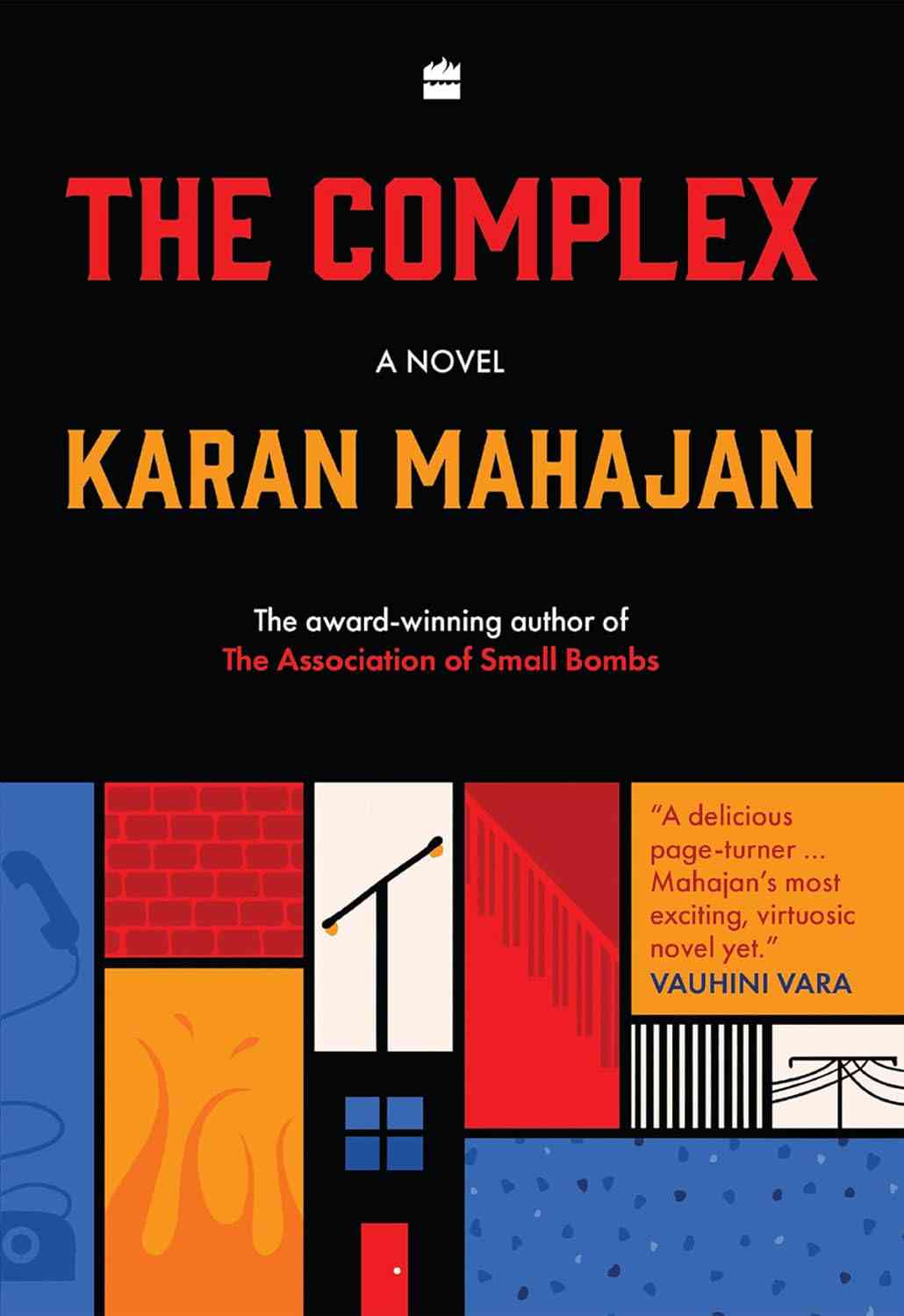
The Complex, Karan Mahajan, HarperCollins India.
