












While Scandinavian countries have increasingly come to resemble other European nations in their domestic and foreign policies, they have also been able to successfully capitalise on aspects of their history and culture that convey positive images of Nordicness to global audiences. Some of this can be characterised as “nation-branding” or “region-branding”, a form of deliberate soft power projection aimed at attracting consumer and investor interest. However, only a small portion of this activity is deliberate. Arguably, everyone has a brand – whether they are aware of it or not – and the Nordic brand has been very successful, even without conscious strategic promotion.
Nordic cultural exports are deeply intertwined with features specifically associated with the Nordic countries. These include their peripheral – and therefore exotic – geographical location, their “untouched” nature, their unique history and culture, and more. In hindsight, the 20th century’s decades of innovative domestic politics and multifaceted internationalism probably prepared Scandinavian countries particularly well for the role of major cultural exporters. Their appeal is drawn from their relatively low levels of military tension after the Second World War, a social model that is poised between socialism and capitalism, and the liberal, progressive and enlightened tone of Nordic societies. Scandinavian cultural exports are therefore easily associated with positive values such as peacefulness, egalitarianism, solidarity, gender equality and environmentalism. There are many examples, and this short chapter will mention only a few of them.
The Vikings remain a source of international fascination, and one of the most recognised tropes of Nordicness, familiar from forms of popular entertainment such as film and television, young-adult fiction, music and computer games. This fascination is not new. At the beginning of the 19th century, the pirates of the north came to symbolise a different, more primitive and raw form of Europeanness that appealed to European nations of Germanic origin who were looking for their own roots. For German composers such as Richard Wagner, who drew inspiration from early Germanic legends preserved in Icelandic poetry, and for Victorian British gentlemen translating Old Norse sagas into English, the Vikings were not a barbarian menace but provided a glimpse into an alternative and supposedly more genuine European past, untouched by Christianity. Similar attitudes to Vikings continue today – and not only in innocent ways, as is demonstrated by the appropriation of Norse imagery by much of the contemporary European far right.
A very different example of a successful Nordic cultural export is the Nobel Prizes – the pre-eminent global awards recognising achievement in many fields, hosted and awarded yearly by award committees in Sweden and Norway. Established by the Swedish 19th-century inventor Alfred Nobel, they have contributed to the success of many writers, public figures and scientists – not least Scandinavian ones, such as the Danish physicist Niels Bohr (1885–1962), who in the early 20th century made groundbreaking contributions to atomic structure and quantum theory. The Nobel Prizes’ reputation rests not only on longevity (they were established in the late 19th century), but also on the idea that peaceful innovation is something specifically Nordic. Nobel, the inventor of dynamite, accomplished a brilliant public relations move by funding, among other prizes, an international peace prize, which is awarded by the Norwegian Nobel Committee. But the peace prize would hardly be so prestigious if it weren’t for Scandinavia’s reputation for peacefulness and benevolent neutrality – whether justified or not – which most countries would find difficult to emulate. This reputation has also helped to sideline the question of why small circles of Swedish experts (and Norwegian experts, in the case of the peace prize) should have the right to decide who is worthy of receiving the most prestigious awards in the world.
Some Nordic cultural exports first saw success in the early to mid-20th century, and therefore have an even stronger association with Scandinavia’s progressive values. The children’s books of the Swedish author Astrid Lindgren (1907–2002) are a good example: relatively little known in the English-speaking world, with the exception of the Pippi Longstocking series, they have had a major, formative influence on generations of children across Northern, Eastern and Central Europe. In some ways a continuation of the earlier tradition of Swedish children’s literature established by authors such as Selma Lagerlöf (1858–1940) and Elsa Beskow (1874–1953), Lindgren’s books, including those about Pippi Longstocking and Emil of Lönneberga, were a breath of fresh air for a genre often characterised by stilted didacticism. Themes such as children’s rights, social and gender equality and compassion for the poor are woven into Lindgren’s stories through humour and adventure in a way that has appealed to readers far beyond Sweden. Of course, there are also other examples of successful Nordic children’s authors. One might mention, for instance, the famous Finnish writer Tove Jansson’s (1914–2001) stories about the Moomins, which often deal with rather dark topics such as loneliness, fear and survival in harsh natural conditions, but also convey soothing images of domesticity and family support in the face of uncertainty and danger.
Nordic architecture design is undoubtedly another 20th-century success. Globally recognisable, and having produced such renowned mid-century figures as Alvar Aalto (1898–1976), Arne Jacobsen (1902–71) and Hans Wegner (1914– 2007), it is characterised by simplicity and understatement, the use of natural materials and the maximisation of natural light whenever possible. Its mantra of functionality over aesthetics – which makes outward beauty but a component in an overall package promoting wellbeing and good quality of life – can be traced back to interwar-era experiments with rationalising Scandinavian domestic life, which continued after the Second World War. Democratised by international companies such as the famous furniture retailer IKEA, founded in 1943, Nordic design has had a far-reaching influence, as have closely related fields such as architecture and planning. Today, they also integrate modern Nordic values, such as sustainability and environmentalism.
The “New Nordic Food” culinary movement, originating in the early 2000s, is an example of a more recent, and hugely successful, Scandinavian cultural export that also emphasises simplicity and sustainability. It aims to anchor food preparation and consumption in the local environment and traditions, putting strong emphasis on seasonality and high-quality local ingredients. Many chefs and restaurants that have adopted these principles have gained global renown, and the movement has influenced other cuisines around the globe. However, the prominence of the New Nordic Food as a kind of ideology may create the misleading impression that most Scandinavians eat this way, which is of course not the case.
A perhaps somewhat unexpected cultural export has been crime literature, sometimes referred to as Nordic noir, which has spilt over into other media such as film and television. Although there were some early successes in the 1960s and 1970s, such as the Swedish authors Maj Sjöwall (1935– 2020) and Per Wahlöö’s (1926–75) novels about police detective Martin Beck, Nordic crime literature experienced a veritable boom in the 2000s and 2010s, making such writers as Henning Mankell (1948–2015), Stieg Larsson (1954–2004) and Jo Nesbø (1960–) world-famous. This might seem strange, given that 20th-century Scandinavia has been known for its historically low crime rates (Iceland’s are almost non-existent), a high perception of public safety, generous penal policies and generally lenient attitudes towards most types of crime. Perhaps it is exactly this lack of crime and overall feeling of safety that has helped to make fictional depictions of crime in the Nordic region all the more striking. Both domestic and international audiences have been fascinated by stories revealing possible cracks in the edifice of supposedly perfect Scandinavian societies, perhaps exposing dark forces hiding underneath. Writers have certainly met this demand. Nordic crime novels are known for their engagement with social problems and challenges, as well as the psychology and personal failings of their brilliant but often imperfect detective figures.
Finally, but certainly not least interestingly, we have self-help books and related genres that have tried to capture the specifically Scandinavian way of life, highlighting cultural stereotypes that supposedly express some intangible truth about what it really means to be Nordic. Perhaps the most promoted example of these has been hygge – a Danish or Norwegian concept expressing the idea of comfort, contentment and cosiness – which has been the subject of countless books, websites and merchandise. Sisu, the Finnish word for grit or resilience, is another well-known idea, and the Swedish term lagom, meaning something like “just right”, is another example. Whether there is, in fact, anything particularly unique or even untranslatable about these concepts remains open to debate, but the wish and readiness to look for a key to the Nordic way of life is in itself telling, and a testimony to the global cultural appeal of Scandinavia. Sometimes referred to as “Scandimania”, this international fascination with Scandinavia has changed over time, but at present it seems unlikely to abate, finding expression in a continuous stream of old and new images of Nordicness.
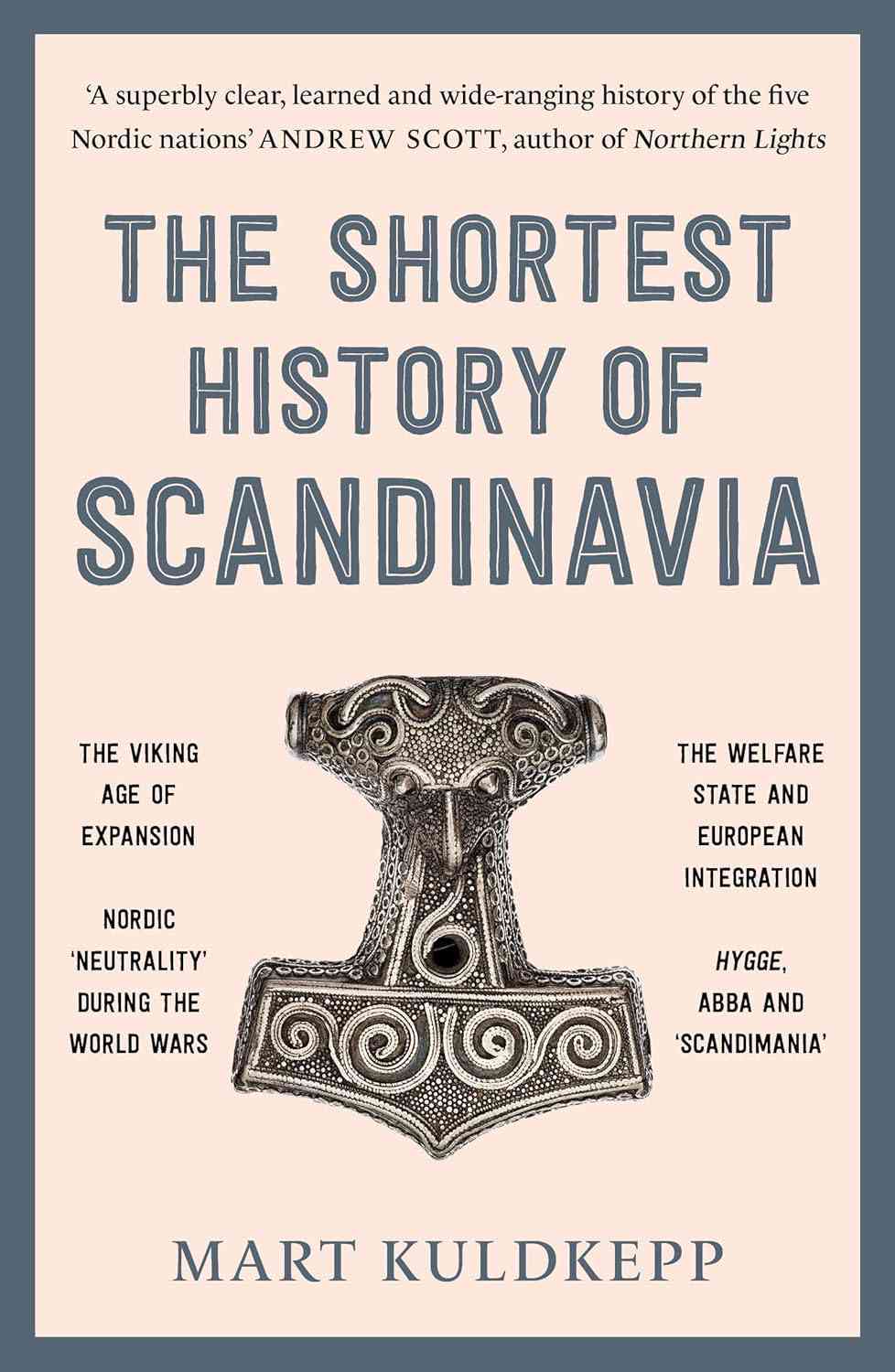
Excerpted with permission from The Shortest History of Scandinavia, Mart Kuldkepp, Pan Macmillan India.
