











In the English translation of Franz Kafka’s short story, Metamorphosis, published in 2007, Michel Hofmann translated the famous opening line (which included the German word “Ungeziefer”, generically meaning insect) in this manner: “When Gregor Samsa awoke one morning from troubled dreams, he found himself changed into a monstrous cockroach in his bed.”
The story is about a deep sense of alienation in the modern world where people have been reduced to cogs in the machine.
Kafka’s entomic tale looms large in the imagination this week as Abhijeet Dipke, a political strategist who once volunteered with the Aam Aadmi Party’s social media team, announced the launch of a satirical political movement called the Cockroach Janta Party.
The party’s name is a response to a remark by Chief Justice of India Surya Kant during a hearing earlier in May when he said some unemployed youths are like “cockroaches” and “parasites” who attack the “system”. They do this by using fake degrees to enter professions such as law and media, and deploy the Right to Information. Kant later claimed that he was misquoted.
CJI Surya Kant says there are "parasites" attacking the system.
— Live Law (@LiveLawIndia) May 15, 2026
"There are youngsters like cockroaches, who don't get any employment and don't have any place in the profession. Some of them become media, some of them become social media, some of them become RTI activists, some… pic.twitter.com/gwwOq8VcaK
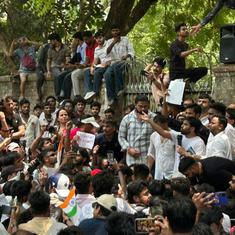
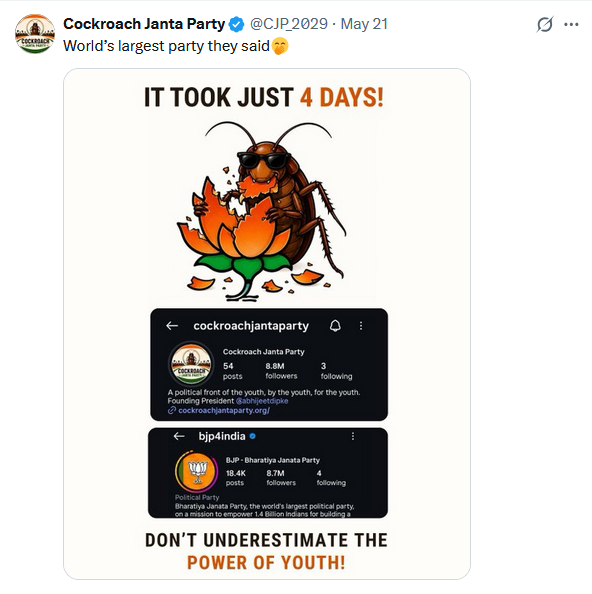
Within a week, the Cockroach Janta Party gathered 22 million followers on Instagram – more than the combined numbers of the Bharatiya Janata Party and the Congress – before its account was blocked. So too was its presence on X (formerly Twitter).
It wasn’t long before its website became unavailable. The Intelligence Bureau had warned that there were “national security concerns” about the social media handles, a senior government official told The Indian Express.
Dipke described the Cockroach Janta Party as secular, socialist and democratic – and said it was a party of the lazy. This inclusion in the founding principles is not surprising. Kafka’s Samsa, after he is transformed into an insect, rebels against the monotony of capitalist labour.
Samsa’s transformation can be read as a defense mechanism against the humdrum routine of modern work culture. By turning into a repulsive insect, he manages to get his family and society to leave him alone. Samsa recovers his right to be lazy.
Dipke’s assertion of an anti-work ethic also has resonances with anti-work anarchists such as David Graeber and John Zerzan, who have critiqued the soul-crushing nature of modern productivity. Graber coined the term “bullshit jobs” to describe unproductive labour and toxic work environments.
The poem Procrastination by Fernando Pessoa’s alter ego Álvaro de Campos is a quasi-Kafkaesque poem where the poet daydreams about work without actually doing anything. “Tomorrow I’ll start thinking about the day after tomorrow” writes Campos. It is an act of postponement, delaying the ordeal.
It would seem that for many unemployed youth, the hyper-productive world has caused mass psychological exhaustion.
The Cockroach Janta Party phenomenon has caused excitement and drawn critique from India’s left-liberals. Some have expressed concern that the movement has no political vision. They note that it is circumscribed by its origins – the digital platform has no real structure on the ground.
The Cockroach Janta Party is seen as a forum where subjective energies such as rage can thrive without ushering in any meaningful structural change. Not only is the angry-young-person phenomenon limited in scope, it could provoke negative energies.
The government has taken down our iconic website - https://t.co/l6i6Ry8h5S.
— Abhijeet Dipke (@abhijeet_dipke) May 23, 2026
10 Lakh cockroaches had signed up on our website has members.
6 Lakh cockroaches had signed a petition to demand the resignation of Dharmendra Pradhan.
Why is the government so scared of cockroaches?…
Some commentators have questioned the quick comparisons being made between the Cockroach Janta Party and the Gen Z uprisings in Bangladesh and Nepal. They say that it bears no resemblance on the ground with these movements.
That is unfair and simplistic. The novelty of these movements does not have to be measured by their failure or success in introducing possibilities of structural change. They often have a longer impact on social and cultural mores that is not immediately visible and decipherable.
Some reservations about the Cockroach Janta Party are grounded in conventional expectations and ideas of politics in an era that has defied convention. Some leftists have claimed that the people behind this parodical movement are drawn from a class that is too comfortable to actually be political anarchists.
However, the precarious nature of private sector employment and the prevalence of freelance economy, have created a diversified working class, particularly in urban areas. They resemble what the philosopher Jean-Paul Sartre called “fused groups”, a spontaneous, organic formation of people in response to a crisis.
In such cases, ideology is less important than purpose. Such movements are less defined by what they are, but what they stand against. The political objective they serve may not correspond logically with their core principles.
When political spaces for dissent have shrunk, and any language and act against the ruling order can be criminalised on flimsy grounds, politics can no longer be measured by conventional yardsticks. Political imagination is always born of constraining situations.
It would be harsh to judge the Cockroach Janta Party by its constraints. For now, what must be acknowledged is the novelty of its satirical content and its metaphoric potential.
Like Kafka’s Samsa, another novel comes to mind: The Revolt of the Cockroach People published in 1973 by Mexican-American attorney, writer and activist Oscar Zeta Acosta. It is an auto-fiction based on the Chicano Movement of the 1960s and ’70s in Los Angeles. The writer transforms a derogatory term used for his people into a combative one.
There has been an alarming rise of pejorative political vocabulary in the country in the last few years. In most cases, it has been about dog-whistling and labelling ideological opponents and marginalised groups – especially Bangladeshis. The Cockroach Janta Party might manage to arrest that troubling phenomenon by owning the epithet as a counter-political move. This, at least, poses a challenge to the degradation of political language.
The cockroach is a symbol of survival. It is a scavenging insect that can resist radiation more resiliently than any other species. Whatever happens to the Cockroach Janta Party, it has managed to formulate a new political language. Its satirical beginning has been acknowledged as threatening. That confirms the idea’s potential.
Manash Firaq Bhattacharjee is the author of Gandhi: The End of Nonviolence.
