











Technology – the great transformative force of the modern age – has revolutionised every sphere of life, reshaping not only how we work but also how we think. No field has escaped its reach. Even in the dusty corridors of law, among its notoriously solemn practitioners on both sides of the bar and bench, technology has made its presence unmistakably felt. Files are out, iPads are in; video conferencing has become routine; and artificial intelligence (AI) has quietly become the preferred tool of legal research, replacing our own natural stupidity.
Elon Musk, CEO of Tesla and X, once rightly remarked: “With artificial intelligence, we are summoning the demon.” A similar concern was expressed by Apple CEO Tim Cook, who said, “We’d rather build Apple Intelligence than just artificial intelligence – one respects your privacy, the other might sell it.” Experience so far suggests that AI is much like a rocket – without a proper control system, it’s simply a potential bomb.
At the pace AI is developing, Warren Bennis’s prophecy may yet come true: “The factory of the future will have only two employees, a man and a dog. The man will be there to feed the dog. The dog will be there to keep the man from touching the equipment.” But ignoring technology is not an option. Once it rolls over you, if you are not part of the steamroller, you are definitely part of the road.
Let me make it clear – I am neither a techno-romantic nor a techno-sceptic. But the thought of artificial intelligence entering judicial adjudication – whether through the Bench or the Bar – is a chilling one. The real danger is not that machines will start thinking like humans, but that humans will stop thinking like humans and begin to imitate machines.
The speed with which technology is consuming every sphere of life has coincided with a steady decline in creative reasoning and problem-solving in humans. Children now struggle with even basic arithmetic without a calculator, while adults have become slaves to their screens – ever “prompt-read”. Young lawyers instinctively turn to the internet for legal research rather than engaging their own faculties in a nuanced interpretation of the law. There is a visible shift in cognitive behaviour: an almost reflexive desire for instant answers through technology, bypassing the intellectual labour that deep thinking, reflection and natural deduction demand.
Our time-tested system of gradual professional progression – beginning as a junior advocate, learning under seniors, and eventually earning designation at a suitably mature stage – is eroding. We now encounter “counsel” fully formed on the day they join the Bar, armed with downloaded material (and occasionally downloaded indignation) drawn from legal research software.
Technology has brought with it a measurable decline in attention span, memory and analytical depth. This human-made monster is penetrating the legal field with astonishing speed – no longer a servant, but increasingly the master. I have no objection to the use of AI, but it must remain a tool, never the adjudicator, and certainly not a substitute for human judgment or legal preparation.
As John Burn-Murdoch of the Financial Times recently asked in his article, “Have Humans Passed Peak Brain Power?”, the decline we are witnessing is neither biological nor environmental. It is something far more insidious: a reshaping of our very cognitive capacities by the technology we created.
Keeping this concern in mind, I began looking for instances where AI has embarrassed itself in the world of law. What I found was both comic and alarming. It turns out that AI doesn’t just err; it hallucinates. On a lighter note, it seems to have acquired all the human follies and tendencies.
Before venturing into this wonderfully human-made world of AI and law, it is worth pausing to reflect on the hazards of this technology. Since this is meant to be a light-hearted piece, not an academic critique, I have chosen to focus on the humorous side of AI’s misadventures – though its potential to create intelligent chaos is, frankly, limitless.
One hotel in Tokyo learned this the hard way. The Henn-na Hotel decided to introduce AI in its hospitality services, deploying 243 T-Rex robots to replace its human staff and to handle everything – from carrying luggage to attending to all the needs of the guests.
The problem started when the machines behaved exactly like machines. One guest, peacefully sleeping in his room, found himself repeatedly awakened by the AI assistant placed in his room, which mistook his snoring for commands. The robot kept asking: “Sorry, I couldn’t catch it. Could you repeat your request?” The management eventually realised that humans were indispensable in the hospitality industry.
Another humorous incident happened in Inverness, Scotland. During the pandemic, a football match was held there, but spectators could not gather physically. Being a football-loving country, the Scots did not want to miss the match. Their solution was simple – artificial intelligence; at least they thought it was a simple solution. They employed an AI-powered ball-tracking system to live-stream the game instead of using a normal television broadcast.
Unfortunately, as happens when machines start “applying” their own mind, the AI camera mistook the bald head of the linesman for the football. The reason was quite simple: the AI engineers had focused on teaching the system the shape and size of the ball, overlooking other variables. The result was that the camera followed the linesman’s head instead of the ball.
Ultimately, artificial intelligence is like a toddler – you must teach it, guide it, and keep it away from the sockets. It is only as good, or as bad, as what and how you feed it.
Hanson Robotics, in the meantime, developed Sophia – a humanoid robot known for its human-like appearance and interactive abilities. She perfectly mimicked human social behaviour and even gave media interviews. In one such interview with CNBC, the journalist, perhaps sceptical of AI or simply joking, asked Sophia, “Will you destroy humans?” Sophia replied without missing a beat: “Okay, I will destroy humans.”
It is statements like this that prompted Elon Musk to describe AI as a greater threat to the world than even North Korea. Interestingly, Sophia was granted citizenship by Saudi Arabia, becoming the first humanoid robot citizen in the world.
Closer to the world of rules and liability, Air Canada found itself learning an expensive lesson. The airline used a chatbot for customers on its website to answer customer queries. One Jake Moffatt of Vancouver used this AI module to ask whether bereavement fares were available following the death of his grandmother. The chatbot informed him that Air Canada, in fact, did offer such a discount, which could be claimed up to 90 days after travel.
Moffatt booked his ticket, but when he later tried to claim the discount, the airline refused, saying no such policy existed and that the chatbot’s responses were not only wrong but also not binding.
Moffatt sued Air Canada and won. The tribunal, presided over by Christopher Rivers, held that the airline must honour the promise made by its chatbot. Air Canada’s lawyers responded with a defence that defied the laws of both man and nature. They argued that the chatbot was responsible for its own actions and that the airline could not be held liable. Never mind that the chatbot was on Air Canada’s website or that it could not be “responsible” for anything, since it was not a person but a couple of lines of code.
Air Canada remained adamant that the chatbot was an independent entity. If it had indeed been sentient, one imagines it would have been indignant at this blatant attempt to throw it under the bus. As it stood, the chatbot maintained a dignified silence.
It fell to Christopher Rivers to point out that a chatbot is not actually a person:
Air Canada argues it cannot be held liable for information provided by one of its agents, servants, or representatives – including a chatbot. It does not explain why it believes that is the case. In effect, Air Canada suggests the chatbot is a separate legal entity that is responsible for its own actions. This is a remarkable submission. While a chatbot has an interactive component, it is still just a part of Air Canada’s website. It should be obvious to Air Canada that it is responsible for all the information on its website. It makes no difference whether the information comes from a static page or a chatbot.
Unsurprisingly, Air Canada was ordered to reimburse $800 to Mr Moffatt.
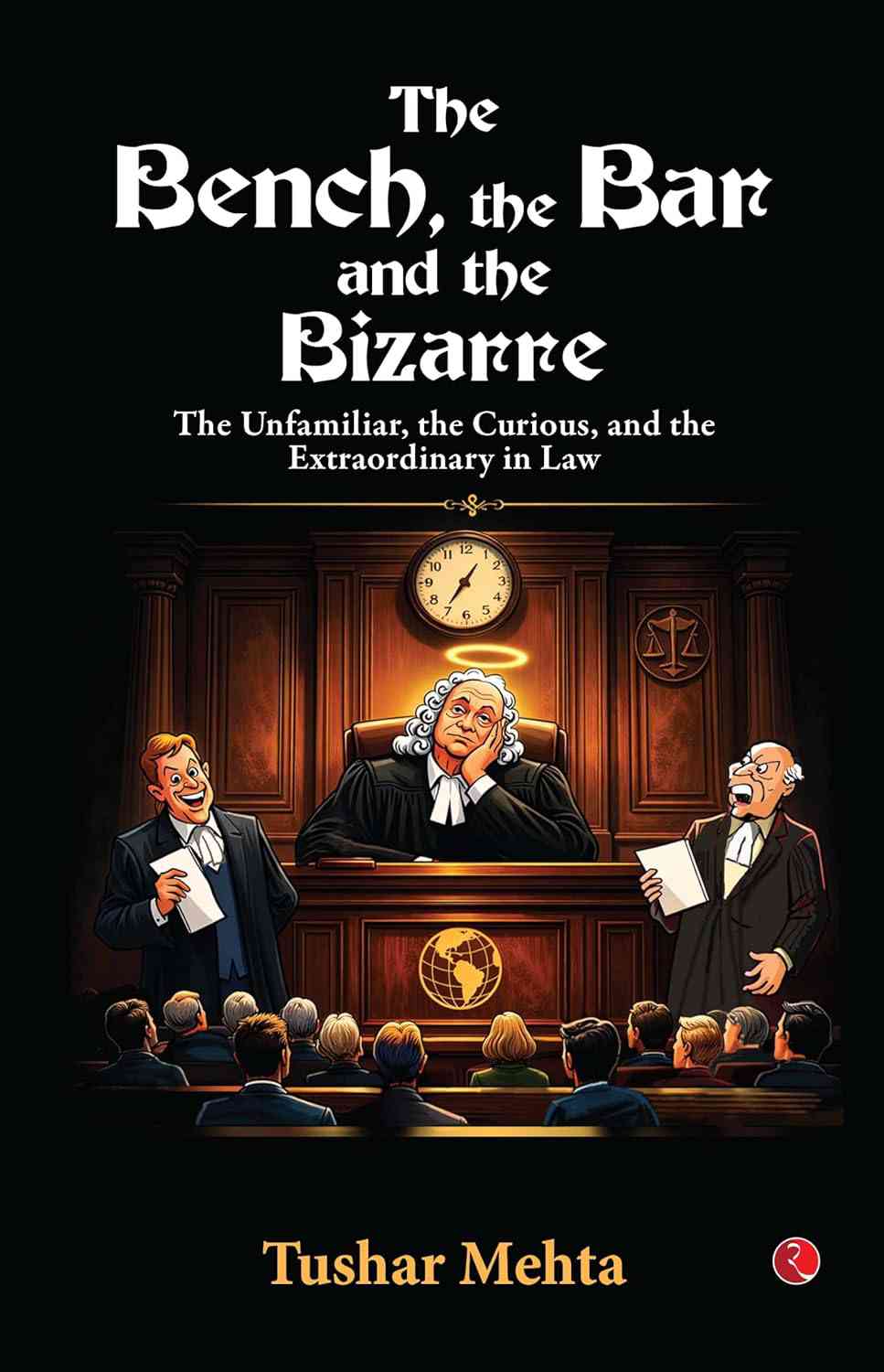
Excerpted with permission from The Bench, the Bar, and the Bizarre: The Unfamiliar, the Curious, and the Extraordinary in Law, Tushar Mehta, Rupa Publications.
