





What are our resources for the practice of a radical freedom today, even as we serve as legal and political subjects of machines of state power?
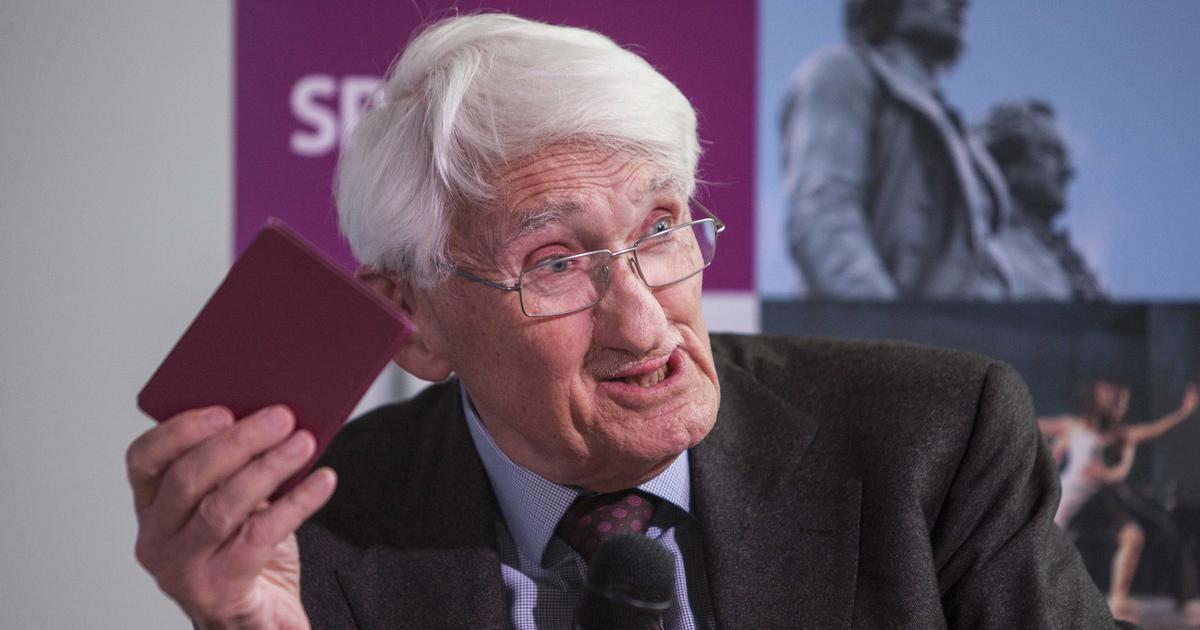
Cynics would say this is all philosophical stuff – these questions have no link to “reality”. Jürgen Habermas showed us a higher wisdom; he gave us a way out of our loyal and coerced memberships in folds of belonging, and for supplementing such memberships with our capacity for celebrating each other and ourselves, ambivalent to the specificity of biography – to be in the presence of strangers, completely.
He was, for me, a utopian thinker. He showed a way for a sliver of such freedom to be even tangentially accessed by practising a democratic self, a stranger-sociability.
A practical formula
I learnt of the power of Habermas’s thought from my late teacher Bernard Bate, who famously wrote about town square oratory cultures and cultures of public address in the South Indian, Tamil, linguistic and social world. It is from Bate that I learnt the power of these ideas, in their potential for unshackling of folds of caste, religion, community, as also the possibilities for Habermas’s theory of the public to be taken to the postcolonial juggernaut of India.
In the public realm, we get to shed the burden of our natal arrangements and occupy a space of debate, dialogue, and mutual constitution of stranger-oriented public selves. We are not all bound in state, capital, and community – Bate said something like this to me, on a hapless New Haven afternoon, as he was preparing to exit US academe – there are other possibilities. It changed my intellectual biography.
Habermas paved the way for this practical formula of modern humanity. Nancy Fraser, Michael Warner, Craig Calhoun, and Seyla Benhabib have all taken the Habermasian provocations in the directions of gendered, queer, multicultural and other forms of counterpublics, taking this possibility out of the bourgeois realm.
What remains to be said by a lonesome Habermasian from Bangalore? That he gave a philosophical armature to my intuitions for the civic, and carved a space for me and my intuitions to rest in a utopia of other forms of reason.
Habermas traces the rise of salons, cafes, and parlours from the 18th century onwards, where the practice of critical-rational debate among bourgeois citizens led to the thriving of democratic culture in Europe. In good measure, Habermas embraces a utopia that, as is the case with utopian thinking, is a practice of dreaming at the limits of the possible. He urges us to
Come out of our private shells and occupy the public space (space, broadly construed);
Listen to each other in patience and respect, especially in acknowledging our mutual strangeness;
Talk to each other in reason as also trust;
Practice an intimate and rigorous format of communicative rationality.
In many ways, this is a utopian sociology of democratic life. Those of us in the non-West, who are anxious about increasing incursions upon civic space and power by state forms and state power, ought to pay attention Habermas not as a sociologist of the bourgeois formats of thinking, but as a utopian thinker, asking more of ourselves and our neighbours, colleagues, friends, and the people that we sit next to on the Namma Bengaluru purple line metro every day, all the time.
At exactly 4 am, I can hear the leaky public incantation of the Ramakrishna Mission monks next to my house, wafting out of the religious assembly. Everyone is welcome, but not everyone will walk in. This is also the challenge of the liberal bourgeois public sphere – everyone is technically welcome, but not everyone will exercise the utopia.
Anupama Rao, in her book The Caste Question, analyses the taking of the liberal promise at face value, by anticaste activists like Jyotiba Phule, asking the question of equal rights to public spaces and concomitant dignities of the colonial state which wore the mask of being liberal. What happens when a sliver of utopian possibility is actually practised? Habermas insinuated this possibility of living at the edges of the possible.
He was perhaps a kind of anti-Foucault, providing a kind of antidote to Foucault’s macabre theories of totalising power that envelop and pivot the apparatuses of western modernity – the family, the hospital, the school, and the prison. Habermas’s ideas of communicative action and individuated reason are Western in their origins, yes, but if we adopt from the West a format of the democratic state form that we are not ashamed to domesticate to our own realities, then why should we shy away from domesticating the theory of public spheres and communicative rationality?
Habermas urges us in this day and age of meaningless overcommunication and enjoyable blame-games, to adopt his utopian charge with which to infuse our democratic social and civic forms, to re-embrace the civic which lies not in the domains of state or ethnicity/religion/community. The public law scholars who are my colleagues at a university in Bengaluru believe in this ethos and its possibility fully, and I, as a cynic, often scoff at their power to cling to feeble utopias of right-based justice.
Perhaps, they are more alive to the need of the hour than I. There is much to take from Habermas in strengthening our faith in ourselves and others, whom we know only by identitarian markers but are mostly strangers with. How should we be comfortable in acting and thinking collectively with strangers?
A contradictory reality
The Stanford Encyclopaedia of Philosophy gives a masterful summary of his early and late scholarship (including his later comments on religion and secularism) – the structural transformation of the bourgeois public sphere, the theory of communicative rationality, and facts, facticity, and norms, normativity being the most popular ones from his oeuvre among social scientists. Reality is contradictory, much to the chagrin of the neat theorists of contemporary social science with their easy causal affinities.
But in acknowledging this contradictory reality, without encouraging naivete, Habermas knew the power of utopias as tools of thought. We have no choice but to believe that we will not merely be nodes in the apparatuses of state and corporate power, and that others will be too.
It is the only way to dare to hope, to protect ourselves from the madness of extreme forms of instrumental reason.
If, as Aime Cesaire has reminded us, we, in the non-West, live each day in the denial of the humanity of the colonised populations in the discursive realm that has arisen out of colonialism. In acknowledging that our humanity has been systematically denied, we would do well to construct and acknowledge it fully to ourselves first. Thus, my advice to the intellectual vanguards of the non-West would be: let’s try not to do such a poor job of being non-Western, anticolonial intellectuals.
Let’s try and invent scholarship and public intellectual vocabularies with as much time and energy as we are currently investing in crying wolf on the internet. Let us try to reconstruct a humanity for ourselves and others like us, in a way that the Cameroonian philosopher Achille Mbembe reminds us: to re-adopt and adapt universal categories in a manner of constructing a Black reason where our remainder-humanity will become the standpoint of a new version of rationality.
When will we stop reifying ourselves through the lens of racialised difference in ways that we hate the colonist for doing unto us?
Habermas has provided the formula for living ever so slightly in the view of light beyond tunnels. Let us practice it.
A Habermasian reading group at your local café would perhaps be a place to start.
