





In those days, going to Lahore was a major event for us girls – for my many friends and sisters and cousins and cousins of cousins! Once, in the month of Maagh, a village elder, Bapu, took us to the city to see the basant mela but he ended up losing his way in the labyrinthine streets of Lahore. The inner alleys were undulating, going in circles, sometimes hitting a sudden dead end. Rows and rows of alluring shops lined the streets, selling cloth, cattle feed, seeds and a variety of provisions. Dingy enclosures with roofs of stretched sheepskin sheltered ironsmiths, jewellers, carpenters, dyers and cloth merchants – all busy in the rhythm of their trades. Then there were special outlets with prized commodities, Kashmiri shawls and Multani carpets, which brought a lot of wealth to Punjab in those days. The men and women in the bazaars were dressed in clothes we scarcely saw in the village- rich silks, fine pearls and embroidered pashminas. It was difficult to describe the glamour of Lahore- you had to see it with your own eyes. It was a big bad city with a beguiling allure, a heady mix of terror and temptation.
So, when we hit a dead end in those streets, Bapu frantically looked for an exit while we girls stayed absorbed, soaking up our surroundings, confident that the old man would escort us to our destination safe and sound. We halted outside a particular shop – a long, dimly-lit hall lined with gunny sacks. It was not clear what the contents of those sacks were. They could have been neem cakes or dry apricots or bajra – it was hard to say. The place itself reeked of oils and greases. A bhishti was sprinkling water on the outer part of the shop and a layer of fine dust was settling, ushering in a brand new day of festivity. Flocks of visitors wearing yellow, the colour of basant, were beginning to appear on the other end of the bazaar. The excitement was palpable. A lone kite was visible in the narrow stretch of sky flanked by roofs on both ends. Soon the sky would be festooned with kites of all shapes and colours, and the young boys would be boisterously cutting each other’s threads in an exciting annual contest. Most shops stocked kites during basant, even those which sold items like paper, clothes, utensils and farming equipment on regular days. During the spring season, every shopkeeper turned into a kite-seller. What’s more, halwais put up temporary stalls – puris and jalebis were our eternal favourites!
But to enjoy the festivities, one needs a light heart. A burdened heart, wrapped in the richest of silks, suffers eternally. Little joys become meaningless. When that happens, you realise how infinitely blessed a carefree little boy flying his kite is. Or, how lucky a little girl dancing joyously next to the Lohri bonfire is. Or, for that matter, how fortunate a father playing with his infant is, oblivious of his lunch growing cold. I like those people who, when engrossed in what they love, forget their puny schedules. They forget to eat, to visit friends despite having promised, or to offer prayers to God. I like such people who have the courage to cause little inconveniences and small disasters.
These rare moments- these are the real treasures, not the baubles we accumulate. Though my struggles were different. I had to safekeep what I had been given in legacy, not so much acquired. Truth be told, this burden of safekeeping a legacy is way more torturous than that of acquiring one.
But in those days, I did not know a thing about what my future was to be. I was but a carefree village girl, bumbling my way through life, going after whatever my heart fancied. And those days gleamed with a rare, untainted glow that retreated into a chimaera as I grew older. Over the years, I have chased that glow but in vain. I sometimes feel we don’t chase after new things. Often, while seeking new attractions, we seek the peace we once knew, living in an unhurried time where we were what we were. We are born as complete beings but as we grow the world chips at our wholeness, and so begins the agonising attempt to recall the half-remembered fullness we once knew effortlessly.
Sometimes we end up becoming what we had condemned all our lives.
True, I too was quite naïve in this way. In hindsight, it hits me all the more – this incontrovertible fact! Most people move from one reality to another, comparable to what they leave behind. But some enter new worlds with unknown sights, hidden mysteries and strange rules. Except that I was in a position where I had to immerse myself into a completely different role. And like they say, sometimes you have no teacher but your experience. My experience taught me every day. I blundered my way through but learnt the ropes. I was a woman thrown into a role bigger than me, but I held on to the girl of my childhood – sweet Jindan. Whenever things became too much, whenever I did not have the answer, I sought it in my mind, frolicking in the expanse of my village. That is where most answers dwell. Our memories are the source of pure, unsullied courage. If you do not let the hardening life experiences cut you off from the spring of wisdom within, you will find answers whenever you need them.
But why am I telling you all this? Ah! I caught this terrible habit as queen – I can be sure of an audience, so I go on and on. Yes, I was recounting the day Bapu took us girls to Lahore. He halted the tonga near a dyer shop to ask the way out of those serpentine lanes. A current of breeze carrying the smell of horse dung was blowing. Surely, there was a stable somewhere in the vicinity. Or maybe there were mounds of fresh horse dung in the cobbled alley. The dyer was busy splish-splashing in his big vat and did not hear Bapu even when he called out to him twice. So, the old man turned towards a woman sitting on her haunches on the outer platform. She was not in purdah and sat with a voluminous green dupatta covering her head and her ornate salwar kameez. She was gorging on a big mango. Her full breasts peeked out from under the tight kameez, the upper tattooed parts pushed up like two half-moons. The tinkling beads of her clunky necklace rubbed against her tattooed, fleshy chest. She sucked on the fruit while a trail of juice dribbled from the end of her mouth all the way down to her shapely elbows. She licked it with one long swipe of her pliable tongue and listened to Bapu.
“Oh, you want to go to Noore di hatti?” she asked in a heavy Lahori accent, adding, “Go straight down this road and take a right. It is the second shop you’ll see in that row. That’s quite a gaggle of girls you’ve packed in there! Yes, they’ll find some pretty trinkets there. Haina kudiyo?” She teased us with a look that was trained to check all out, head to toe, in a go.
After a pause, she looked around to face Bapu and added, “Today you are busy, but come alone another time and I can show you goods that you can see for yourself.” She started guffawing, her two paan-stained teeth shining a seductive red.
Bapu looked up, slightly embarrassed, and realised that we were in those unholy quarters of Lahore, the Shahi Mohalla. He could not recall how and when he had veered into these bylanes.
I looked up and saw a woman with an ample bosom sunning her curly hair in the protruding balcony of the building. For a split second, her eyes met mine and she stretched out her hands, touching them to the sides of her forehead like a compliment to my beauty. She uttered a shrill ‘Subhaan Allah’. Truth be told, it was not flattery I felt but a strange dread.
Bapu quickly roused his mare and off we trotted from those infamous lanes. “And these alleys of pleasure are not alien to the Maharaja himself,” said Bapu after we had trotted off for some distance.
“Like what, Bapu? Kiven? How?”
We girls drew a blank.
“Never you girls mind. That is a story for another day. Not worth spending too much of this day on. We only have a few hours in Lahore. So here we are.”
The look on poor Bapu’s face did not dissuade me from pulling his leg.
“Are you sure, Bapu, that it isn’t about you having fun here in your younger days?”
“Ni chup kar! Stop it! You shaitaan, wicked Jindan!”
He went red in the face and we all had a good laugh.
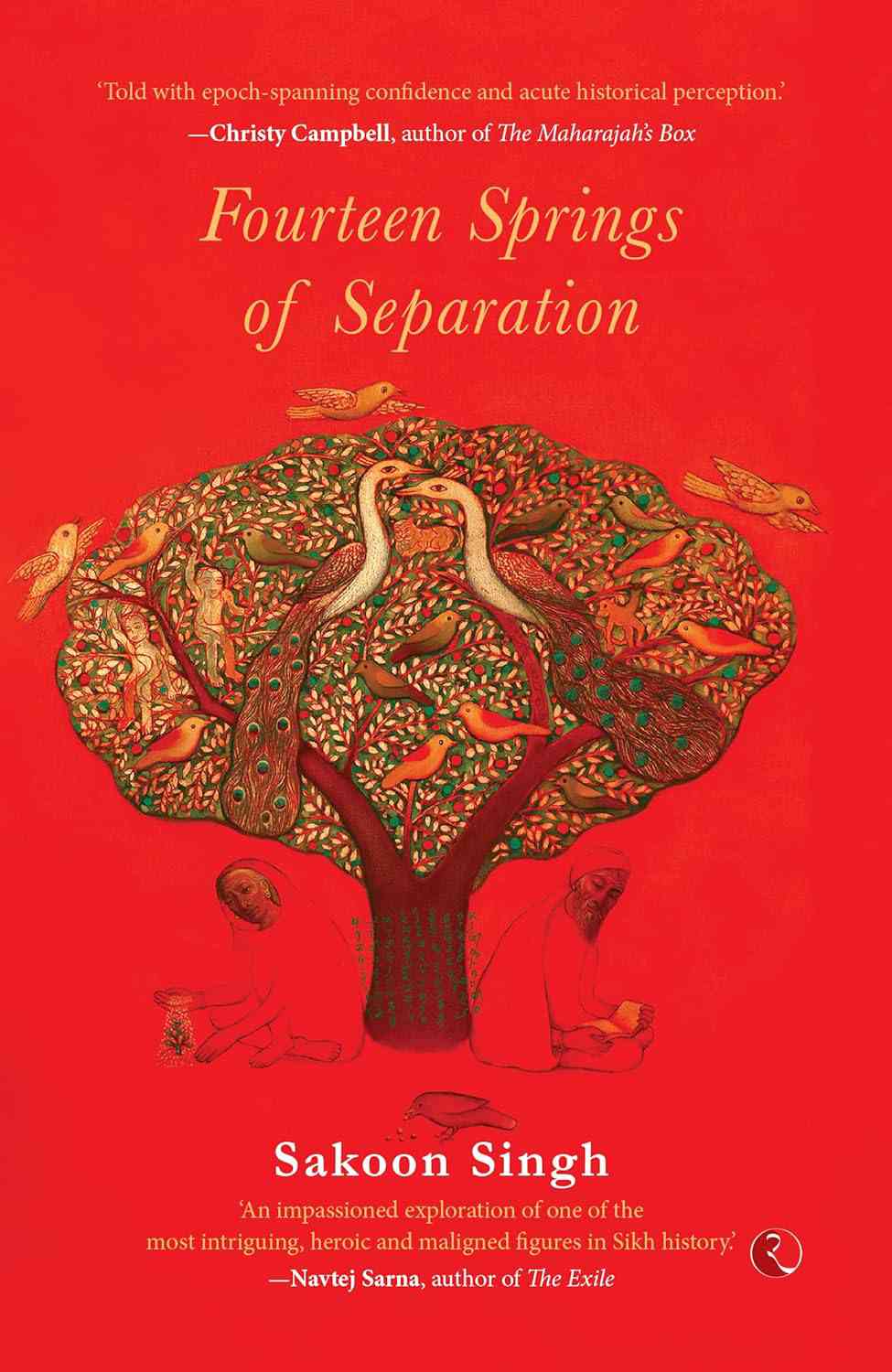
Excerpted with permission from Fourteen Springs of Separation, Sakoon Singh, Rupa Publications.
