

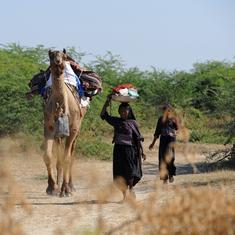



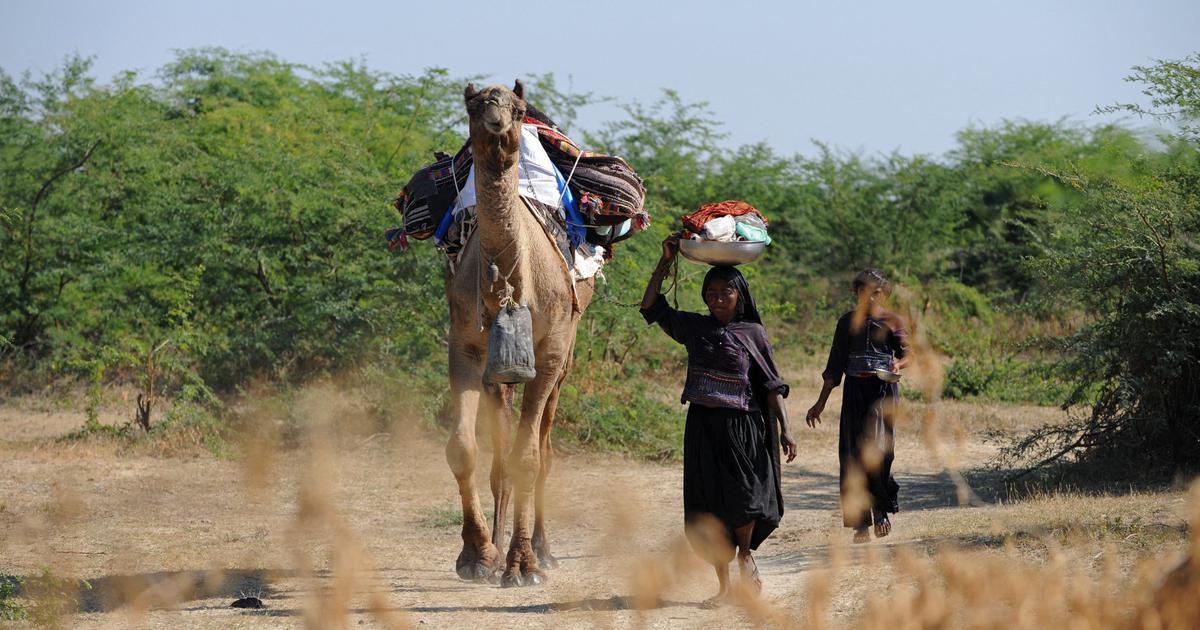
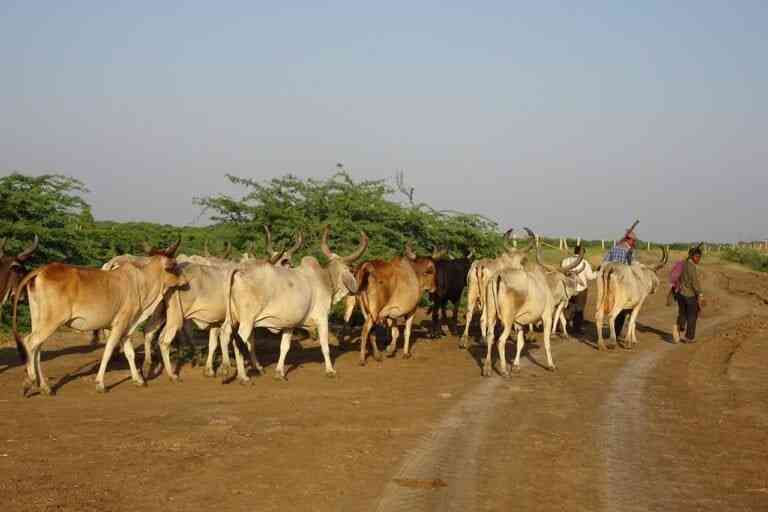
Nasibi Shermamad Jat, 55, remembers how, as a child, she would walk to the rakhal near her village with her mother to take their buffaloes for grazing. “I plucked imli [tamarind] from the trees and collected grass during drought,” she recalls. After she got married, her visits to the rakhal continued with her husband and their camels.
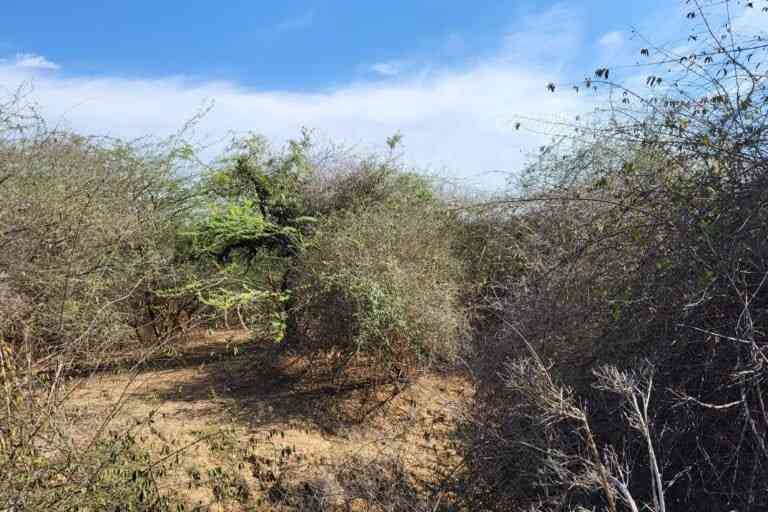
A protected area, a rakhal is typically characterised by sparse tree cover, shrubs, and grass in a savannah-like landscape, found in the arid and semi-arid regions of Kachchh, Gujarat.
Nasibi’s village is one among the many villages across the parched region of Kachchh, where shades of white, beige and sandy brown dominate the landscape. Belonging to the pastoralist Maldhari community in Dhragavandh, a village near the India-Pakistan border, Nasibi’s family of eight owns 30 camels and six buffaloes. There are four rakhals surrounding her village located inside the Narayan Sarovar Sanctuary.
“The kings gave us rakhals to graze our animals,” says Nasibi. Rakhals began as grass preserves in the 1880s, with the purpose of supplying fodder for animals and for hunting by the rulers of the princely state of Kachchh. Cutting trees was banned even then.
The royal court earned revenue from some rakhals by allowing Maldharis to graze their herds in these areas. After Independence, the rakhals were taken over by the state forest department.
In present times, rakhals are facing several pressures in the form of urbanisation, industrialisation, the fading away of traditional ecological knowledge, invasive species, renewable energy expansion, and a younger generation that knows little about them.
Biodiversity of rakhals
More than a hundred plant species are present in just five such rakhals in Kachchh, according to a recent study by the botanists from the Maharaja Sayajirao University of Baroda, Gujarat. “We tend to believe there is very little diversity in desert areas,” says Kavi Oza, the lead author of the study, adding that the study has proved otherwise.
Conducted between 2020 and 2023 across five rakhals in the Mandvi region of Kachchh – Sherdi, Vanothi, Pyaka, Godhara, and Hamla-Manjal – the study utilised field interviews of locals, including those from pastoral communities, to conclude that Azadirachta indica (neem), Cocos nucifera (coconut), Acacia nilotica (babul) and Prosopis juliflora (vilayati kikar, known as gando baval in Gujarati), were the most present. The majority of the species have medicinal uses for the local communities, followed by their use as food, firewood, and fodder, among others.
Co-author of the study Vinay M Raole shares that rakhals remain most critical in Bhuj, Khavda, Nakhatrana, and Naliya talukas, where water and arable land are scarce.
Invasive problem
An invasive species, P juliflora, plays a significant role for the community because of its value, such as firewood, the study finds. Ecologist Arun M. Dixit, who has studied the plant biodiversity of Kachchh extensively, acknowledges that this is a concern, but notes that communities have genuine use of this tree and their knowledge of it cannot be dismissed. “We use gando baval as firewood to cook,” says Nasibi.
A plant species found in rakhals that is struggling for survival is Commiphora wightii (Guggul), used as a medicinal resin, says Raole. He says that there has been a steep decline in mature Guggul trees between 1985 and 1995, adding that only young saplings remain in many locations.
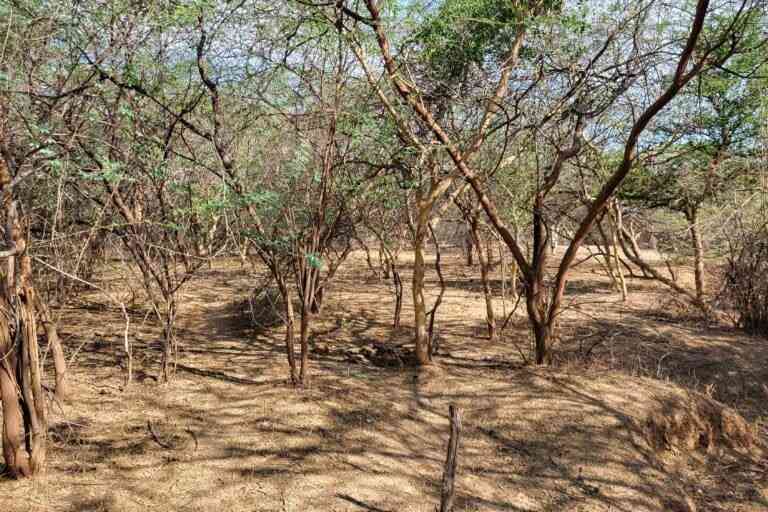
“When I was a child, there were many native trees in rakhals, such as desi babul (Acacia nilotica subsp. indica), Kher (Acacia chundra), liyar (Cordia gharaf), gangeti (Grewia tenax), and guggul, but now those trees are very few in numbers. Gando baval has spread over the entire area,” says Nasibi.
Rakhals today
After Independence, the forest department classified rakhals as “superior” and “inferior”. The superior rakhals served as emergency grass stores, Dixit explains. “During drought periods post independence in Kachchh, the department distributed grasses harvested and stored from these rakhals to Maldharis at nominal prices or for free,” he adds. The inferior rakhals are leased out to villagers for grazing.
Most rakhals continue to be managed by the forest department, according to Dixit. The local community has some formally recognised rights such as right of way, grazing, and limited fuelwood collection, but tree cutting is prohibited, he adds.
Despite having recognised forest rights in some rakhals, Maldharis such as Nasibi struggle to find grazing land. The forest department has threatened her family with action if they take their animals to the rakhals, which are within the Narayan Sarovar Sanctuary. In rakhals that fall under national parks sanctuaries, grazing and grass collection are not allowed. Nasibi will soon have to find a new place to feed her animals.
Traditional knowledge
To document these rakhals that are under various pressures, the research team spent three years conducting field visits to Kachchh and spoke to village heads, traditional healers, and members of pastoral communities. After data collection, the team used ethnobotanical indices to understand it further.
The restricted grazing in rakhals makes them better managed than surrounding unprotected areas, points out Dixit as a reason for the high biodiversity in those lands. He notes that an index used in the study indicates significant species richness and habitat heterogeneity within the rakhals – the rocky, uneven terrain creates a microhabitat, where rarer species survive alongside dominant ones such P. juliflora, sheltered from competition.
The researchers faced some challenges. Most interviewees were elderly males and the study acknowledges the need for more inclusive research in the future. Dixit shares that one of the limitations of the study is the two separate investigations presented – one, the ethnobotanical survey of community knowledge and the other, the biodiversity assessment of rakhals – without building an explicit relationship between them. He also points to the small sample study of just 45 informants across one taluka as a drawback.
Studies like this can feed directly into People’s Biodiversity Registers – documents listing all bio-resources and their uses, that every village panchayat is required to maintain under the Biological Diversity (BD) Act, 2002 in India. “This in turn, can protect community knowledge from commercial exploitation,” says Dixit. “The younger generation is losing touch with their roots,” Oza says.
Future of rakhals
The study recommends formally recognising rakhals as critical biodiversity zones in local conservation policy, prioritising species that have high cultural importance, and planting saplings and knowledge sharing initiatives where elders share their ecological knowledge with the youth.
The study opens ground for further work which could include identifying the actual custodians of traditional knowledge, and linking research findings to biodiversity conservation, eco-restoration, and climate resilience policy, Dixit says.
Back in Dhragavandh, Nasibi’s 19-year-old grandson Hussain uses his phone to look up rakhals in maps and learn more about the plant life there. Her daughters know the land very well. “Our parents taught us about the rakhals and we teach our grandchildren about them. They take an interest in it because they also have their own small herds,” she says.
This article was first published on Mongabay.
