



Once Golee had spread the word, the gathering under the canopy had grown so large and was filled with so many kinds of chatters and twitters, chirps and howls, that it was impossible to discern who was saying what. They were one united voice of the jungle.
“You see,” chattered Macaque, “there are plans to chop down our tree homes so the humans can construct big bright blocks they call buildings on our island. To do this, apparently, they need to erase nine million trees. They will destroy our paradise to create their man-made paradise.”
Golee’s eyes nearly popped out of his head. “WHAT?” he cried, “That must be a huge amount. I mean, I can just about count up to nine, but I’ve heard a million is a really large number! That would mean so so so many trees. But why would anyone in their right mind want to cut down even a single tree? I mean, do humans even know how many creatures make their homes in every one?”
“Exactly. And this is why we must reach Delhi, somehow, some way, no matter what. Does anyone here have any idea where it is and how to get there?”
All the animals began talking at once, giving tips and suggestions, discussing the jungle path ahead, how confusing it was and how easy it would be to get lost in there.
“Best would be to have some local guidance and some path clearers,” Golee mused. “The elephants would be perfect for this task.”
A large matriarch elephant stepped forward and patted Golee’s head with her trunk. “I am Maata Haati. My tribe and I would be delighted to assist you. Like little Golee here, I too lost my precious mother to Catchers. Her passing made me never want to trust another human again. We would like to join you on the long march ahead.”
Macaque high-fived Treeshrew and whooped. The elephants would be an amazing asset on the journey, beating clear passages through unknown terrain and protecting them from human eyes. All the other animals could walk in the middle of the group of these great giants completely unseen.
“Thank you so much, we greatly appreciate your guidance,” said Treeshrew, humbly.
“We should begin at once. Night is the best cover,” trumpeted the matriarch.
As they walked in the wake of their mighty new friends, the Nicobar Crew lifted whispered voices together in song. The groves of coconut palm seemed to sway in time to their rousing anthem. Then the trees bowed low and the distant ocean roared a response, as if it were lending support to the intrepid crew.
We are NICOBAR,
(travelling far, travelling far)
And we belong to SAMBELONG
(hear our song, hear our song)
An island rare as rare can be,
(like a diamond in the sea)
We’ll never let the sun go down
(let’s all hear you make some sound)
’til Nicobar is FREE!
As they marched along, Treeshrew muttered to Cat Snake, a little concerned, “The only thing I’m anxious about is what will happen when it gets light?”
Cat Snake waggled her head and sighed. “Do you ever s-s-stop worrying about s-s-s-omething?” she hissed. “Relax-x-x-x. The elephants have this. We’ll find some kind of hiding place-c-c-ce. It is a really big forest, you know.”
“I know, I know. I just can’t help feeling a little jumpy, navigating such unfamiliar land, even if we do have good friends to guide us. The smells are all different. The dangers are new. And the thought of those horrid Catchers hiding behind trees waiting to pounce absolutely terrifies me!”
Nico P, who was flying low, joined in. “Trust in our new companion, Pangolin the protector,” he cried. “We will succeed. Just have a little faith.”
The journey through the jungle was a long and arduous one. The Nicobar Crew and their new friends walked all night, then all of the next day and the next night too.
Each new morning, the forests of Tamil Nadu awoke to a delightful symphony of birdsong.
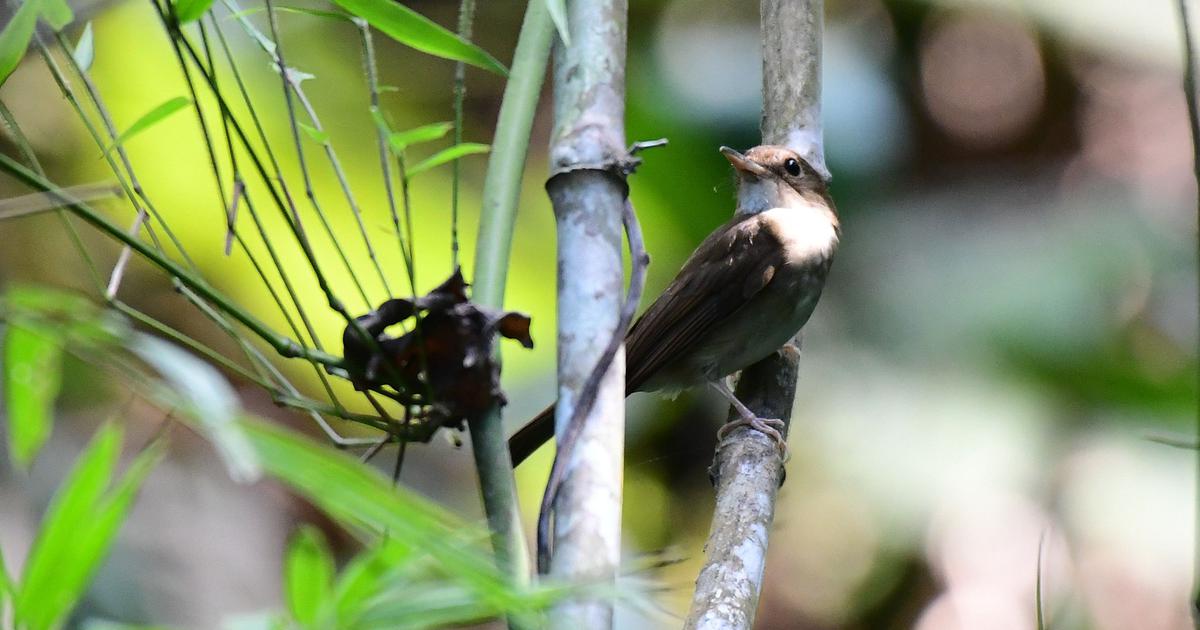
As the trees stretched their branches and shook out their leaves, the Conductor Koel would rouse the entire forest with his baton-like call. In response, the forest would fill with voices – the fugue of Fairy Bluebirds; the trill of Bush Robins; the wheet-pen of the Pitta; the two-note whistle and warble of the Scarlet Minervets and the pritpitee, prit-pitee of the Jungle Prinia. Bi-bi-bi-bi-bi, the Common Babbler would babble out. Tissweet, tisweet, the Green Warblers would squeak. White-crested Laughingthrushes chortled in delight. And having woken up, the sun would finally rise, basking the entire forest in a bright, warm glow.
On the second morning, the Nicobar Crew had stopped to rest in a glade to enjoy the first warmth of the sun when suddenly Treeshrew pointed to something on the wet earth.
“Oh!” she cried.
“What is it?” chorused the others.
“Footprints,” she replied with a gulp. “Look! Fresh in the mud. Larger than a langur’s. They can only belong to a human.” She looked around anxiously, then whispered, “I’ve got a funny feeling that the human is watching us right now.”
The animals clustered together instinctively, peering around. From a nearby shrub came the sound of a crackle. And in the dawning light, the Nicobar Crew and their friends froze to see shadows of human faces staring at them from behind masks of leaf and twig and branch.
“What is that?” whispered Macaque, in terror.
Lion-tailed Macaque from the Tamil Forest gang shook his mane anxiously. “Let’s hope they don’t get any closer, my cousin. They may well have weapons.”
Maata Haati stepped forward. “Taramp, taraamp!” she bellowed. “Come out, whoever you are. Show yourselves.”
Being multispecies fluent, all the animals understood her words perfectly. But they were unprepared for what came from the mouth of one of the emerging humans. In perfect elephantspeak, the human greeted them: ‘Welcome, friends. We have been following your journey through our shared forests for a long time. You must be on an urgent quest to be walking together so peacefully, both predator and prey.’
The human, bare-chested, bare-footed, held a long stick. Across his back was slung a quiverful of arrows and a bow. He gave the Crew a small bow and continued: “Our people, the Kattunayakan tribe, like you, have lived in the forest for as long as we have been a tribe. Like you, we understand its ways. We rely on its trees and plants and waterbodies for our survival. We collect honey. Our ancestors tamed wild elephants for the maharajas, and were known as the haati whisperers. But those days are long past. Humans from the cities have been coming to our forests and hills for years trying to cut down trees and mine minerals here. We try to save them. We only know this way of life and believe it to be the best one.”
Once the Nicobar Crew had gasped out their amazement at hearing a human speak at such length and in such perfect elephant, they began muttering and whispering amongst themselves. The matriarch elephants nodded wisely together. Maata Haati took another step forward, feeling out the human with her trunk. “I have heard of you. My brothers have spoken of forest-dwelling humans who worship and respect us as guardian spirits of their tribe. We thank you for respecting our power and for caring for all fellow creatures on this earth.”
Excerpted with permission from The Great Nicobar Journey, Tansy Troy, Talking Cub.
