





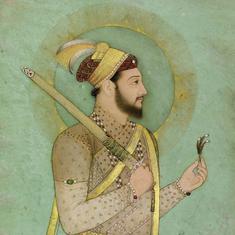

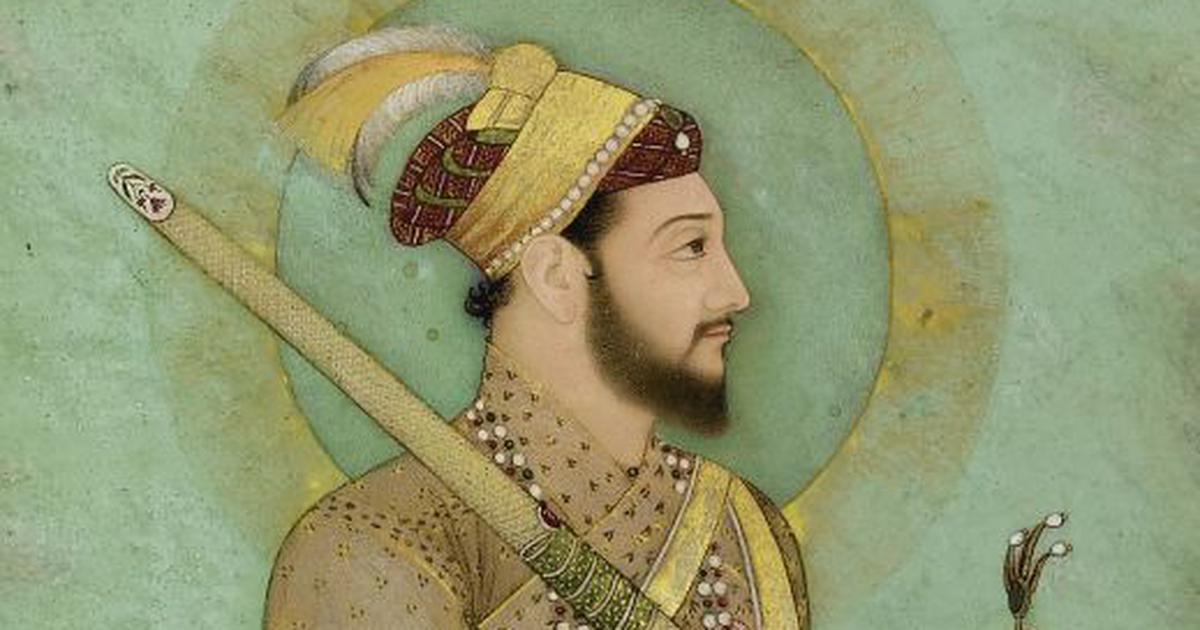
Haibat, Dara, Primavera, Sarmad, sons of Sulaiman – quite a few heads have rolled by now.
Dara and Sarmad were poets, as were some others. Head-hunting must have become a private obsession with Aurangzeb, and maybe he kept an account of the number of beheadings during his reign.
If only phrenology had been in vogue in the 17th century, the king would have amassed quite some wealth to fund the seemingly endless number of military campaigns during his reign. Phrenology was a 19th-century pseudo-science, considered as revolutionary as the telegraph in the 1850s, wherein the human mind (phrenos) was studied by examining skulls. Much like palmistry assumes that human destiny gets mapped onto the palm, the phrenological assumption was that the mind was mapped onto the inner skull, and in turn to the outer skull. The skull was mapped into 50 odd zones of criminality, romance, genius, etc. The only problem was the skin on the head; and the study, therefore, was better conducted on skulls of the deceased. This was a raging idea in the field of psychology, and human skulls were procured from far and wide by doctors. Of special interest, obviously, were skulls of geniuses and criminals. There were riots in England outside execution houses to procure bodies of the deceased criminals. Legends around common criminals grew, so that their skulls would fetch higher prices on the market. The skulls and stories travelled, and grew in their value, as the criminal was transformed into a cannibal from a spoon thief in most legends. Islands in Polynesia were wiped out in pursuit of exotic skulls of indigenous peoples. The trade was truly global, and ran from Tasmania to Philadelphia via India and Europe. The swordsmen of the seventeenth-century India certainly knew the art of decapitation, and they would have been premium professionals had they been born two hundred years later.
The other big decapitation in the Aurangzeb beheading-canon is that of Guru Teg Bahadur (1621-75 ce), the ninth Sikh guru. Guru Teg Bahadur was brought in chains in front of Aurangzeb in 1675 CE. Legend has it that Aurangzeb asked him to perform a miracle if the latter was indeed a holy man. The guru, wary of torture to extract information about his arms and hideouts, found an ingenious way to cut short the ordeal. He said that the amulet around his neck made him immune to any attack. Upon this Aurangzeb asked his executioner to decapitate the guru. In one fell swoop, the guru’s head was on the floor. The amulet was opened and allegedly it read – “Sar diya, sir na diya” (Gave my head, but not my secret).
Another legend penned in the late 19th century by Pandit Shardha Ram Phillauri says that Guru Teg Bahadur liked to wander in forests. One day, he went into a forest near Agra. He sent a follower to get some confectionery and gave him his seal ring and a shawl to obtain food. The seal was identified, the Guru was apprehended and brought before Aurangzeb, who made various efforts to convert him to Islam, and had him tortured. Teg Bahadur is believed to have told Aurangzeb that if God did not want multiplicity and multiple religions to exist, they would not have existed. Eventually, the Guru ordered his own disciple to behead him one morning. What is of interest here, obviously, is how the disciple had access to a sword inside a prison. The body was then smuggled out of prison by Majabi Muslims (for Sikhs would be identified) and taken to Anandpur. The decapitated head was cremated at Chandni Chowk, where Gurudwara Sisganj (a heap of heads) stands today. The Majabis were consecrated by Guru Hargobind as Rangharetas86 (those who can steal the colour off anything).
Whether he was beheaded by Aurangzeb, or on his own orders, Guru Teg Bahadur made good of his name – his name literally means “valiant of the sword” – and died by the sword. He also made amends for the mistakes of Ram Rai.
Teg Bahadur was one of the five sons from three marriages of Guru Hargobind (1595-1644 CE), the sixth Sikh Guru. Hargobind appointed his grandson Har Rai as his successor. The eldest son Guruditya had already passed away, and Hargobind thought it best to anoint his eldest son’s eldest son to the position of the Guru, much to the consternation of Teg Bahadur’s mother. Legend has it that he promised her that one day Teg Bahadur would be his successor, and so it was, in the time to come. Guru Hargobind passed away in 1644 CE. Guru Har Rai supported Dara in the war of succession.
Aurangzeb had a strange grudge against Dara – about men of spiritual disposition supporting Dara. This point is worth noting, as it suggests that the angst of loneliness might have been troubling Aurangzeb’s heart, and not hatred for Sufis because the entire Mughal lineage was associated with, and devoted to one or the other Sufi order. Aurangzeb himself is buried next to his spiritual master Sheikh Zainuddin. His daughters Zeb un-Nissa and Zinat were compassionate donors to Sufis, poets and writers. He then was left out, as an aberration, an eyesore amongst the Mughals. This infuriated him, and the wild child in him – as is the case with most autocrats – took to the path of decapitating the dissenter.
As we have seen earlier, Aurangzeb had doggedly pursued Sarmad and eliminated him. It was Har Rai’s turn next. He was also summoned in 1660 CE over the same question – why the Guru had supported Dara. Har Rai sent his son Ram Rai instead, with express instructions that he was to perform no miracles and that he shouldn’t compromise on the integrity of the Guru Granth Sahib. Ram Rai is said to have compromised Sikh principles by twisting a stanza from the Granth Sahib, which Aurangzeb alleged was against Islam.90 It is worth recalling that the same method was employed against Sarmad – with Aurangzeb knowing that Sarmad never uttered the full kalma, and this would be sufficient to declare him a heretic and kill him. Ram Rai, probably aware of this, chose survival over decapitation.
Aurangzeb had taken offence to this verse:
“Mitti Musalman ki pere pe kumar,
Ghar bhande itan kian jaldi kare pukar”
Dalbir Singh Dhillon translates the verse thus:
“The ashes of the Muhammadan fall into the potter’s clod;
vessels and bricks are fashioned from them; they cry out as they burn.”
Ram Rai tweaked the phrase and said that it was a mistake committed by the scribe; that Nanak meant “Be imaan” (dishonest, one without integrity) and not “Mussalman”. Aurangzeb was assuaged with this reply. Har Rai promptly disinherited Ram Rai and never saw him again, while Ram Rai remained a friend of Aurangzeb from hereon. Har Rai died the very next year, in 1661 CE, at age 31, leaving the Guru’s position to the second son of Har Rai, toddler Har Kishan. Har Kishan died within two years, probably of chicken pox. On his deathbed, Har Kishan is believed to have uttered the word “Bakala”. This is the place where Teg Bahadur, 44, was living at the moment, nearly like a wandering mendicant, barely concerned with worldly affairs. Destiny had other plans and his mother persuaded him to take on the responsibility. Guru Teg Bahadur always expressed his desire to pass on the position to his son Govind Singh and to wander off into the forest. Eventually, Teg Bahadur, also a poet, got his release by the sword.
Ram Rai’s tweak, however, aligns better with present-day divisive discourses, where sentiments are easily hurt and literary nuances are overlooked. However, Nanak’s own formulation is neat – he is putting an end to the debate whether cremation or burial is the right practice by reminding both sides that all ultimately return to dust. Whether it’s the pyre or potter’s fire, time’s ire reduces all to dust. The potter-clay metaphor was used in the same vein by other saints of the day too, the most notable being Kabir’s: “Maati kahe kumhaar se, tu kya raunde mohe/ Ek din aisa aayega main raundungi tohe.” (The soil says to the potter – what vanity to think that you can trample upon me/ A day will come when I will trample upon you).
The point, however, is that in the middle of all this Mughal hostility against the Sikhs, Dara was still their friend – despite his father and despite his despotic brother. This is a testament to the idea that Dara had a genuine interest in various spiritual traditions. He craved a larger Sufi alliance and deeper understanding. Historians have generally pointed out that Dara was a lost poet, a lost cause, his strategic skills no match for Aurangzeb’s. However, an alliance with the Sikhs was a brilliant strategy, especially with Guru Hargobind, who made Shah Jahan’s army bite the dust on three occasions. To be friends with one’s father’s avowed enemy, while remaining the favourite of the father, is quite something.
The Mughal-Sikh acrimony has its genesis in the time of Guru Arjan Dev (1563–1606 CE), the fifth Guru, and the predecessor of Guru Hargobind. The matter, in hindsight, seems to be much ado about nothing. But it is the little bonfires gone wrong that become wildfires. A wedding proposal was brought to the Guru for his son Hargobind. The girl in question was the daughter of Chandu Shah, an administrative official at the court of Jahangir. With time passing by, as Chandu Shah learnt that it was the house of a Faqir his daughter had been betrothed to, he grew furious. On learning of Shah’s attitude, the Guru cancelled the marriage. Though Shah himself wanted this annulment, with him not being the first mover, his fury had some fuel added to it. He started maligning the Guru, and the latter was summoned to the Mughal court several times and humiliated. Sikh tradition has it that eventually Jahangir wanted him eliminated. Chandu Shah, who wanted the perfect humiliation, suggested that the Guru be tied inside a cowhide and burnt. On learning of this, Guru Arjan Dev expressed his last wish that he would like to take a bath in the Ravi River. While bathing, he drowned himself and his body was never found – and so he escaped the humiliation.
Trumpp suggests that though this is the traditional legend, Jahangir would not have pronounced a death sentence over nothing. He finds a plausible cause in the book Dabistan – Guru Arjan’s support for Khusrau, the eldest son of Jahangir who had rebelled against the emperor. The Guru had only offered prayers and no military support – the Sikhs were not organised militarily by this time. He was imprisoned and died of the harsh treatment meted out in the prison in 1606 CE. Again, this appears to be a case of much ado about nothing. Historians probably need to start writing more about fragile male egos and the psychological problems of autocrats than about military strategies. The Sikhs were unfortunate that they sided with the losing princes in two wars of succession of the Mughals, at the time of the end of the rule of Jahangir and then Shah Jahan.
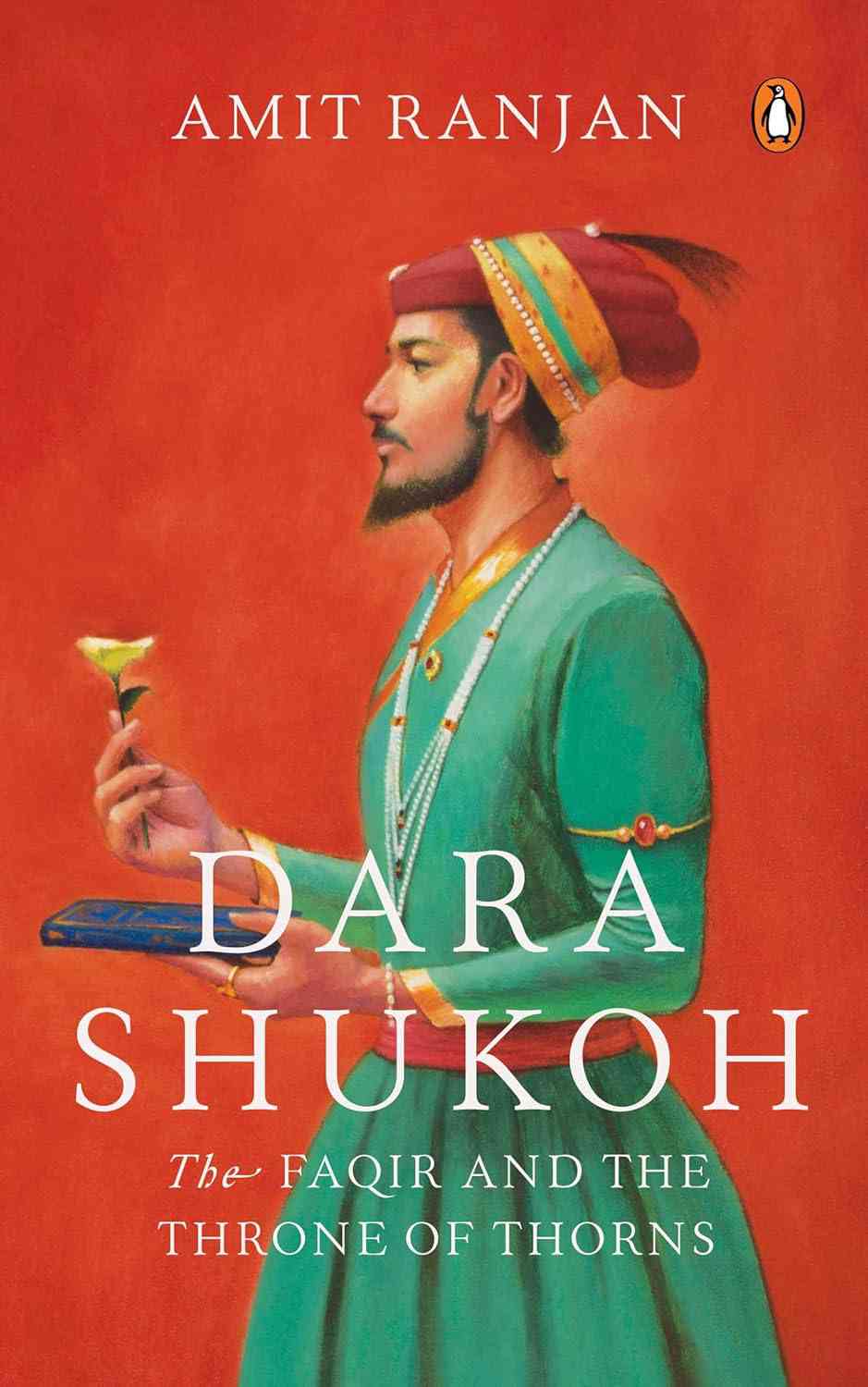
Excerpted with permission from Dara Shukoh: The Faqir and the Throne of Thorns, Amit Ranjan, Penguin India.
