








While describing a tense moment between her mother and herself, Rani Neutill notes, “We remain locked in a cradle of enmity, sweating, grasping for air, our faces so close that I could feel her searing breath.” This sentence pretty much captures the deeply turbulent yet fiercely intimate relationship between a mother and a daughter, recalled with acute vividness by Neutill in her memoir Do You Know How Lucky You Are?. Set primarily in India and America, Neutill’s transnational memoir locates the mother-daughter relationship within the larger context of postcolonialism. Without being too analytical, Neutill shows how personal relationships are influenced by historical as well as political circumstances. The simultaneously tender and acerbic nature of the mother-daughter relationship is a reflection of precisely such circumstances.
The memoir opens with “I DON’T WANT TO SEE my mother,” a statement that is soon upended as Neutill confronts her ailing mother and remembers that same mother at her most fierce and overwhelming. In the process, Neutill confronts herself and her past too. The memoir, then, becomes a record of this dual confrontation on the writer’s part – a tale of witnessing and reconciliation. The memoir is also an ardent act of mourning, not to overcome the loss of a mother who left an indelible impression on her daughter’s life, but to rebirth her on the page, as suggested by the epigraph from Annie Ernaux: “I believe I am writing about my mother because it is my turn to bring her into the world.”
Like mother, like daughter
Readers familiar with diaspora narratives may find some familiar tropes in the mother-daughter story: a middle-class girl from Calcutta – a city where “traces of colonialism lingered everywhere”, named Shukla, makes her way out of India, marries a white American man several years older and financially affluent, with whom she has a child – Rani. After the death of her husband, Shukla brings up her daughter as a single parent, while facing various obstacles. Even after acquiring American citizenship for professional convenience, she clings to her Indian identity through cultural practices, faith, and superstition, while young Neutill, despite her biracial identity and relentless efforts, fails to fit in with American girls at school.
The memoir would have been rather simple and read like an early Jhumpa Lahiri story if it had merely focused on the mother-daughter dilemma in a Californian city. But Neutill chooses to complicate things further by introducing the angle of postcolonialism, which insinuates the effects and consequences of India’s colonial past. The memoir shows how post-colonial subjects – primarily women- are haunted by the trauma of colonialism across subsequent generations. In Neutill’s maternal family, the haunting takes the shape of madness. As Neutill’s mother, long after the mental breakdown of her sister, who had seen the Partition riots of 1946 in Calcutta as a child, descends into paranoia and hallucinations, a gradual alienation settles between the mother and the daughter.
Neutill’s coming-of-age takes place under the shadow of her mother, whether present or absent, far or near. The memoir describes Neutill’s obsession with the need for her mother’s validation, attention and affection, even as she turns away from her as she grows older, sometimes voluntarily and sometimes by force. While in America, Neutill tries hard to get rid of her mother’s oppressive protection, which in fact emerges from the subtle jealousy she feels towards her daughter’s sexuality and youth. This eventually leads her to abandon young Neutill in India, under the care of her maternal grandmother. What starts out as punishment for Neutill eventually turns favourable as she finds love, friendship and belonging in her new school in Calcutta. However, in spite of these developments, she too seems to show signs of anxiety and paranoia during this time, which are conditions inherited from her mother, and accentuated by her mother’s attitude towards her.
The craft of form
What stands out about Neutill’s narrative is the writer’s ability to conjure images with words. Whether it is a living body or an inanimate object, a moment in time or a stretch of space – Neutill displays commendable craftsmanship at making her descriptions as tangible and picturesque as possible. Her writing is imbued with a rare tangibility and visuality that prevent the chapters, which may sometimes come across as repetitive, from becoming monotonous. Thus, the text becomes very cinematic.
Take, for instance, this “close-up” description of her mother’s emaciated physique: “Her legs are bent but splayed wide, a pose she might have once called ‘unladylike’. She is dressed in a pink cardigan buttoned all the way up to her neck … At the sight of me, her eyes widen in recognition, the corner of her mouth turned upwards.” Or the description of a cul-de-sac: “One day, when the winds were roaring, I stared out into the darkness of our neighbourhood, at the shadows of palm trees swaying. Their leaves looked like the weeping feathers of a wet bird.”
While the former shows how minutely the mother’s body parts are presented, the latter portrays a poignant landscape creating an atmosphere of uncertainty and anxiety in a wide-angle. There is as much poetic lyricism in Neutill’s writing as unabashed corporeality. It does not have a tonal uniformity which makes the narrative both uneven and unpredictable like the mother-daughter relationship it describes.
Another striking aspect of the memoir is that it is filled with a spattering of Bengali words and phrases. Neutill does not footnote these words but provides a simultaneous English equivalent. Example: “‘Esho, esho,’ she says, gesturing me to enter”; “‘Cholo, let’s go’, my mother said.” Anyone familiar with the language would know the Bengali word esho in the context of the sentence quoted above means “come in”, and cholo means “let us go”. But it is also not very difficult to guess for those who do not know Bengali. However, what this stylistic strategy does is rupture the flow of English. It adds another layer to Neutill’s tonal unevenness. As a biracial person with Bengali roots who has witnessed people bearing the brunt of colonialism, she employs this strategy to push back against English as the language of former colonisers.
Through writing the memoir, Neutill not only comes to terms with a difficult mother but also liberates herself from the expectations she had of her. The memoir underscores how the ideal image of the mother is thrust on women by society on one hand, which includes the family, and their own children on the other. Women who cannot live up to the high maternal standards are often misunderstood and reprimanded. After all, not everyone is lucky enough to have a daughter like Neutill (just as she was lucky to have a mother like Shukla), who returns to unravel the woman hiding behind the maternal garb. But perhaps, this project of bringing the mother to the world – as a woman with flaws, rage and temperamental imperfections, has a larger political significance.
Rani Neutill’s Do You Know How Lucky You Are? has been published at a time when mother-daughter memoirs are in season. Within the Indian literary scene, this book stands with the much-discussed Mother Mary Comes to Me by Arundhuti Roy. Internationally, it stands with Sasha Bonét’s The Waterbearers: A Memoir of Mothers and Daughters. The surge in publication of mother-daughter memoirs can be interpreted as a response to the destructive and patriarchal authoritarianism that is governing the world. The figure of the mother, at once monstrous and vulnerable, fierce and frightful, terrible and tender, serves as a counterforce that, without being deified, enables care, creation and emancipation.
Samudranil Gupta teaches English at Jindal Global Law School, OP Jindal Global University, Sonepat.
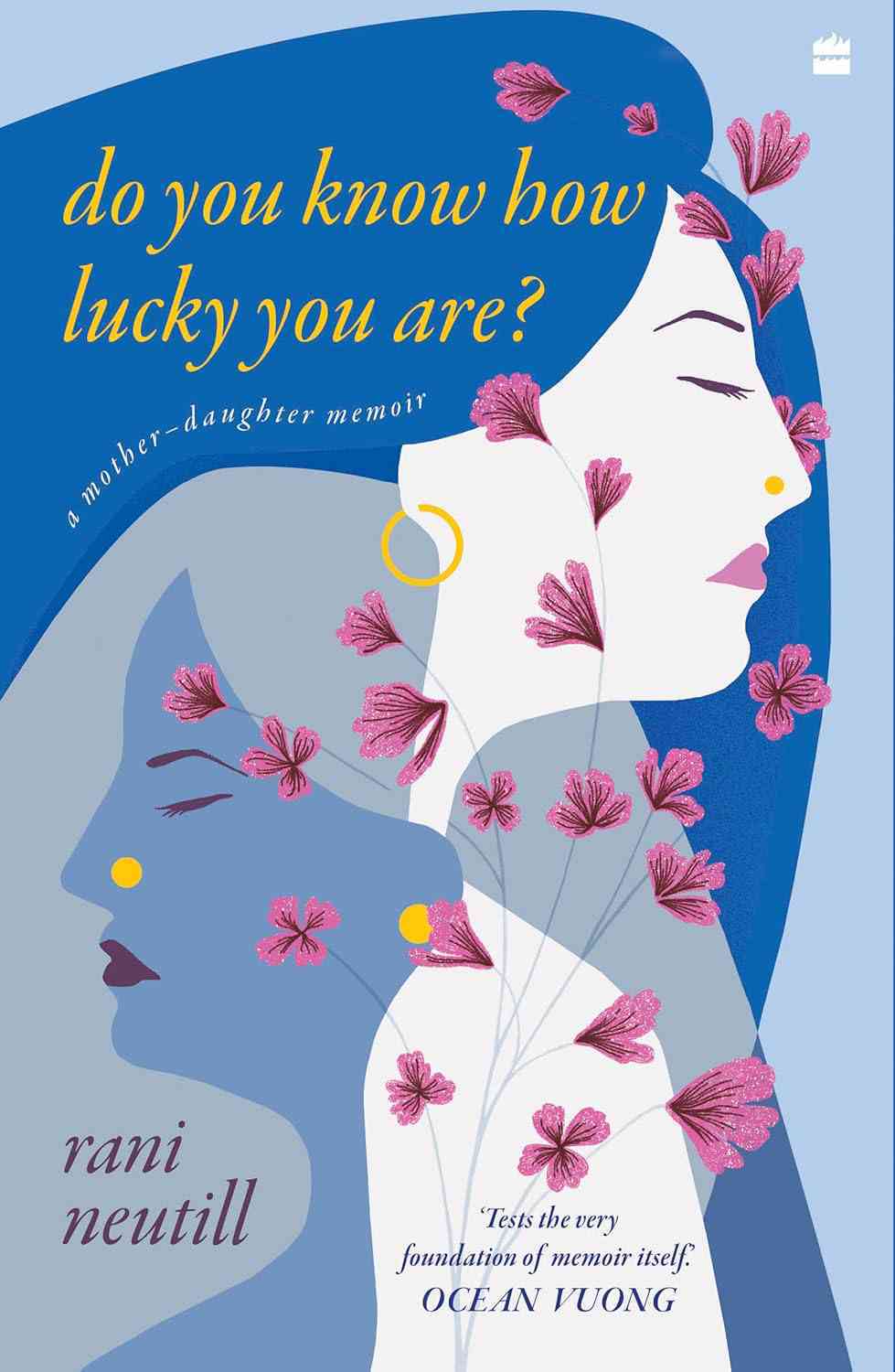
Do You Know How Lucky You Are: A Mother-Daughter Memoir, Rani Neutill, HarperCollins India.
