

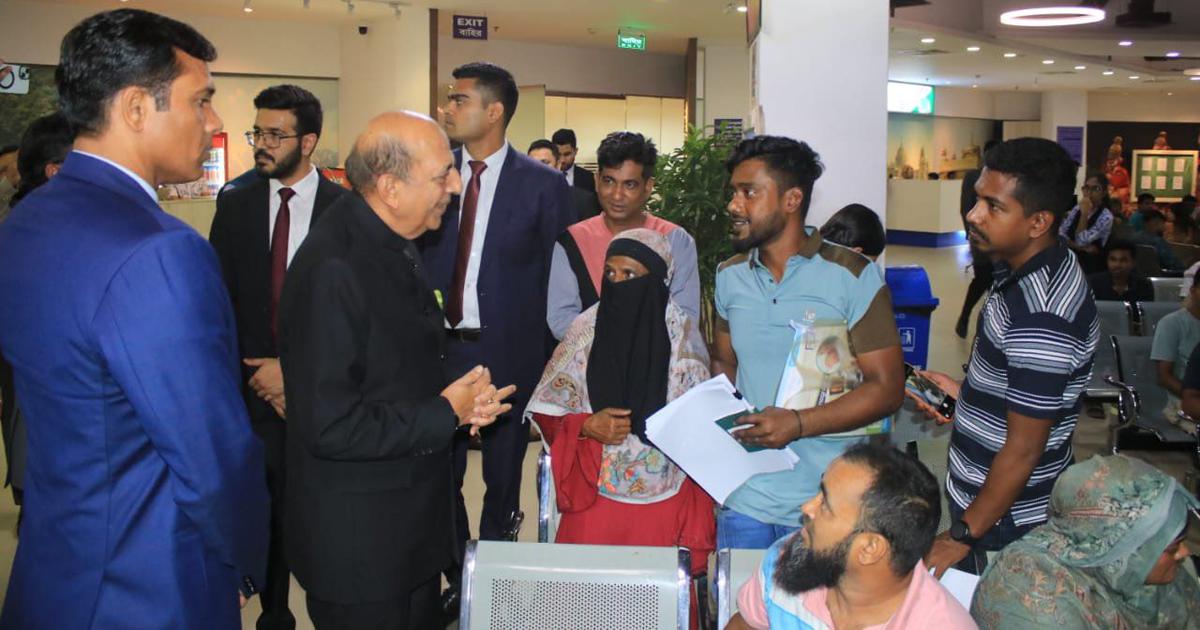
On Thursday, Dinesh Trivedi, India’s newly appointed High Commissioner, who had presented his credentials to the Bangladesh President Mohammed Shahabuddin only hours earlier, made an announcement nearly two years in the making.
He said tourist visas for Bangladeshi citizens would resume. Applications will open on Sunday, processed across five centres in Dhaka, Rajshahi, Chittagong, Sylhet, and Khulna.
Urgent medical visas would continue uninterrupted, he added.
The announcement coincided with Prime Minister Tarique Rahman’s state visit to Beijing, which served as a reminder of how badly Bangladesh-India relations had needed a confidence-building gesture.
Since August 2024, when India suspended tourist visa services following the political upheaval that led to the ouster of Sheikh Hasina, the dominant narrative surrounding Bangladesh-India relations has been one of growing estrangement.
Anti-India sentiment surged across Bangladesh, manifesting itself in street protests, media commentary and social media discourse.
It was fuelled by longstanding grievances over border killings by India’s Border Security Force and “push-ins” across the border of people India claimed were Bangladeshi.
Bangladeshis are also irate about misinformation about their country circulating in the Indian media, as well as by India’s decision to shelter Sheikh Hasina and numerous Awami League leaders.
Within Bangladesh, there has been a rise of Islamist hardliners and pro-Pakistani sentiment.
To many observers, this seemed to signal that Bangladesh had, at least emotionally, turned away from its largest neighbour.
Incomplete narrative
That narrative contains an element of truth, but it is also incomplete.
Beneath the political turbulence and diplomatic chill, there is a deeper, more enduring reality: the ordinary Bangladeshi’s connection to India.
It is a connection shaped not so much by politics than by history, geography, language and everyday life. Long before the emergence of modern nation-states, the people of Bengal shared a common cultural and social space. Many of those ties endure across the border.
Kolkata is closer to Dhaka than many Bangladeshi districts are to the capital.
The language spoken in West Bengal is familiar, the food in border states is recognisable, and Bengali-speaking doctors are available in hospitals that can often be reached more easily than specialised medical facilities elsewhere.
For the Bangladeshi middle class, India has long represented the first and most natural international horizon. A first trip abroad, a medical consultation, a wedding-shopping visit or a journey to see relatives in West Bengal, Tripura, or even Meghalaya and Assam — these are not the experiences of a privileged few.
In the year from April 2023, more than 2.1 million Bangladeshis visited India, accounting for over 20% of all foreign tourist arrivals in the country. No other bilateral travel relationship in South Asia comes close.
Before August 2024, Indian Visa Application Centres in Bangladesh had processed several thousand visas daily. That fell to three digits.
The 2.1 million annual visitors decreased to 470,000 by 2025. Bangladeshis who had been planning medical trips rescheduled, waited and in many cases simply went without treatment.
Those who needed urgent care and managed to obtain medical visas through the greatly compressed processing system were the fortunate ones.
Medical visas
Bangladesh used to account for 70%-75% of all medical visas India issues annually. The patients behind those numbers are not wealthy individuals pursuing rare procedures.
They are middle-class families managing cardiac conditions, cancer diagnoses, kidney failure. When the channel to obtain Indian visas narrowed, the cost was paid by patients and their families.
It is visits by ordinary Bangladeshis that made New Delhi-Dhaka ties so resilient.
Five visa processing centres is a beginning, not a full-fledged restoration. Before August 2024, India operated 16 visa application centres across Bangladesh. Trivedi acknowledged that expansion is planned. It must come quickly and at scale. A partial reopening that leaves long queues and scarce appointments risks undermining the goodwill the announcement itself has generated.
But the instinct behind the announcement is the right one. The best argument for restoring tourist visa access is not economic or strategic. It is that the people of India and Bangladesh have not actually drifted as far apart as the political rhetoric would suggest.
Jannatul Naym Pieal is a Dhaka-based writer, researcher and journalist. His email address is jn.pieal@gmail.com.
