









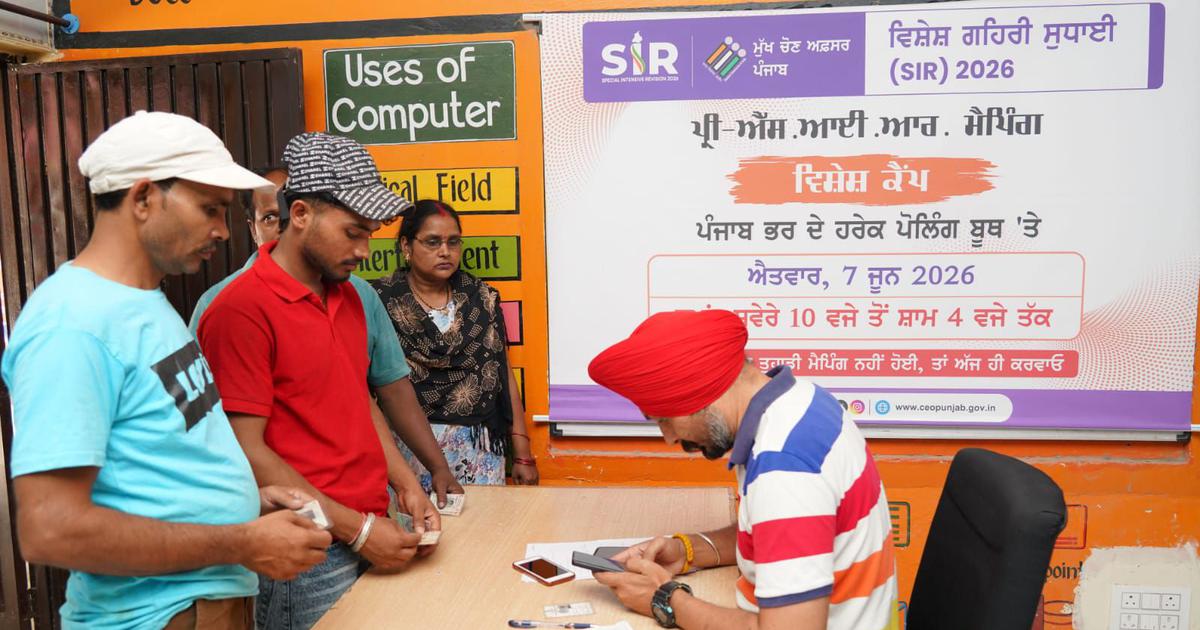
A 33-year-old man in Patiala – resident at the same address since birth, with his mother registered as a voter at that same address for decades – is being asked by his Booth Level Officer to produce proof of where a qualifying relative was registered as a voter in 2002.
The Election Commission’s enumeration form allows legacy linkage through a father, mother, grandfather, or grandmother – not just the father, as many Booth Level Officers have been incorrectly demanding in the field.
In this case, the obvious qualifying relative is his father – a retired senior government officer and ex-serviceman who, as the law expressly provides for service personnel, was registered at various posting addresses during his career rather than at the family home.
His Electors Photo Identity Card, or EPIC, bears an old posting address with no connection to the family’s Patiala home. The son has voted in multiple elections over 15 years without incident. His mother’s registration at the family address is uncontested – and the mother is herself a valid qualifying relative under the form’s own instructions.
Yet neither the mother’s registration nor the son’s 15-year record has been treated as sufficient. The Booth Level Officer is fixated on the father’s posting-address EPIC. That fixation reflects a training failure, not a legal requirement. And that training failure is causing unlawful distress to voters across Punjab.
A journalist’s testimony
The Patiala case is not unique. Journalist Gopikrishna has shared a strikingly parallel experience. A voter in Kerala since 1989, he relocated to Delhi for professional reasons. Field officers, acting on neighbours’ reports, deleted his name from the Kerala roll. When he complained to the Chief Electoral Officer of Kerala, he pointed out that his neighbour – defence minister AK Antony – had also been absent from Kerala since mid-2005 and had not had his name deleted. The Chief Electoral Officer could not answer. She acknowledged the sarcasm.
Gopikrishna eventually registered in Delhi from 2012 by declaring his Kerala enrolment for cancellation. His conclusion: the Election Commission’s rules are not user-friendly. They were not user-friendly in 2009. The SIR has made them actively hostile to the very voters whose franchise it claims to protect. The law is clear that ordinary residence is determined by the voter’s own settled intention – not by a neighbour’s report to a field officer. Both cases, separated by 17 years, demonstrate the same institutional failure.
Both cases point to the same systemic problem: Booth Level Officers in the field are operating with incomplete and inconsistent training about what the ECI’s own form actually says. The enumeration form on voters.eci.gov.in offers three options: (a) my own name exists in the last SIR roll; (b) my parent’s name (Father, Mother, Grandfather, or Grandmother) exists in the last SIR roll; or (c) neither my name nor my parent’s name exists. The term used is “parent” in the widest sense – four qualifying relatives, not one.
An investigation by Siasat during the Telangana SIR found that even ECI call-centre executives were unclear on whether maternal grandparents qualified, while the Rajasthan CEO had to issue a specific clarification that married women should trace legacy to their parents, not their marital homes. This confusion at the highest administrative level is replicated at the Booth Level Officer-level on the doorstep.
In Punjab, Booth Level Officers asking voters exclusively for the father’s 2003 registration are not following the ECI’s form – they are following an imperfect briefing. The booth level agent, present at the visit, must know the form better than the Booth Level Officer and correct the error on the spot. The citizen, opening the door, must know their rights before the knock arrives.
This is not an argument against the SIR as an exercise. The Supreme Court upheld its legality on May 27 and that judgement is not in contest here. Electoral rolls need cleaning and the Commission has constitutional authority to conduct that exercise.
What is contested is the specific legacy linkage methodology – the demand that voters enrolled after 2003 trace a genealogy of voter registration going back to that year, and produce parental registration records from a quarter-century ago as proof of their own current eligibility. That demand has no basis in the Constitution, the Representation of the People Act, or the Registration of Electors Rules. It treats the 2003 base roll not as a reference point for administrative matching – which is legitimate – but as a presumptive threshold of eligibility that no law authorises.
I. The Constitutional starting point
Article 326 of the Constitution is unambiguous. Every citizen who is not less than eighteen years of age shall be entitled to be registered as a voter. The Constitution specifies grounds for disqualification: non-citizenship, unsound mind, crime, and corrupt or illegal practice. Inability to trace a parent’s 2003 voter registration is not among them.
Article 324 vests the superintendence, direction, and control of the preparation of electoral rolls in the Election Commission – a power of supervision and revision, not a power to create eligibility conditions the Constitution does not authorise.
The Supreme Court’s judgment of May 27 upheld the SIR as constitutionally valid under Article 324 and Section 21(3) of the RP Act. That judgement is binding and not in contest here. But it does not, and cannot, authorise the Election Commission to demand of any voter a condition of eligibility that the Constitution and the RP Act do not prescribe. The SIR is legal. The legacy linkage demand, as currently implemented, is not.
II. What the Representation of the People Act Says
Section 19 of the Representation of People Act, 1950, prescribes two conditions for registration: age of 18 years on the qualifying date, and ordinary residence in the constituency. Two conditions. Nothing else.
Section 20 defines ordinary residence. Section 20(1A) provides that a person temporarily absent from his ordinary residence shall not cease to be ordinarily resident there. Section 20(3) provides that persons with a service qualification – armed forces and para-military personnel – shall be deemed ordinarily resident in the constituency where they would have been but for their service. This directly protects the Patiala family: the father’s registration at posting addresses was a legal consequence of his service, not evidence that the family home was elsewhere.
Section 22’s proviso is equally critical: before any deletion on the ground that a person has ceased to be ordinarily resident or is otherwise not entitled to be registered, the Electoral Registration Officer shall give the person concerned a reasonable opportunity of being heard. This is not discretionary. It is a statutory guarantee.
A deletion processed without this hearing is unlawful. The Registration of Electors Rules, 1960 – Rules 13 and 21 – govern inclusion and objection procedures. Neither authorises a Booth Level Officer or an Electoral Registration Officer to demand parental voter registration from 23 years ago as a condition of continued enrolment.
III. The 2003 Baseline
The legacy linkage requirement is an administrative methodology chosen by the Election Commission for computational matching – not a statutory requirement. The 2025-26 exercise has departed critically from the 2003 design of the SIR.
Documents placed before the Supreme Court in the Bihar SIR litigation show that the 2003 guidelines used the existing electoral roll and EPIC card as the base for verification — a voter could establish continued registration by producing their own EPIC. The current SIR initially excluded the EPIC from its list of valid documents for post-2003 voters, reversing the Commission’s own prior practice with no statutory justification, corrected only through Supreme Court interim directions.
There is a further contrast: the 2003 SIR was conducted over six months, well before any state election. The current exercise was compressed to three months and run close to election dates. The Commission cannot invoke the authority of its own 2003 precedent while simultaneously abandoning that precedent’s most voter-protective features.
A voter enrolled lawfully in 2008, 2012, or 2018 – through a process that was verified, legally compliant, and EPIC-supported – cannot be retrospectively treated as provisionally unverified because the Commission changed its methodology two decades later.
IV. The parental linkage demand
Even with the form’s wider definition of qualifying relative — father, mother, grandfather, or grandmother – the legacy linkage requirement systematically disadvantages three categories of citizen.
First, voters who were minors in 2003 and whose qualifying relatives were not enrolled that year for lawful reasons: service personnel registered at posting addresses rather than family homes, internal migrants who had not yet re-enrolled, or persons who had moved constituencies.
Second, newly married women: the Rajasthan CEO issued a specific clarification that married women must trace legacy to their own parents, not their marital homes – yet Booth Level Officers across states have been directing women to produce their father-in-law’s or husband’s 2002 registration, which is procedurally wrong and contradicts the form’s own instructions.
Third, orphans, adopted persons, and those whose family records were lost in displacement, natural disaster, or the upheavals of partition-era migration. For none of these categories does inability to produce a qualifying relative’s 2003 voter record bear any relationship to the person’s own citizenship or ordinary residence.
The ex-serviceman father in the Patiala case illustrates a specific iniquity under Section 20(3). That provision deems a service person ordinarily resident in the constituency where he would have been resident but for his service. His voter registration accordingly reflects a deemed legal residence, not his physical location at any given time. His EPIC records one address; his service record reflects others; his retirement address may be a third.
These non-linearities are the direct legal consequence of a provision Parliament enacted to protect service personnel and their families. To penalise a son for his father’s service-mandated registration history is not roll-cleaning. It is the SIR’s algorithm punishing the very statutory accommodation Parliament designed for those who served the nation.
V. SIR and the law
The SIR can lawfully verify that every person on the roll satisfies the two conditions of Section 19 – age and ordinary residence – as of the qualifying date. It can direct Booth Level Officers to conduct door-to-door enumeration, collect enumeration forms, record discrepancies, and flag entries for review.
Following the hearing mandated by Section 22, it can delete entries that are demonstrably ineligible: deceased voters, voters who have demonstrably ceased to be ordinarily resident, duplicate entries, non-citizens. All of this is within the ECI’s authority under Article 324 and the RP Act.
What the SIR cannot lawfully do is create a presumption of ineligibility against any voter who cannot trace their or their parent’s name to the 2003 roll, and then require that voter to discharge that presumption through a documentary standard the Act and the Rules do not prescribe.
The burden of proof for deletion rests on the Electoral Registration Officer, not on the voter. The Supreme Court’s August 2025 interim direction in the Bihar case – requiring acceptance of Aadhaar and EPIC as valid documents – was an implicit acknowledgment that the legacy linkage requirement, as originally formulated, imposed on voters a burden the law does not authorise. It is that burden which this article addresses.
VI. What the citizen must do
If your Booth Level Officer is demanding parental 2003 voter registration documentation, the following steps are your legal protection.
First, do not refuse to cooperate. Fill the enumeration form, produce your own EPIC and Aadhaar, and write clearly on the form: “Parent’s 2003 voter registration not traceable due to service posting history. Voter enrolled by due process. EPIC and Aadhaar attached. Ordinary residence at enrolled address established.” This creates a written record of your cooperation and your inability to comply with a demand the law does not authorise.
Second, check the draft roll the day it is published on July 31. Do not wait. If your name has been deleted or flagged, file a claim under Form 6 or Form 8 immediately, citing: (a) Section 19 requires only age and ordinary residence as conditions of registration; (b) Section 20(3) of the RP Act protects the families of service voters from exactly this kind of documentation trap; (c) Section 22’s proviso requires a hearing before any deletion Booth Level Officer a deletion without a hearing is unlawful; (d) the Supreme Court has directed acceptance of Aadhaar and EPIC as proof of identity and residence. Attach copies of both.
Third, if your claim is rejected without a hearing, appeal to the Chief Electoral Officer under Section 24 of the RP Act, simultaneously approaching the District Election Officer. Fourth, if the CEO’s response is unsatisfactory, approach the Punjab and Haryana High Court under Article 226 of the Constitution. The legal arguments are available. The statutory framework is on your side. Act in the first week of August – not the last.
VII. Political Parties, BLAs
Every booth level agent must be trained, before June 25, to identify the legacy linkage demand when it is made and to note in writing on the Booth Level Officer’s enumeration record: “Voter has produced EPIC and Aadhaar. Parental 2003 registration not traceable due to service posting history [or: migration / family circumstances]. Party objects to deletion without hearing under Section 22, RP Act 1950.”
That single notation, consistently made across flagged voters, creates an evidentiary record the Electoral Registration Officer cannot ignore without legal exposure. The booth level agent must also understand that his role is not merely to witness whatever the Booth Level Officer has been directed to do. He is the party’s active legal representative at the point where a voter’s franchise is either protected or compromised.
Parties must simultaneously run a data exercise now, before the visits begin: download the current roll for each of Punjab’s 25,000 booths, identify voters enrolled after 2003, and confirm that each has consistent EPIC and Aadhaar documentation at the enrolled address. Voters with self-supporting documentation are legally protected regardless of parental traceability.
When the draft roll is published on July 31, parties must monitor the deletion reasons field – required to be published following the Supreme Court’s Bihar direction – and file a standardised legal claim for every deletion coded as legacy-linkage-unresolved. A party that prepares that standard brief now will file a hundred claims in the time it would otherwise take to draft one from scratch.
VIII. The Line the SIR Cannot Cross
Twenty-three years have passed since the 2003 SIR. Voters enrolled lawfully in the intervening period did so by satisfying the two conditions the law prescribes: age and ordinary residence. Families have moved. Ex-servicemen have retired to addresses different from their service rolls. Children born into long-established households have grown up, enrolled, and voted across multiple elections without once being asked to prove their parents were on a voter list in a year when they themselves were ten years old.
The SIR cannot, without statutory authority, retrospectively impose on these voters a burden of proof that the RP Act never placed on them. The Election Commission’s power under Article 324 is wide. It is not unlimited. The Constitution and the RP Act are not administrative guidelines adjustable at the Commission’s convenience. They are the boundary within which even the most legitimate institutional exercise must remain – and a methodology that exceeds that boundary is not an exercise of constitutional power. It is a departure from it.
The Patiala voter has been a registered elector for 15 years. His mother has voted at the same address for decades. His father served the nation under terms that Section 20(3) of the RP Act specifically accommodates. The family’s roots at that address are corroborated by every document the household possesses and by every revision of the roll in which the mother’s name has appeared.
No field algorithm designed in 2025, anchored to a base roll from 2002, can take that franchise without a hearing, without legal authority, and without a statutory basis that simply does not exist. The law gives this voter his registration. The law protects his registration. The SIR’s methodology cannot override the law.
This article was first published on The KBS Chronicle.
