







July 4 marks the 250th anniversary of the day America’s colonists issued a declaration stating their desire to be free of British rule. The anniversary is an occasion to revisit two questions that are fundamental to US history: what motivated the American colonies to turn against their overlords across the Atlantic? And how did an outmanned colonial military defeat a superior British fighting force?
An unlikely country – India – factors into both answers. Let’s review them, in reverse chronological order.
In April 1775, war broke out between the American colonies and the British. The colonists won that first battle of what became known as the Revolutionary War. While the British had more experience, more troops, and more money, they could never conquer the colonists. For several years, the two sides battled to a stalemate. But the tide turned in 1781. What changed? To answer that, let’s look at a battle fought the previous year – in India.
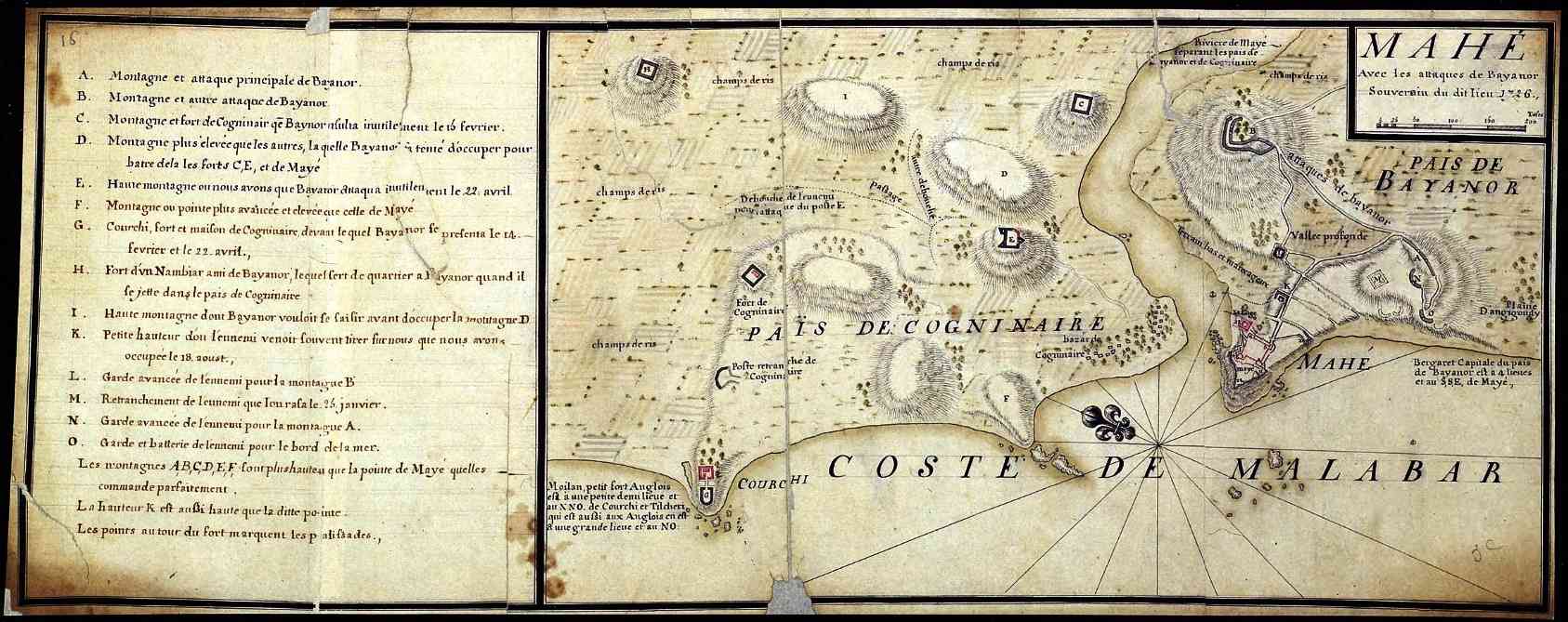
Soldiers from the East India Company – a de facto arm of the British government – were enmeshed in what became known as the Second Anglo-Mysore War. The battle stemmed from Britain’s seizure of a port controlled by the French government in Mahé, on the Malabar coast, in 1779. Portions of India were under French rule at the time.
The port was closely aligned with Mysore’s ruler, Haidar Ali, and he responded to its seizure the following July by mounting a massive invasion of the Carnatic region, deploying 80,000 troops. Two months of warfare followed, with the decisive battle fought on September 10 in the town of Pollilur. The use of what was then cutting-edge rocket technology helped Ali and his troops prevail.
The East India Company suffered 3,000 fatalities and lost nearly half its officers. It was “the severest blow that the English ever sustained in India,” according to a leading British military official of the era, Sir Hector Munro.
The outcome was wake-up call to the British, who feared French encroachment. Soon afterwards, the British doubled the number of troops they had in India, which meant reducing their presence in the Revolutionary War. It was a critical decision – and one that would have far-reaching consequences.
The reallocation helped the British achieve military parity with India in what become known as the Second Anglo-Mysore War, which concluded in 1784 with the Treaty of Mangalore. But this came at the expense of the fighting forces in the American colonies.
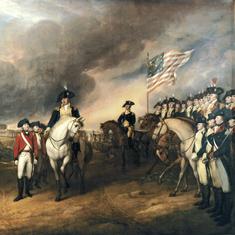
The British were henceforth short staffed, and unable to keep up with the colonists, who in January 1781 won a key battle in South Carolina. Nine months later, the two sides squared off in Yorktown, a city in Virginia. But the British, with 8,000 troops, could not compete with the nearly 20,000 troops representing the Americans and the French.
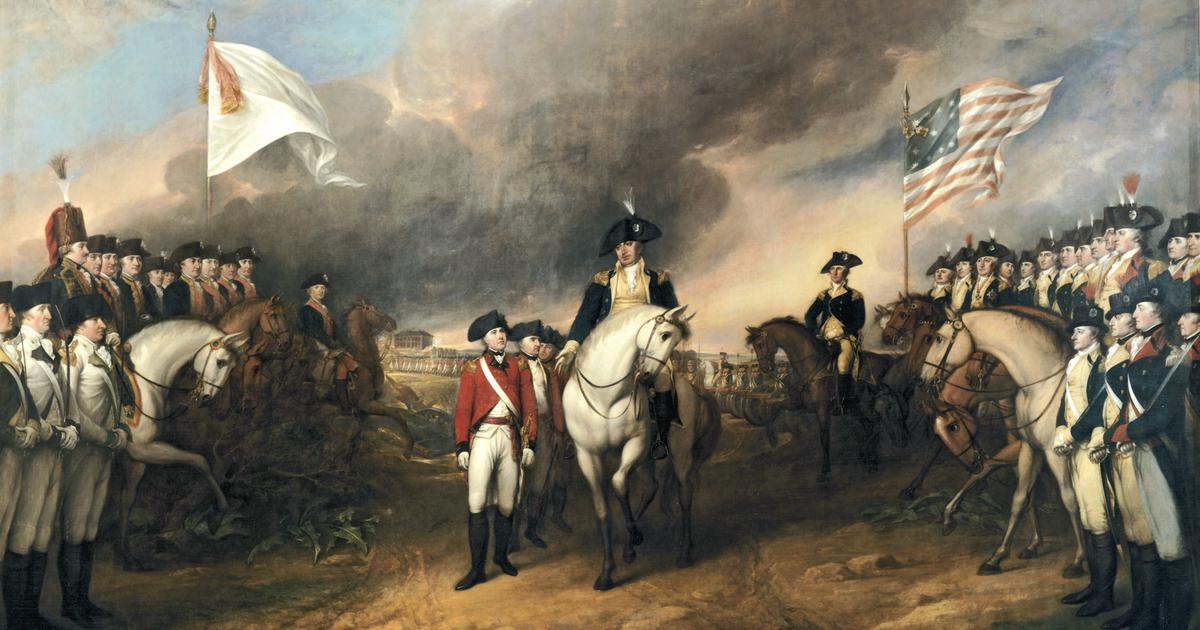
On October 19, Britain’s military leader in the American colonies, Lieutenant General Charles Cornwallis, surrendered, effectively ending the Revolutionary War (though battles would continue for another two years). Soon thereafter, America’s political leaders gathered to celebrate the American victory.
At the event, they toasted Haidar Ali – “May he continue to be a scourge to the British!” The duke of Manchester later declared, “The neglect of not having a proper naval force in America was the cause of the calamity.”
That sentiment is amplified in a forthcoming book by the University of Chicago’s Steven Pincus: “In many ways the defeat . . . at Pollilur led ineluctably to Cornwallis’s surrender at Yorktown.” Pincus adds, “No explanation for the emergence of the American state can be complete without consideration of developments on the Indian subcontinent.”
Hyder Spanks the English
— Folkloristan (@folkloristan) May 22, 2025
To show that the English did not have sole rights on myth making, here is a cartoon by Antoine Borel, showing Hyder Ali of Mysore giving a British officer a thorough spanking while a French soldier smirks and supplies the twigs. pic.twitter.com/6sAVrbRKYv
The story of India’s role in American colonists wanting to break free of the British begins in 1757. That’s when the East India Company won a landmark battle in the Indian city of Palashi (often Anglicised as “Plassey”). The victory gave the East India Comopany control over Bengal, which was home to 25 million-30 million people at the time. And it led the British to assert themselves throughout India – taking control of taxation in Bengal and other regions.
But there was one element the British could not control: the weather. In 1768, North East India received little rain, and the following summer it received none. The ensuing drought was devastating. It severely handicapped the local farmers. By 1770, a full-fledged famine broke out; estimates of the number of deaths range from 1 million to 10 million. (The episode was memorialised a century later in the celebrated novel Anandamath by Bankim Chandra Chattopadhyay.)
The famine’s impact was exacerbated by the East India Company’s actions – or inactions. The East India Company had access to food that was not distributed, some rice was hoarded for profiteering, and tax collections continued – sometimes with higher assessments than in the pre-famine period. William Dalrymple, the eminent historian of India, has called the Company’s conduct during this period, “one of the greatest failures of corporate responsibility in history”.
Accounts of the East India Company’s malice in Bengal eventually made their way into publications that were read throughout the American colonies. And those accounts helped stir up the already smoldering anti-British sentiments that would lead to the Declaration of Independence.
One such account from 1771, titled “Letter from a Gentleman in India,” painted a gruesome portrait of what had happened in Bengal. The author wrote, “On our arrival here, we found a river full of dead human carcasses floating up and down, and the streets crowded with the dead and dying, without anyone attempting to give them relief.” It was reprinted in papers in American colonies such as Connecticut, Massachusetts, New Hampshire, and Rhode Island.
Later, in 1773, a prominent critic of British rule, John Dickinson, from the state of Pennsylvania, wrote a scathing article about the East India Company’s actions in India. He said their conduct “for some Years past, has given Ample Proof, how little they regard the Laws of Nations, the Rights, Liberties, or Lives of Men. They have levied War, excited Rebellious, dethroned lawful Princes, and sacrificed Millions for the Sake of Gain.” He went on to reference their “most unparalleled Barbarities, Extortions and Monopolies,” which he said, “stripped the miserable Inhabitants of their Property, and reduced whole Provinces to Indigence and Ruin.”
He blamed the East India Company for the famine, charging it with having “engrossed all the Necessaries of Life, and set them at so high a Rate, that the Poor could not purchase them.” He warned that the Company’s chief minister was determined “to executive his Plan of enslaving America,” and that the company had “now, it seems, cast their Eyes on America, as a new Theatre, whereon to exercise their Talents of Rapine, Oppression and Cruelty.”
In 1774, a celebrated bishop serving the colonies, Jonathan Shipley, delivered a speech in which he suggested that the famine in Bengal could be replicated in America. The speech was reprinted in large cities throughout the colonies.
THOMAS PAINE: "I prefer peace. But if trouble must come, let it come in my time, so that my children can live in peace." pic.twitter.com/8SOhUgRAa2
— The Conservative Alternative (@OldeWorldOrder) May 13, 2026
The commentary undoubtedly influenced the thinking of Thomas Paine, another vocal critic of the British. The author of a celebrated anti-British pamphlet Common Sense, in 1774 he wrote a withering diatribe against the East India’s Company’s chief executive in Bengal, Robert Clive. “Fear and terror march like pioneers before his camp,” wrote Paine, “murder and rapine accompany it, fame and wretchedness follow in the rear.”
India, wrote Paine, was “a bloody monument of unnecessary deaths”.
The widespread commentary about the East India Company’s actions in India sparked fear among the colonists that they could meet the same fate as the people of Bengal. Coupled with several other measures, such as the British tax on Indian tea, the colonists’ revolutionary fervor steadily escalated.
When the Continental Congress in the US issued its Declaration of Independence in July 1776, there were references to the “long train of abuses”, “history of repeated injuries” and “absolute tyranny” of the British in the American colonies. The indictment mirrored commentary about British malfeasance in India.
The influence of Indians on America’s early history – both as military victors and as famine victims – is a potent reminder of the unlikely ways nations can be impacted by seemingly unrelated events in faraway places.
Today, India’s influence on the United States continues, though that influence looks very different from the past. It emanates from vibrant companies that export goods and services to America – and through millions of Indian-Americans who occupy prominent places in medicine, information technology, and other dynamic sectors of the US economy.
Matthew Rees, a former White House speechwriter, is the president of Geonomica, a US-based ghostwriting firm, and a contributing editor to the South Asian Herald.
