







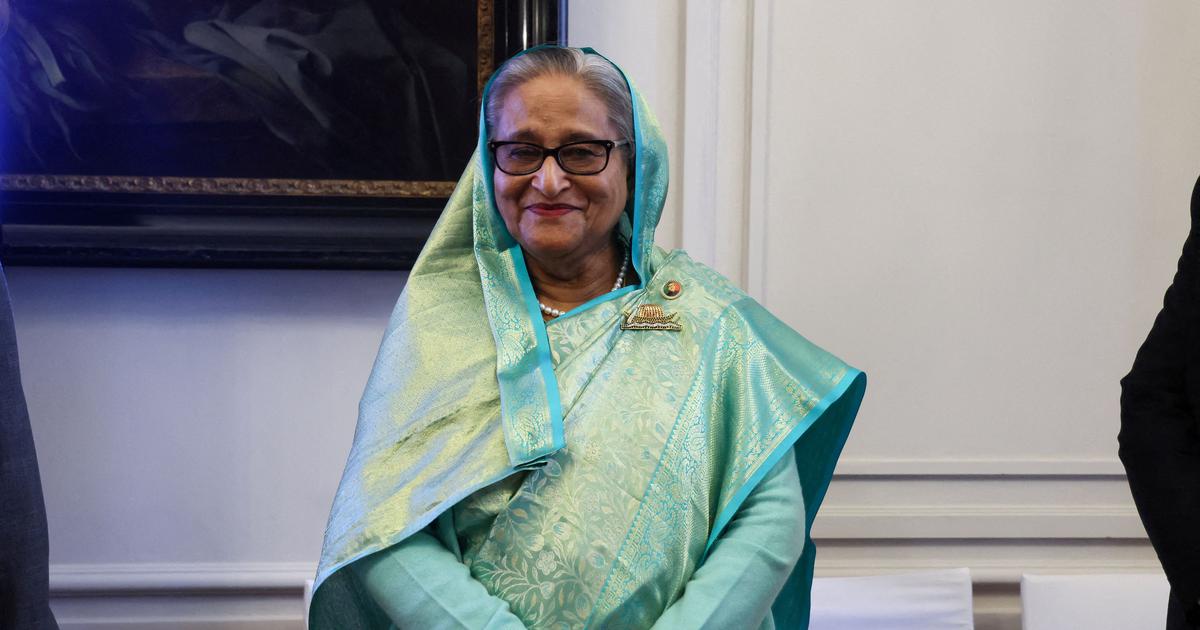
Sheikh Hasina, the ousted prime minister of Bangladesh, has said that she will return home around December and surrender despite the death sentence handed down against her while she has been living in exile in India.
In a telephone interview with Reuters published on Friday, the 78-year-old said she would return alongside senior Awami League leaders to challenge what she called the unlawful dissolution of her party.
“They may arrest me on my return, they may even kill me,” she said. “Still, I have to go. If death comes, I want it to come on my own soil.” She also called the courts that sentenced them “farcical”.
Hasina has been saying for months now that she will return to Bangladesh.
In an interview with NDTV on June 28, she said she would be back this year. Five days earlier, in an opinion article for The Print, she wrote that she would return to restore democracy, the rule of law and the spirit of the Liberation War. In late May, Times of Bangladesh reported that party activists had already been mobilised ahead of her return.
The Reuters interview, however, was different in two important ways.
For the first time, Hasina gave a specific timeframe, saying she would return “around December”. She also spoke directly to an international news agency over the phone – that too for nearly an hour as the report suggests – instead of issuing a written statement or a recorded message.
That alone made the interview major news in Bangladesh. Many local media outlets reported it prominently despite a December 2024 court order banning the publication of Hasina’s speeches. The government later reminded newspapers, television channels and online platforms to comply with that order.
Nevertheless, the interview dominated the country’s political discussion throughout Friday – a public holiday. However, very few people appear convinced that Hasina will actually return this year.
Awami League will rise again.
— Bangladesh Awami League (@albd1971) June 28, 2026
- Sheikh Hasina
Read the full interview here:https://t.co/AICIDgT1CV#Bangladesh pic.twitter.com/PQluQ2gh7T
Among political observers, the more common view is that this is another attempt to reassure Awami League supporters rather than a concrete plan.
When Hasina fled Bangladesh in August 2024, I argued in a piece on The Diplomat that the Awami League had no obvious successor and was entering a period of political uncertainty. Nearly two years later, that situation has barely changed.
Even Hasina’s son, Sajeeb Wazed Joy, who was highly visible during the first few months after her fall, has largely disappeared from public view. That leaves Hasina herself as the party’s only real source of political hope. Her promise to return has therefore become one of the few messages capable of keeping grassroots activists motivated.
Ironically though, Hasina has done little for those activists as of now.
Awami League leader Mohibul Chowdhury told ANI on Friday that more than 140 former MPs, along with many former chairmen and mayors, remain in jail. Thousands of party workers have also been arrested under Operation Devil Hunt.
The Awami League’s own website claims that more than 300 leaders, activists and supporters were killed between August 2024 and late 2025 through mob attacks, extrajudicial killings and deaths in custody.
The figure was not independently verified. But even if it was true, the contrast is difficult to ignore. Ordinary party workers have carried most of the risk, while the senior leadership, including Hasina, has remained safely abroad.
Seen in that light, Hasina’s latest promise looks less like a declaration of imminent return and more like an attempt to rebuild confidence among increasingly frustrated supporters.
Whether a telephone interview alone can achieve that is another question, especially when Hasina has not appeared publicly for once since leaving Bangladesh.
VIDEO | Dhaka, Bangladesh: "Sheikh Hasina must return to Bangladesh. We are ready to welcome her warmly," says Nahida Luna, Bangladesh Chhatra League (student wing of Awami League) leader.
— Press Trust of India (@PTI_News) July 10, 2026
Bangladesh's deposed prime minister Sheikh Hasina is preparing to voluntarily return to… pic.twitter.com/MJDVMzKqog
The timing is significant as well.
The government and political parties in Bangladesh across spectrums are currently observing July as the month of the mass uprising that removed Hasina from power two years ago.
Her announcement comes in the middle of those commemorations and appears designed to challenge a political narrative that has largely been dominated by her opponents.
There may also be an electoral calculation behind it.
Union Parishad elections are expected to begin in October, with the election schedule likely to be announced in August.
Although the Awami League – whose activities are currently banned – was barred from contesting February’s parliamentary election, that restriction does not apply to local government polls. It became clear last month that party members who meet the legal requirements can still contest those elections.
If so, Hasina’s announcement may be aimed as much at energising local activists ahead of those polls as at signalling an actual return in December. Strong performances in local elections could help the party rebuild before attempting a national comeback.
Whatever her real intentions, the interview also creates a diplomatic opportunity for Bangladesh.
Dhaka has repeatedly asked India to extradite Hasina since she took refuge there. Most recently on Thursday, State Minister for Foreign Affairs Shama Obaed Islam said there was no lack of diplomatic efforts to bring Hasina back to the country to face trial.
New Delhi, however, remained largely silent until April, when foreign ministry spokesperson Randhir Jaiswal said the request was being examined under India’s legal process. The carefully worded response neither accepted nor rejected Bangladesh’s demand.
Legally, Bangladesh has grounds to seek her extradition under the bilateral extradition treaty signed in 2013 and amended in 2016. The politics, however, are far more complicated.
Even if India agreed in principle, human rights organisations could argue that Hasina would not receive a fair trial in Bangladesh. That could trigger legal challenges and increase pressure on India to seek assurances before handing her over.
Grounds for asylum
Hasina could also apply for asylum in India on the grounds of political persecution, making extradition even more difficult.
However, her latest remarks point in the opposite direction.
Someone preparing to seek asylum is unlikely to publicly declare a willingness to return home and face arrest – or even death.
That gives Bangladesh’s government a stronger diplomatic argument.
Dhaka can now tell New Delhi that Hasina herself says she wants to return and face the courts. If that remains her position, Bangladesh can reasonably expect a clearer answer from India on its extradition request.
South Asian politics has never been short of dramatic declarations. Hasina may still not return in December, and India may still refuse to extradite her.
But by publicly saying she is ready to come back and face whatever awaits her, Hasina has made it harder for New Delhi to keep avoiding a more definite answer about her future in India.
Jannatul Naym Pieal is a Dhaka-based writer, researcher and journalist. His email address is jn.pieal@gmail.com.
