









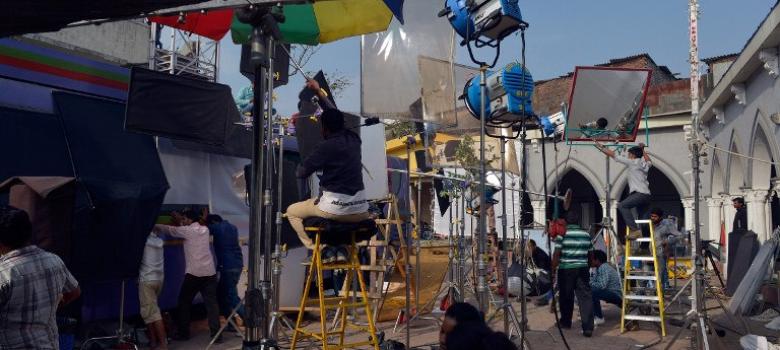
On Monday, some of the action on the floors of a Hindi television show in Mumbai shifted behind the camera, when members of the production team began assaulting three representatives of a technicians’ union. Representatives of the Allied Mazdoor Union had come to take their members home after receiving complaints that the light men were being made to work for more than 12 hours a day. The beatings were carried out by production team members who wanted to finish the shoot.
The violence, relatively rare in an industry where protests by unions are commonplace, sparked an angry flash strike in Film City on Tuesday. More than 2,000 members of the Allied Mazdoor Union, which represents light men, set makers and spot boys, stopped work at numerous film and TV shoots, demanding better wages, timely payments and more reasonable work hours.
While producers are more worried about the Rs 5 crore losses that they allegedly suffered because of the half-day strike, few are asking questions about the exploitative working conditions of blue-collar labourers in the glamour industry.
According to the Allied Mazdoor Union, technicians and spot boys make up about 60% of the work force on any film or TV set. Given that India is one of the world’s largest producers of films and daily soaps, this is a massive labour force. “But we are not protected by any labour laws and remain in the unorganised sector,” said Gangeshwar Shrivastav, general secretary of the Union.
In 1998, Sushma Swaraj, who as union minister for information and broadcasting, officially granted the film world the status of an industry. While this meant that producers could turn to banks to finance their projects, it has not changed much for technicians.
As of now, says Shrivastav, the only thing protecting workers’ rights in the industry is a memorandum of understanding signed periodically between four producers associations and the Federation of Western India Cine Employees, the parent body of 22 unions that work with film technicians and craftsmen.
Among other things, the MoU stipulates that technicians will work for not more than 12 hours at a time. For some technicians, like light men, additional time is required before and after each shoot to set up and dismantle lights. “But some producers make us work for 18 hours at a stretch, excluding this extra time,” said Shrivastav.
Light men also often work with equipment that is mounted on runways several feet above the ground, putting them at great risk. “Several workers have died because of accidents on set, but they are still not given helmets, safety belts or even drinking water,” said Opender Chanana, former general secretary of the Federation of Western India Cine Employees and author of The Missing 3 in Bollywood: Safety, Security, Shelter. “This would be unacceptable by the labour laws of most countries.”
Producers make no provisions for the health and physical security of technicians, says Chanana, and sickness levels among the workers is very high. Even Film City, a property owned by the Maharashtra state government, has no ambulances or emergency medical services at hand. Most technicians come from low-income families and live in the outskirts of the city, so they spend long hours commuting and get very little rest. “A peon in a bank enjoys more privileges than a film technician,” he said.
For all of this, light men typically get paid an average of Rs 750 a day. This is technically meant for an eight-hour shift, said Shrivastav, but producers pay that amount for 12-hour shifts and more. “These payments are often not even regular, which is another violation of the MoU,” said Shrivastav.
Since the MoU has no legal standing, unions have started protesting through non-cooperation, by pulling their members out of film and TV sets after they are done with 12 hours of work. This has brought matters to a head with producers. In a statement to Mid-Day, JD Majethia, head of the Indian Film and Television Producers Council claimed that the MoU clearly mentions “there will be no stoppage of work by any craft, and disputes and problems will be discussed at regular meetings”.
While the workers’ unions and producers’ associations battle it out, some producers do acknowledge that technicians end up getting a raw deal amidst the glamour of entertainment industry, particularly in the television industry.
“Daily soaps work on crazy deadlines, and there is a lot of pressure to deliver content, so technicians do get overworked,” said filmmaker and producer Rohan Sippy. The pressure begins, he says, right at the top with the TV channels. “Workers definitely need better wages to survive in Mumbai, but often the producer does not get increments from the channel,” said Sippy.
If a channel delays payments, the ones most affected, inevitably, are those at the bottom of the food chain.
We welcome your comments at
letters@scroll.in.
The violence, relatively rare in an industry where protests by unions are commonplace, sparked an angry flash strike in Film City on Tuesday. More than 2,000 members of the Allied Mazdoor Union, which represents light men, set makers and spot boys, stopped work at numerous film and TV shoots, demanding better wages, timely payments and more reasonable work hours.
While producers are more worried about the Rs 5 crore losses that they allegedly suffered because of the half-day strike, few are asking questions about the exploitative working conditions of blue-collar labourers in the glamour industry.
According to the Allied Mazdoor Union, technicians and spot boys make up about 60% of the work force on any film or TV set. Given that India is one of the world’s largest producers of films and daily soaps, this is a massive labour force. “But we are not protected by any labour laws and remain in the unorganised sector,” said Gangeshwar Shrivastav, general secretary of the Union.
In 1998, Sushma Swaraj, who as union minister for information and broadcasting, officially granted the film world the status of an industry. While this meant that producers could turn to banks to finance their projects, it has not changed much for technicians.
As of now, says Shrivastav, the only thing protecting workers’ rights in the industry is a memorandum of understanding signed periodically between four producers associations and the Federation of Western India Cine Employees, the parent body of 22 unions that work with film technicians and craftsmen.
Among other things, the MoU stipulates that technicians will work for not more than 12 hours at a time. For some technicians, like light men, additional time is required before and after each shoot to set up and dismantle lights. “But some producers make us work for 18 hours at a stretch, excluding this extra time,” said Shrivastav.
Light men also often work with equipment that is mounted on runways several feet above the ground, putting them at great risk. “Several workers have died because of accidents on set, but they are still not given helmets, safety belts or even drinking water,” said Opender Chanana, former general secretary of the Federation of Western India Cine Employees and author of The Missing 3 in Bollywood: Safety, Security, Shelter. “This would be unacceptable by the labour laws of most countries.”
Producers make no provisions for the health and physical security of technicians, says Chanana, and sickness levels among the workers is very high. Even Film City, a property owned by the Maharashtra state government, has no ambulances or emergency medical services at hand. Most technicians come from low-income families and live in the outskirts of the city, so they spend long hours commuting and get very little rest. “A peon in a bank enjoys more privileges than a film technician,” he said.
For all of this, light men typically get paid an average of Rs 750 a day. This is technically meant for an eight-hour shift, said Shrivastav, but producers pay that amount for 12-hour shifts and more. “These payments are often not even regular, which is another violation of the MoU,” said Shrivastav.
Since the MoU has no legal standing, unions have started protesting through non-cooperation, by pulling their members out of film and TV sets after they are done with 12 hours of work. This has brought matters to a head with producers. In a statement to Mid-Day, JD Majethia, head of the Indian Film and Television Producers Council claimed that the MoU clearly mentions “there will be no stoppage of work by any craft, and disputes and problems will be discussed at regular meetings”.
While the workers’ unions and producers’ associations battle it out, some producers do acknowledge that technicians end up getting a raw deal amidst the glamour of entertainment industry, particularly in the television industry.
“Daily soaps work on crazy deadlines, and there is a lot of pressure to deliver content, so technicians do get overworked,” said filmmaker and producer Rohan Sippy. The pressure begins, he says, right at the top with the TV channels. “Workers definitely need better wages to survive in Mumbai, but often the producer does not get increments from the channel,” said Sippy.
If a channel delays payments, the ones most affected, inevitably, are those at the bottom of the food chain.
