






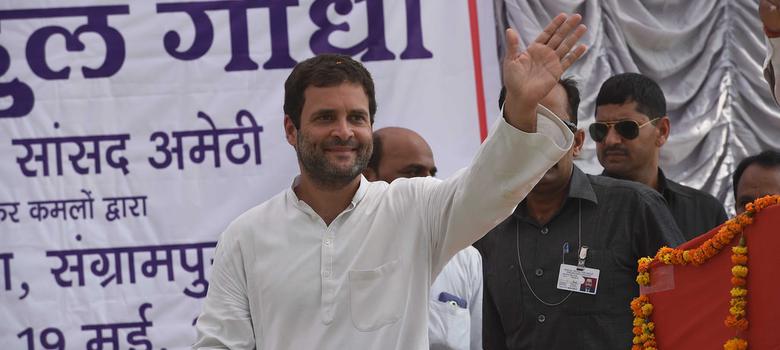
Reports that Congress vice-president Rahul Gandhi could meet Bihar Chief Minister Nitish Kumar shortly to firm up an alliance between their parties for the coming Bihar assembly elections have filled Congress cadres with some hope. They had begun to wonder lately if the Nehru-Gandhi scion would go beyond targeting the Modi government.
The Congress sees the move as an indication that Rahul Gandhi is serious about shouldering greater responsibility in party affairs as he prepares to take over as its president later this year. If his proposed meeting with the Janata Dal (United) leader does come through, it will be his first such interaction with a prospective ally, a task which was handled in the past by Congress president Sonia Gandhi and senior party leader AK Antony. It will demonstrate that he is moving beyond smart soundbites and taking a long-term view of the party’s future.
There is no doubt that Rahul Gandhi’s sustained campaign against the Bharatiya Janata Party-led National Democratic Alliance government on his return from a mysterious sabbatical has energised the Congress rank and file, which was feeling dejected after the party’s disastrous performance in the last Lok Sabha election. His new energised avatar has helped the Congress occupy the opposition space and pushed the ruling alliance on the defensive.
Organisational revamp
Forced to lie low after its shock defeat, the Congress was exceptionally lucky that the ruling alliance’s move to amend the 2013 land acquisition bill presented it with an emotive issue to corner the Modi government even before it completed one year in office. A despondent Congress grabbed the opportunity to build a high-decibel campaign against the ruling alliance, enabling Rahul Gandhi to take centre stage and project Prime Minister Narendra Modi as “anti-farmer and pro-corporate.”
Having achieved initial success with his shoot and scoot policy, restive Congress members now believe it is high time that Rahul Gandhi unveiled his long-term vision for the party’s revival.
To begin with, the Nehru-Gandhi scion has to end the lingering uncertainty about the impending organisational reshuffle which has virtually paralysed the party. Faced with an uncertain future, most office bearers are only going through the motions as they try to save their jobs. As a result, there are doubts if Rahul Gandhi is getting adequate and proper feedback from otherwise preoccupied general secretaries about the states under their charge. Most state leaders themselves are hanging around Delhi, lobbying for posts and positions in anticipation of large-scale changes in the party organisation.
Defunct state units
Rahul Gandhi also needs to take time off to focus attention on streamlining and strengthening the party organisation in each state. It is an acknowledged fact that the Congress organisation in the states is in deep crisis. The party has virtually become defunct over the years in states like Bihar, Uttar Pradesh, West Bengal and Tamil Nadu, where it has lost its traditional core support base to regional players. In other instances, state units are mired in intense factionalism. Pointing to the bitter infighting in the Punjab unit between former Chief Minister Amarinder Singh and state unit president Pratap Singh Bajwa, Congress leaders counselled that Rahul Gandhi should step in and resolve these differences at the earliest.
“Now that he has plunged back into action, Rahul Gandhi should get down to specifics,” said a former Congress minister known for his proximity to Rahul Gandhi. “For instance, he should focus on each state, overhaul state-level organisations, hold intensive interactive sessions with party workers and build local leadership.”
In this context, Congress members are happy that Rahul Gandhi is set to take greater interest in the upcoming Bihar assembly election even though the party is a marginal player in that state.
Although the Congress vice-president is reported to be keen on tying up with Nitish Kumar if the Janata Dal (United) and Lalu Prasad Yadav’s Rashtriya Janata Dal fail to stitch up an alliance, Congress insiders believe the party leadership should broker peace between the two since division in their ranks will be advantageous to the BJP.
Existential question
In addition to focusing on the party organisation and its state units, Rahul Gandhi has to address a larger existential question: what does the Congress stand for? The grand old party has not only lost its place as the country’s main political force to the BJP, but it is also floundering in the face of fast-paced socio-economic and demographic changes which have eroded its traditional vote base. Although it is early days yet, the Congress is desperately searching for a slogan like Indira Gandhi’s “Garibi Hatao” or Modi’s “Achche din aane walen hain” which will touch a chord with the people and explain what the grand old party has to bring to the table.
More specifically, the Nehru-Gandhi scion has to show what he and the Congress stand for, what they have to offer as opposed to the ruling alliance. The party’s position on the land bill is a clear attempt to reach out to the marginalised sections by grabbing the left-of-centre space and underlining its pro-poor credentials. But Congress leaders believe they need to go beyond this and come up with a more comprehensive strategy to position itself as a party which can meet the needs of an aspirational India.
“Where do we go from here: that’s the big question confronting us now,” remarked a senior Congress leader. “The land bill issue was presented to us on a platter. But what we need is a plan… a strategy to take our battle to the next level.”
We welcome your comments at
letters@scroll.in.
The Congress sees the move as an indication that Rahul Gandhi is serious about shouldering greater responsibility in party affairs as he prepares to take over as its president later this year. If his proposed meeting with the Janata Dal (United) leader does come through, it will be his first such interaction with a prospective ally, a task which was handled in the past by Congress president Sonia Gandhi and senior party leader AK Antony. It will demonstrate that he is moving beyond smart soundbites and taking a long-term view of the party’s future.
There is no doubt that Rahul Gandhi’s sustained campaign against the Bharatiya Janata Party-led National Democratic Alliance government on his return from a mysterious sabbatical has energised the Congress rank and file, which was feeling dejected after the party’s disastrous performance in the last Lok Sabha election. His new energised avatar has helped the Congress occupy the opposition space and pushed the ruling alliance on the defensive.
Organisational revamp
Forced to lie low after its shock defeat, the Congress was exceptionally lucky that the ruling alliance’s move to amend the 2013 land acquisition bill presented it with an emotive issue to corner the Modi government even before it completed one year in office. A despondent Congress grabbed the opportunity to build a high-decibel campaign against the ruling alliance, enabling Rahul Gandhi to take centre stage and project Prime Minister Narendra Modi as “anti-farmer and pro-corporate.”
Having achieved initial success with his shoot and scoot policy, restive Congress members now believe it is high time that Rahul Gandhi unveiled his long-term vision for the party’s revival.
To begin with, the Nehru-Gandhi scion has to end the lingering uncertainty about the impending organisational reshuffle which has virtually paralysed the party. Faced with an uncertain future, most office bearers are only going through the motions as they try to save their jobs. As a result, there are doubts if Rahul Gandhi is getting adequate and proper feedback from otherwise preoccupied general secretaries about the states under their charge. Most state leaders themselves are hanging around Delhi, lobbying for posts and positions in anticipation of large-scale changes in the party organisation.
Defunct state units
Rahul Gandhi also needs to take time off to focus attention on streamlining and strengthening the party organisation in each state. It is an acknowledged fact that the Congress organisation in the states is in deep crisis. The party has virtually become defunct over the years in states like Bihar, Uttar Pradesh, West Bengal and Tamil Nadu, where it has lost its traditional core support base to regional players. In other instances, state units are mired in intense factionalism. Pointing to the bitter infighting in the Punjab unit between former Chief Minister Amarinder Singh and state unit president Pratap Singh Bajwa, Congress leaders counselled that Rahul Gandhi should step in and resolve these differences at the earliest.
“Now that he has plunged back into action, Rahul Gandhi should get down to specifics,” said a former Congress minister known for his proximity to Rahul Gandhi. “For instance, he should focus on each state, overhaul state-level organisations, hold intensive interactive sessions with party workers and build local leadership.”
In this context, Congress members are happy that Rahul Gandhi is set to take greater interest in the upcoming Bihar assembly election even though the party is a marginal player in that state.
Although the Congress vice-president is reported to be keen on tying up with Nitish Kumar if the Janata Dal (United) and Lalu Prasad Yadav’s Rashtriya Janata Dal fail to stitch up an alliance, Congress insiders believe the party leadership should broker peace between the two since division in their ranks will be advantageous to the BJP.
Existential question
In addition to focusing on the party organisation and its state units, Rahul Gandhi has to address a larger existential question: what does the Congress stand for? The grand old party has not only lost its place as the country’s main political force to the BJP, but it is also floundering in the face of fast-paced socio-economic and demographic changes which have eroded its traditional vote base. Although it is early days yet, the Congress is desperately searching for a slogan like Indira Gandhi’s “Garibi Hatao” or Modi’s “Achche din aane walen hain” which will touch a chord with the people and explain what the grand old party has to bring to the table.
More specifically, the Nehru-Gandhi scion has to show what he and the Congress stand for, what they have to offer as opposed to the ruling alliance. The party’s position on the land bill is a clear attempt to reach out to the marginalised sections by grabbing the left-of-centre space and underlining its pro-poor credentials. But Congress leaders believe they need to go beyond this and come up with a more comprehensive strategy to position itself as a party which can meet the needs of an aspirational India.
“Where do we go from here: that’s the big question confronting us now,” remarked a senior Congress leader. “The land bill issue was presented to us on a platter. But what we need is a plan… a strategy to take our battle to the next level.”
