





Football fans had much to cheer about in 2015.
Barcelona conquered Europe yet again, meticulously dissecting a brave Juventus 3-1 in the UEFA Champions League final, while Belgium rose to the top of the FIFA rankings. Across the Atlantic, Alexis Sanchez single-handedly propelled Chile to Copa America glory on home soil, and the United States’s imperious form secured victory at the Women’s World Cup.
At home, Kolkata giants Mohun Bagan won the I-League and the second Indian Super League was a compelling watch, culminating in a five-goal thriller of competitive and topsy-turvy football in the final, which was won by Chennaiyin FC.
Yet, it was not exactly a beautiful year for the beautiful game in India. In an encore of a sullen 2014, many deficiencies resurfaced both at club and national level, and the progress made to address the manifold problems has been negligible, if not non-existent.
At club level, the schism between the I-League and the Indian Super League is omnipresent. The I-League began on January 9, with defending champions Mohun Bagan beating newcomers Aizawl FC 3-1, but the fun and frolic that enticed fans in the ISL was notably missing.
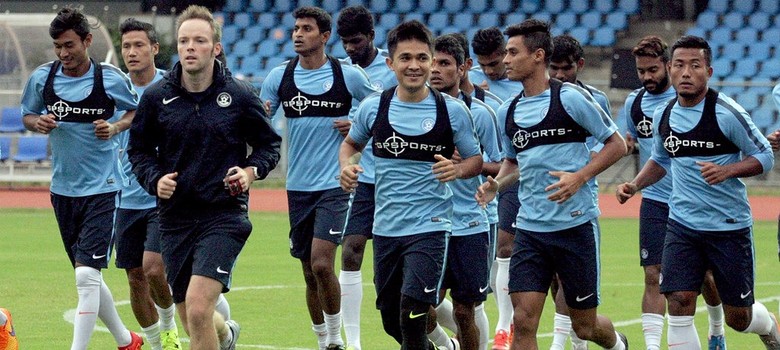
At the national level, the Blue Tigers were a major disappointment. New coach Stephen Constantine, a Greek-Cypriot Londoner, failed to deliver on his promise of an attacking brand of football. Constantine has watched Arsene Wenger coach his players at Arsenal and has visited Spain manager Vicente Del Bosque to understand the intricacies of "Tiki-Taka", but his expert knowledge could not prevent India from slumping to a 2-1 defeat against tiny island of Guam in World Cup qualification, one of several dismal performances in 2015.
Kushal Das, the general secretary of the All India Football Federation, spoke to Scroll about the state of the Indian game.
Does Indian football require a merger between the Indian Super League and the I-League?
It’s clear that ultimately there needs to be one league. The ISL was started with a different purpose, because the I-League has been around for 15 years and it didn’t really get that buzz. A shorter tournament might create that buzz, but at the same time we recognise that for the development of football, two leagues are not good. But it’s a good problem to have. At some point, we need one league – we are working on it, we are talking to all the stakeholders. It will take time; it’s difficult to outline when it will happen, but it will.
What do you identify as the core problem?
Popularity is an issue. In terms of marketing, glitz and glamour, the I-League after the ISL is a different [experience]. It’s creating an issue with development, players and national coaches. You have players going from I-League clubs to ISL clubs for two months with a different coach. They return to the I-League clubs with a different coach and they go to the national team with a different setup too. That is all creating a bit of an issue. There are some legacy clubs in the I-League with a lot of history. At the same time, the economics of the ISL is completely different. The amount of investment is much higher than in the I-League.
Is the Indian Super League good for the development of the game?
I think ultimately you need money for development. Unless you get money, there is no development. That is what we are attempting to do – the creation of the ISL, and in the end of the creation of one profitable and sustainable league, so the money that is generated can go into development.
The national team had a disappointing year. Is there a long-term plan to rejuvenate the Blue Tigers?
We have a four-year-strategic plan, which was created with the help of FIFA. The plan focuses on grassroots and youth development and that’s why we bid for the Under-17 World Cup. That is going to give a great push as far as youth development is concerned. It’s going to take some time. It’s only when the development program is in place – the U-17 World Cup team would probably produce the players we require. They may actually end up playing in Europe in the real sense – we don’t want an Indian to play only 15 minutes in a league. No, we want players of calibre who can play regularly in a league. That should help a lot. In about 10 years' time, or probably seven to eight years' time, the national team will start to do better.
What should be the legacy of the Under-17 World Cup?
It’s huge to host a World Cup, even if it is an U-17 World Cup. [It’s about] the creation of an activation process to popularise football, improve the infrastructure and develop a competitive team that can produce the right players – who can play in Europe and be part of the national team in later years. India has never played in a [senior] World Cup. I think it will act as a big catalyst.
