




Rush Hour: Karnataka governor’s House speech sparks row, Manipur man shot dead and more
Become a Scroll member to get Rush Hour – a wrap of the day’s important stories delivered straight to your inbox every evening.
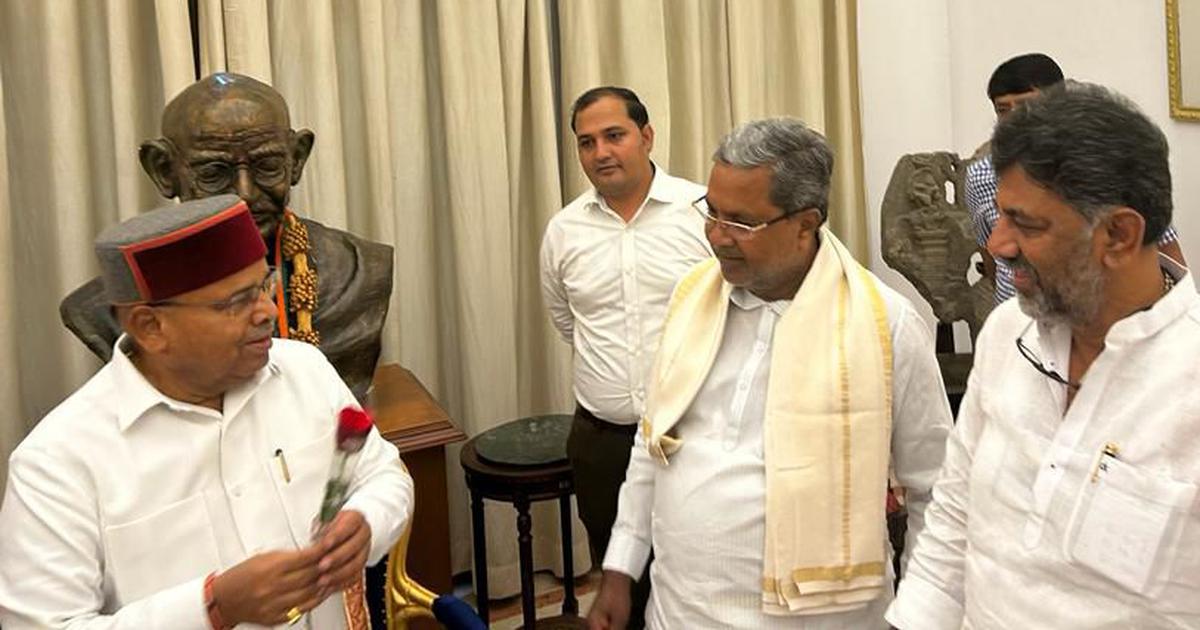
Protests erupted in the Karnataka Assembly after Governor Thaawarchand Gehlot only read out two lines from his customary address to the joint session of the state legislature. Gehlot objected to 11 paragraphs in the speech prepared by the Congress government in the state.
The speech contained criticism of the Union government, including its introduction of the Viksit Bharat – Guarantee for Rozgar and Ajeevika Mission (Gramin) Act that replaced the Mahatma Gandhi National Rural Employment Guarantee Act.
Citing the Constitution, Chief Minister Siddaramaiah said that the governor is “bound to read the address prepared by the Council of Ministers and has no authority to substitute it with a speech of his own”.
This was the third such controversy in three days involving governors in Opposition-ruled states. The previous two instances took place in Tamil Nadu and Kerala. Read on.
Members of the Great Nicobar Tribal Council alleged that in a January 7 meeting with the district administration, they were asked to sign “surrender certificates” as a way to hand over their ancestral lands for the Great Nicobar Project. They said that the administration made the request verbally.
The project includes the construction of a new township, a power plant, a greenfield international airport and a transhipment port. It is expected to use 166 sq km of the island, which also includes about 27 coastal villages that the Nicobarese tribal communities had lived in for generations and depended on for livelihoods.
In a press conference, the tribal chiefs said that the officials from the district commissioner’s office and a tribal welfare body, the Andaman Adim Janjati Vikas Samiti, were present at the meeting. They said that they did not sign the certificate, saying that they needed time to deliberate on the matter. Read on.
A 29-year-old man was on Wednesday abducted and shot dead in Manipur’s Churachandpur district by unidentified assailants, who recorded a video of the killing and circulated it, an Assam Rifles official told Scroll. A purported video of the killing showed the man, Mayanglambam Rishikant Singh, sitting on the ground in darkness and pleading to persons not visible in the video, after which two shots were fired at him.
Singh was a member of the Meitei community from Kakching town. For the past month, he had been staying in Churachandpur with his wife Chingnu Haokip, who belongs to the Kuki-Zo community. Read on.
The Supreme Court allowed Hindu prayers from sunrise to sunset during the Basant Panchami festival on Friday at the disputed Bhojshala-Kamal Maula mosque complex in Madhya Pradesh’s Dhar district. The bench also permitted Muslims to offer namaz between 1 pm and 3 pm on the day.
It directed that a list of persons coming to offer namaz be submitted to the district administration.
The 11th-century structure, protected by the Archaeological Survey of India, is claimed by Hindus and Muslims. While the Hindus believe that the Bhojshala is a temple dedicated to the deity Vagdevi, or Saraswati, the building is a mosque for the Muslim community. Read on.
A Delhi court acquitted former Congress MP Sajjan Kumar in a case related to inciting violence in the Janakpuri and Vikaspuri areas in the national capital during the 1984 anti-Sikh riots. The court said that there was “no evidence of instigating any such mob” and “of conspiracy”.
However, Kumar will remain in jail because of his convictions in other cases.
In the present matter, a case was filed against Kumar in February 2015 linking him to the violence in Janakpuri, where two men were killed on November 1, 1984. He was also booked for the killing of a man named Gurcharan Singh, who was allegedly set ablaze on November 2, 1984, in Vikaspuri. Read on.
If you haven’t already, sign up for our Daily Brief newsletter.
