







Rush Hour: India-EU trade deal announced, protests erupt against new UGC equity rules and more
Become a Scroll member to get Rush Hour – a wrap of the day’s important stories delivered straight to your inbox every evening.
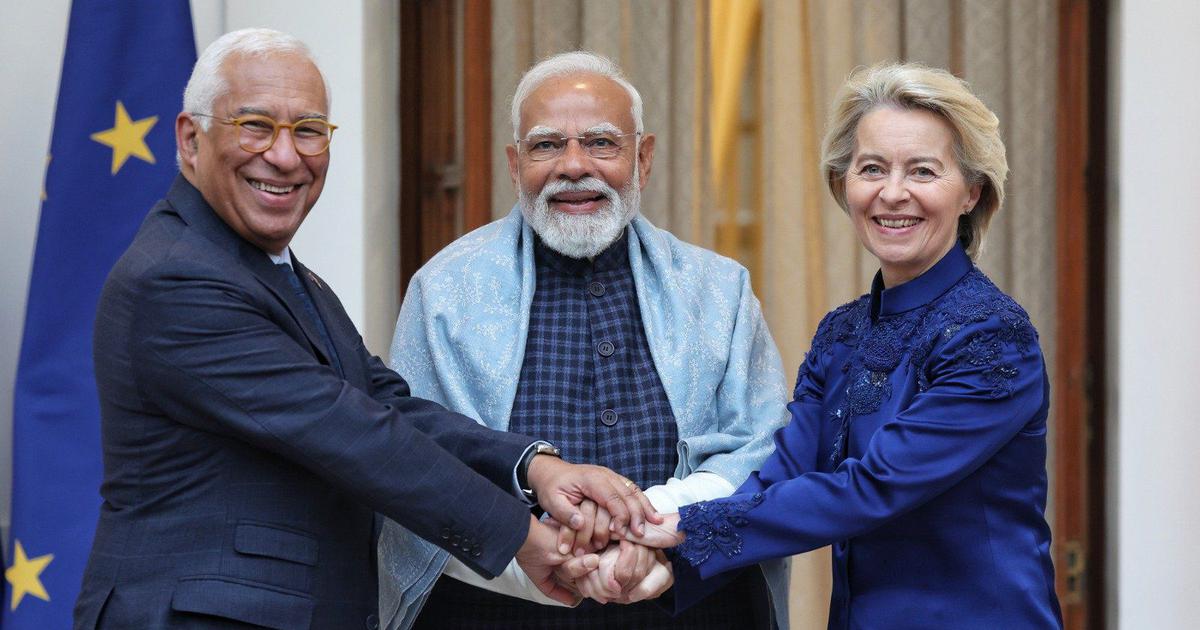
India and the European Union announced that they have finalised a free trade agreement after nearly 20 years of negotiations. The deal, covering 25% of global gross domestic product, will cut or eliminate tariffs on nearly 97% of European exports to India.
Prime Minister Narendra Modi said that the agreement would make it easier for Indian farmers and small industries to access the European market. New Delhi said that the deal will safeguard sensitive sectors such as dairy, poultry, and certain fruits and vegetables.
The tariffs on cars will be gradually lowered from 110% to 10% and the levies on processed agricultural products, which are currently at 50%, will be eliminated.
India and the European Union also announced that they were elevating their relationship to a security and defence partnership to improve cooperation in the defence industry sector and maritime security. Read on.
Assam Chief Minister Himanta Biswa Sarma claimed that four lakh to five lakh Miya voters will be deleted when the special intensive revision of electoral rolls takes place in the state. The Bharatiya Janata Party leader said his job “is to make the Miya people suffer”.
In Assam, “Miya” is a derogatory word used to refer to undocumented immigrants and is exclusively directed at Muslims of Bengali origin. They are often accused of being undocumented migrants from Bangladesh.
Sarma, addressing reporters about allegations of “vote theft” on Tuesday, said: “Yes, we are trying to steal some Miya votes. Ideally, they should not be allowed to vote in Assam. They should be able to vote in Bangladesh.”
In Assam, the Election Commission is conducting a “special revision” of the voter list, instead of the special intensive revision exercise underway in 12 states and Union Territories. Assembly elections are expected to be held in the state in three to four months. Read on.
The new University Grants Commission regulations on promoting equity in higher education institutes sparked protests by upper-caste students in several cities, and led to a challenge being filed in the Supreme Court. The students argue that the rules, notified on January 13, could lead to discrimination against them and that they do not provide for safeguards against false complaints.
Protests were held outside the commission’s headquarters in Delhi and at Lucknow University.
The plea in the Supreme Court argues that the new framework denies grievance redressal mechanisms and institutional protection to persons who do not belong to the Scheduled Castes, Scheduled Tribes and Other Backward Classes.
The BJP Kisan Morcha’s vice president in Uttar Pradesh’s Salon town resigned from his post, citing discontent about the new regulations. This came a day after the Bareilly city magistrate resigned to protest “anti-Brahmin” government policies. After he resigned, the Uttar Pradesh government suspended him on charges of indiscipline. Read on.
The Madras High Court set aside an order of a single-judge bench who had directed the Central Board of Film Certification to grant a U/A certificate to actor-politician Vijay’s film Jana Nayagan. The court sent the matter back to Justice PT Asha for fresh consideration.
A U/A certificate allows children below the age of 12 to watch a film under parental guidance.
The High Court said that the principles of natural justice had not been followed in the single judge’s order. It added that the film certification board should have been given an opportunity to defend its decision before the direction was issued.
Jana Nayagan, which is Vijay’s final film before the Tamil Nadu elections, has been caught in a legal battle after the censor board delayed the certification of the movie. It was supposed to release on January 9, ahead of harvest festival Pongal. Read on.
If you haven’t already, sign up for our Daily Brief newsletter.
