







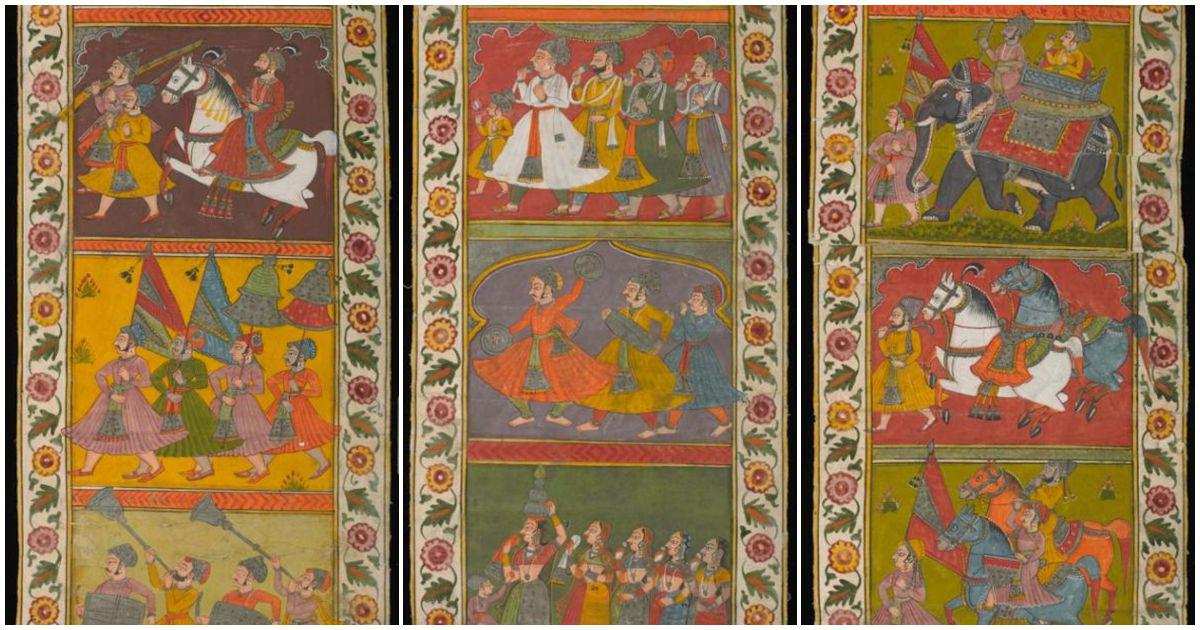
Badshah Jahangir appears in profile at his jharoka. Soon, three men come into view – two noblemen holding rolled-up papers, one atop an elephant and a third in white robes. The court scene gives way to the bustle of the city outside, to a public space teeming with musicians, monks, merchants and officials. Finally, two white-robed individuals read from a long piece of paper to a similarly attired distinguished figure seated in a pavilion, surrounded by disciples, performers and women making an auspicious swastika design with rice.
These vignettes, composed in Agra in 1610 by artist Ustad Salivahan, illustrate a letter recording how a contingent of Jain priests convinced Mughal emperor Jahangir to issue a farman prohibiting animal slaughter during the eight Jain holy days of Paryushan and then communicating this news to subjects and laity.
Roughly three metres long and as wide as an A3 sheet, the scroll is currently accessible not in its original, physically fragile form, unfolded bit by bit. Instead, it appears byte by byte as a high-resolution scan on a monitor at the Lalbhai Dalpatbhai Institute of Indology in Ahmedabad, one of the world’s foremost repositories of Jain art.
Beyond its intriguing narrative, the Agra scroll is notable for its form. It is perhaps the most celebrated example of a distinctive epistolary artefact: the vijnaptipatra, described by art historians Shridhar Andhare and Laxmanbhai Bhojak as “an illustrated letter of invitation to a monk requesting him to spend the next Chaumasa (four months) of the rainy season at the host’s town”. Commissioned by Shvetambara Jain sanghas, mainly in Gujarat and Rajasthan, particularly Marwar’s Sirohi area, these scrolls were typically painted in opaque watercolour, sometimes extending up to 30 feet, and produced by scribes (lahiyas) and artists from the Mathen community.
Meritorious act
Art historian Dipti Khera, the foremost scholar of these objects, notes in an article in Journal18 that while invitation letters can be traced to the 14th century, vijnaptipatras flourished in the 18th and 19th centuries. Indeed, apart from the Agra scroll, all those in Lalbhai Dalpatbhai Institute’s scanned collection belong to this period, suggesting a surge in production. For the most part, their making followed a standardised process.
Scribes and artists would work from a blank, floral-bordered template, its upper portion pre-painted with auspicious motifs, street and bazaar scenes, Jain temples and other buildings, and episodes such as monks delivering sermons or Mahavir’s birth. Once complete, the invitation scrolls were dispatched around Dussehra, allowing sufficient time to arrange the monk’s visit by monsoon, should it be accepted.
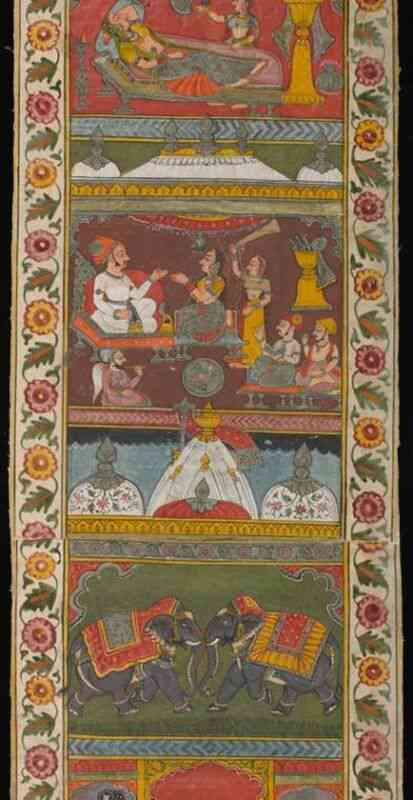
According to Andhare and Bhojak, commissioning a scroll was considered both a meritorious act and a marker of civic prestige. The first scholar to study these curious objects, archaeologist Hirananda Sastri explains in his 1942 book Ancient Vijnaptipatras that these letters were part of a Jain Sangh’s ritual atonement, expressing their high regard for the invited holy man and listing their meritorious deeds that they hoped would secure his goodwill. Perhaps reflecting this broader practice of seeking pardon or benediction from a religious superior, Sastri identified another type of vijnaptipatra – an exchange between two monks, one a guru and the other a disciple. This tradition is echoed in literary compositions modelled on the structure of the vijnaptipatra. For example, in the text Induduta, the author Vinayavijaya sent a vijnapti, or solicitation, during Paryushan from Jodhpur to his guru Vijayaprabha-suri in Surat – carried by the titular moon, in the manner of Kalidasa’s cloud messenger or Meghaduta.
Sastri examined 15 examples of the genre, from the 17th-century Agra scroll to some from the early 20th century, cataloguing the visual elements that recurred in the pictorial section. Apart from the inaugural mangala-kalasa (auspicious pitcher), the illustrations included one of two sets of eight sacred Jain objects, spanning the Brahmāna to animals such as the cow and the lion, as well as the elements. These were followed by depictions of the 14 Great Dreams of the last Tirthankar (preacher), Mahavir’s mother Trishala, featuring celestial flowers, banners and abodes, a milky ocean, a white moon, a sun as red as a parrot’s beak, and a fire fed with ghee. According to Andhare and Bhojak, these pictures occupy the upper half of the vijnaptipatra, separated by horizontal borders, while the lower half contains textual descriptions of the town’s beauty and its religious and social significance.
Like Andhare and Bhojak, Sastri recognises these letters as a form of travelogue. As an epigraphist, he focused on their textual canon – mostly a mix of Sanskrit and Prakrit, in prose and verse – and gave examples of epic epistles modelled on Kalidasa’s Meghaduta, showing how they vividly and enduringly described Jain-dominated cities along India’s western coast, from Jodhpur to Surat, as well as other sites such as Ellora and Diu.

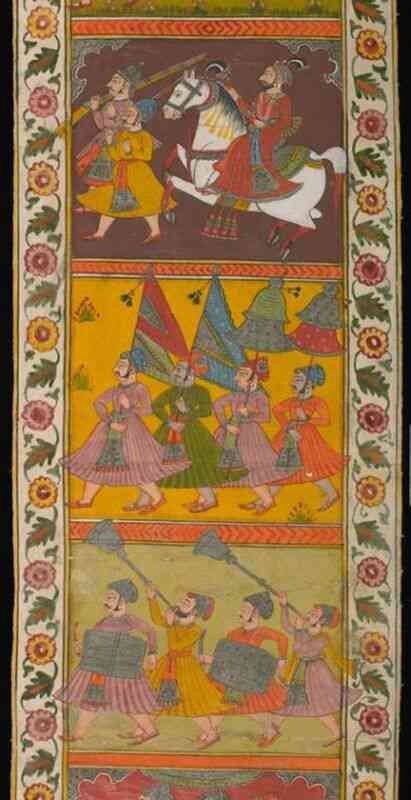
Sastri says these letters chronicled the area’s history and offered insights into its society. This affective, non-scientific articulation of space is central to appreciating the vijnaptipatras, much like the pseudo-topographical Jain pilgrimage maps known as tirthapatas. The representation of place was an important element of vijnaptipatra iconography, whether through direct depiction or a distinct visual language unique to a locale. Khera notes that although many vijnaptipatras followed a standard iconographic formula – where artists “cited images from an established canon without necessarily particularizing pictorial references to represent sites of a specific place” – they “almost always employed regional painting styles”. Across the vijnaptipatras available for virtual viewing at the Lalbhai Dalpatbhai Institute, the rendering of geographies and scapes is coded, layered, capturing the bhava of a place, denoting real locations – what Khera termed “charismatic cities” – and enticing the recipient to visit them.
In an 1835 vijnaptipatra sent by the Jodhpur Sangh to a monk in Ahmedabad, the dreams of Queen Trishala and the celestial court of Mahavir’s father, King Siddhartha, give way to recognisable urban scenes: houses, temples, shops, tradesmen and city-dwellers going about their routines, with the bustle of Jodhpur’s market animating the page. In her analysis of a scroll roughly from the same period – an unusual 1830 dual-axis example from Udaipur in which the artist transected the vijnaptipatra’s traditional vertical orientation with the horizontal motif of a procession – Khera interprets the strategy as a way to “replicate travelling or walking through the city of Udaipur”. Yet, even as the Lalbhai Dalpatbhai Institute’s Jodhpur scroll adhered to the straightforward up-down format, its unrolling by the monk addressee would likely have evoked the sensation of moving along the bazaar’s narrow streets, experiencing the city with the eye in the way the inviter hoped he would in time on foot.
Bazaar objects
Not all vijnaptipatras originated inland. A 19th-century example sent from Surat to a monk in Rajasthan features an image of a ship at sea, with sailors wearing European-style headgear.
In an essay in the journal Intersections, Khera examines a 17th-century scroll from Diu and cites an 18th-century one from Surat to note that coastal invitation letters bear harbour scenes at the end of the painted portion, with the visual margin echoing the shoreline – a convergence of horizons representing both the monastic and mercantile worlds of the Indian Ocean’s Jain communities. By bringing together the ambulatory guest clergy and the seafaring traders who would attend their assembly onto one visual plane, the vijnaptipatra offers the invitee a glimpse of his influential laity.
Beyond their religious function and panegyrical form, vijnaptipatras also allude to the complex sociopolitical and economic networks of late medieval and early modern India. The 1610 Agra scroll, for instance, is an explicitly political document, depicting an imperial city alive with merchants, monks, and Mughal and European officials. As Khera notes in her Journal18 essay, it circulates from the darbar to the sangha via the intermediary sphere of the market – the site of the Jain community’s power and influence.
Indeed, she argues that these illustrated letters are multivalent and multilayered “bazaar objects” – predecessors of popular art, produced at the periphery of courtly ateliers, containing diverse iconographies and enacting multiple identities: “from an urban panegyric scroll to a cartographic object, from an invitation letter to a proclamation document”. By representing their Jain commissioners’ political capital, commercial prosperity and movement through the mercantile community’s religious circuits, vijnaptipatras emphasised not only the towns’ piety within internal pilgrimage economies but also projected power outward, particularly after British colonisation.
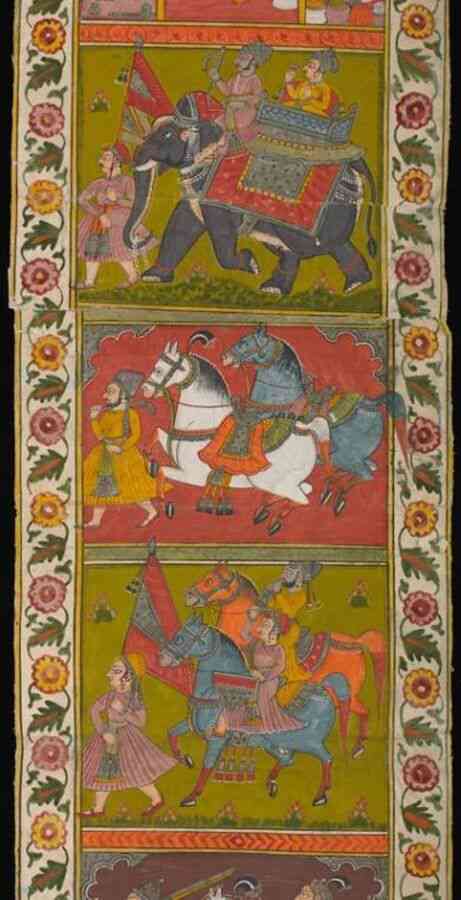
One example of this kind of projection, highlighted by Khera in her Intersections essay, is a 1795 Surat vijnaptipatra. That year, Surat had experienced riots, partly triggered by the British disruption of vessels needed by the Muslim community for the Hajj. For the Jain community, the vijnaptipatra may have served as a means to assert public claims to the city, drawing followers and pilgrims through the presence of the invited monk, while demonstrating the influence of Jain merchants among them. As Khera observes: “Thus vijnaptipatra-scrolls were indeed letters that constituted personal homage and invitations to a single monk, but they were equally public letters that carried proclamations of a time yet to come.”
Embodiments of a transregional economic, political and religious network, the geographic configurations in these letters also speak to a scale and mode of spatiality and movement that is “local”, pertaining, as Khera notes, to “shorter-distance travel, the flip side of [the] global”, which historiography has privileged as the more significant order, spanning greater extents. Yet the complex category of the local exemplified by vijnaptipatras illuminates both the situated ecosystem and the channels connecting it outward and inward – for example, the oceanic subgenre of the scroll reveals the scapes, figures and practices linking port and inland regions. The versatility, variety and polyvalence of these artifacts is captured by Khera: “As a quintessential travelling object created at the behest of religious Jain communities who constituted powerful trading groups, vijnaptipatra-scrolls shaped and were shaped by travels – on foot and by ships, long and short, trans-regional and trans-oceanic, and religious and mercantile.”
The cool, dark basement library of the Lalbhai Dalpatbhai Institute of Indology – housed in a Brutalist building designed by BV Doshi – might seem an unlikely place to spend an afternoon poring over centuries-old manuscripts, yet it is one of the few libraries in the world where at least a dozen are preserved.
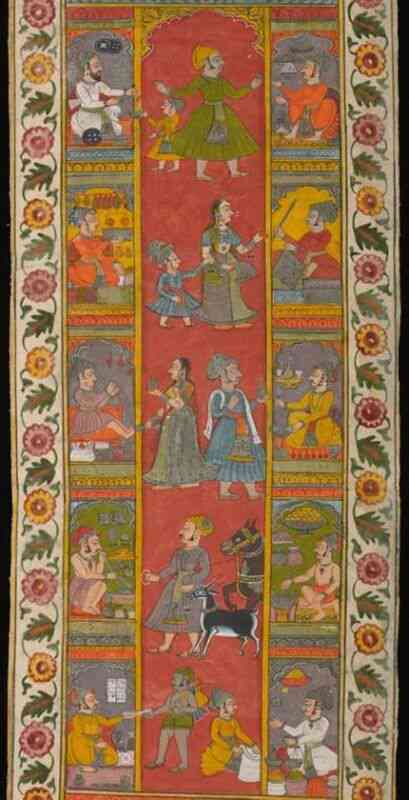
Sitting before the library computer and beholding the vibrant, charismatic cities of early modern western India, one is struck by the continuity of scrolling practices across centuries. Whether unfurling a manuscript register by register or gliding down a digital screen, and whether driven by monastic piety or scholarly curiosity, perhaps something of the vijnaptipatra’s original allure endures: the image unfolds and one imagines being there.
Kamayani Sharma is an independent writer, researcher and podcaster based in New Delhi. This project was made possible under the Scroll x MMF Arts Writer Grant.
