




“What just happened?”
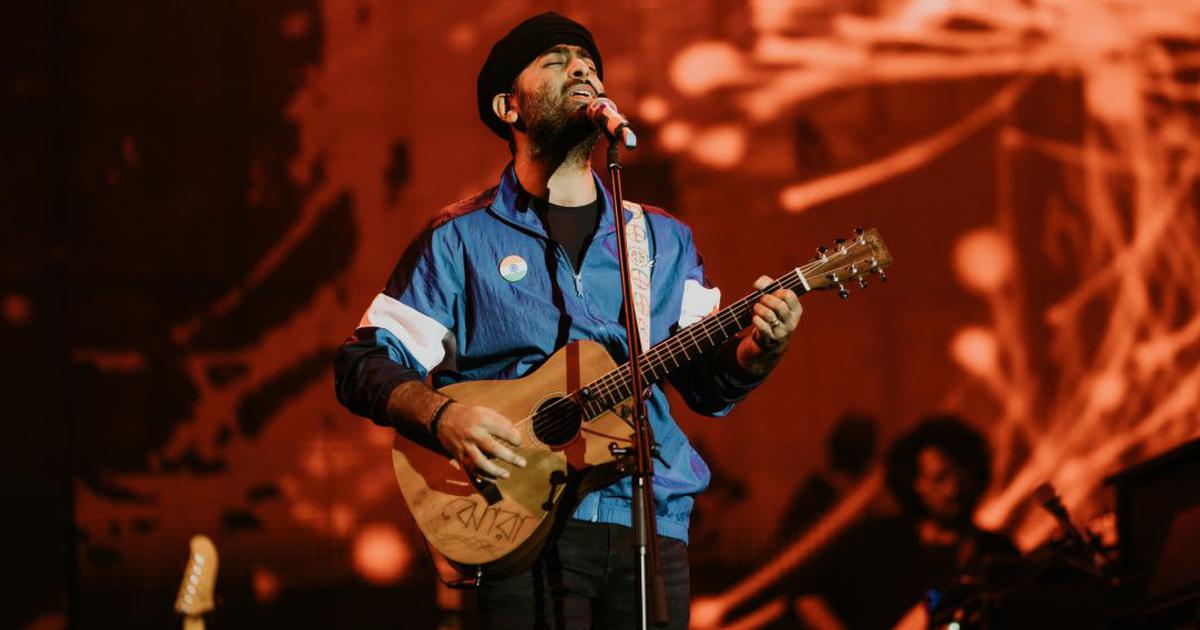
Anoushka Shankar asked as she raised her brows, made an O with her mouth, and spread her arms to the crowd at Netaji Indoor Stadium in Kolkata on Sunday. Arijit Singh had arrived out of nowhere, sang three songs, languid stage presence and all, waved goodbye and left. The crowd had no idea that Singh would turn up.
Singh’s impromptu performance, which had him vocalising a Ravi Shankar composition and singing an original tune, was all the more surprising because of his recent declaration that he won’t be “taking any new assignments as a playback vocalist from now on.” Fans were devastated.
Singh’s unanticipated shimmy hints at the kind of performer’s life he might focus on: surprising, motivating, exciting, and unbound by the Mumbai film industry’s general banality.
Indeed, over the past few years, social media has registered the sort of whining previously pointed out by critics and observers: the market is flooded with Arijit Singh, and he’s sounding the same in all songs.
There are only so many ways you can sing about a broken heart, more so in an industry where music labels-turned-production houses dictate how a song should feel and sound, how lengthy it should be, at what second the first verse should kick in. Any wild-at-heart artist would feel choked by such algorithmic bizarreness.
Singh has hinted at this moment for years. In 2017, the Jiaganj, Murshidabad, native, told PTI, “If you sing all the songs in the market, then obviously people are going to get exhausted, including me.”
He has also been critical of the hand that feeds. In a podcast in 2023, Singh said, “An artist is not as practical as a businessman. But since the business depends on the artist’s work, if everyone feels it’s not fair, then something is wrong. People should think about it.” T-Series, in particular, has been in the crosshairs of online Bollywood obsessives over Singh’s retirement.
Speculating away, there was also the matter of AR Rahman getting cornered for his suggestion that his Muslim faith had something to do with him being sidelined in the film industry. Singh is a major Rahman fanboy and a close collaborator. Moving away from the industry would be one way of showing solidarity to the great one.
The question remains: what next?
Any artist’s trajectory can be mapped from the hidden, unexplored elements in their existing work.
Take Shah Rukh Khan. Man wanted to be an action star. Aditya Chopra (director, Dilwale Dulhania Le Jayenge) saw in him a matinee idol. Fate took Khan in another direction, but he never missed a chance to deliver thrills in his films through the ‘90s and 2000s. Watch his hippity-hopping in action scenes in films like Duplicate, coupled with his blood-faced growling. You will know he is auditioning for a Sanjay Dutt role. Therefore, Pathaan, Jawan, King – they had to happen.
A distant but relevant example is the great British band Radiohead.
Radiohead’s electronic and experimental era was a shock to one and all when Kid A arrived in 2000, but the threats were already there in their early albums – Planet Telex, their opener from The Bends (1994), or Paranoid Android from their most successful record OK Computer (1997). You will hear a rock band trying to play electronic music using the guitar-bass-drum set-up.
Arijit Singh is nothing if not a rolling stone. Instead of relentlessly trying to break into the Mumbai playback scene, he invested his early earnings into a studio, which launched a career in music programming. At the time, he worked with all the leading composers: Pritam, Vishal-Sheykhar, Shankar-Ehsaan-Loy, Mithoon. When Singh moved to playback, he knew the ins and outs of the process better than the competition.
Aashiqui 2 (2013) made him a star. Twelve years of singing about broken hearts will exhaust any normal person. More so, when copycat singers and composers arrive. (See If not Arijit Singh, who?)
His stardom also created a legion of entitled, unimaginative fans. In the concert on Sunday, which had a stellar supporting band, including the fabulous Sarathy Korwar on percussion, a chunk of the crowd left immediately after Singh’s final song. It felt like Indian cricket fans switching off the TV after Sachin Tendulkar got out in the 1990s.
Singh told The Music Podcast in 2023, “There was a time when I used to associate with my name: Arijit Singh. But as I grew up, there came a point when hearing my name would annoy me. There would be a crowd calling out my name. Initially, it felt overwhelming, but eventually I realised that my name is not me anymore. It’s a perception people have created about me.”
Still, the best composers deployed him in ways that felt fresh to us, and surely him: Sajde (Kill Dil, Shankar-Ehsaan-Loy), Khul Kabhi (Haider, Vishal Bhardwaj), Binte Dil (Padmaavat, Sanjay Leela Bhansali).
The non-film songs Singh has composed, produced and sung over the past few years reveal that he is as much interested in the entire soundscape as he is in his vocals. While Bollywood uses him to dominate a track, Singh’s non-film tracks, such as Rooh Jaga Doon and Barkha, are interested in ambient emptiness and sonic hyper-details. Singh is a studio craftsman, after all.
His 90-minute soundtrack for Pagglait (2021), apart from great tunes, has exceptional, otherworldly production. All independent-minded singer-songwriters who found fame through films in India are aching to break free and become sovereign.
Sid Sriram, in a Scroll interview in 2025, has expressed interest in doing more independent albums and composing soundtracks. Singh’s colleague, Sunidhi Chauhan, has revamped her stage image as a bad-bitch diva. All artists want to reclaim their identity from the machine.
