




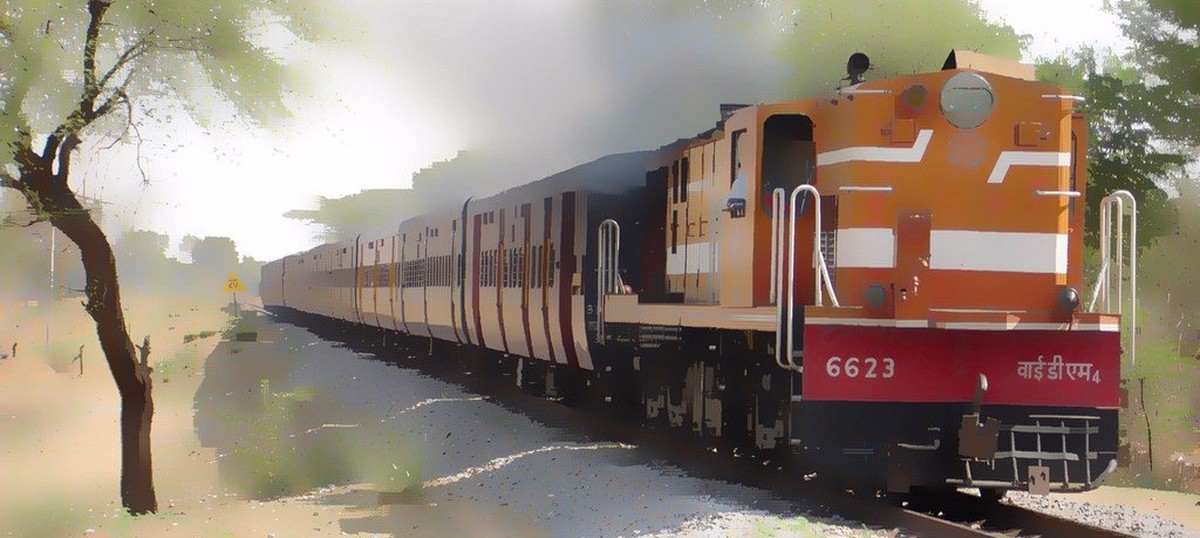
The train started, chugging out tiny sighs in a chain. She ran and caught the train. As she was searching for her seat, the ticket examiner asked, “No. 52 Jaya?” She nodded.
“The passenger has arrived,” he announced and moved ahead, circling No. 52 in his notebook. A man who had pursued him for the seat went and stood by the toilet.
Unaware that a passenger had come to occupy the window seat, Kamini was busy saying “tata”, sticking her head out of the window. When she turned, a sliver of a moon glittered on her nose.
Kamini looked at Jaya and said, “Just sit there for a bit, please?”
Only for a little while. After that the person who will occupy the seat is me, she seemed to say. Jaya sat down gingerly on the edge.
The train’s speed steadied into a soothing rhythm. The sizzling heat spread a golden hue outside. The second-class passengers folded their legs, stretched them or just reclined. A languid drowsiness, the effect of the morning meal, consumed a number of passengers.
Kamini’s four-year-old boy occupied the place near the window. Jaya leant behind, realising fully well that it would take a while before she took possession of it.
Within half an hour, the little boy’s arms and legs were caked with dirt and he looked around eagerly for new mischief to accomplish. He kept twisting the lid of the water jug, downing water and shutting it. His mother Kamini looked relaxed, as if the whole compartment belonged to her. Diamonds dazzled in her ears. A thick chain circled her neck. Eight slim bangles on her arm. Her hair was loosely tied, a string of slightly wilted jasmine around it. Faint scratches on her thumb from cutting vegetables. Turmeric added to the glow on her face.
Her not-so-old father sat next to Kamini. When she asked now and then, “Appa, do you want to eat anything?” he merely gestured with his hand and shut his eyes.
A couple sat beside Jaya. The wife leant her face against the window, looked out lazily, a paper cone of fried groundnuts in her left hand. Now and then, her husband put his hand inside the packet and scooped out some nuts; each time he did that, she kept inspecting the amount of nuts left over in the packet.
Her husband’s head – either naturally or as a result of his crop – was like a squashed papaya. He reclined, spreading his legs out. His rubber chappals had slipped off and lay near the feet of the older man. Not wanting to ask him to sit properly, the old man sat folding his legs on the seat.
The wife cautioned him, “Don’t look now,” and whispered something in his ears. But he immediately looked at Kamini’s diamonds and the twisted rope-chain round her neck and nodded meaningfully. Realising that they were speaking about her, Kamini pulled out the ends of her sari from her waist and wrapped it gently around her shoulders.
Because he had looked immediately the wife pinched him sharply. The next time the wife tried to tell him something, he dismissively asked her not to say anything, gesturing to her that he knew everything.
The old man who appeared to be sleeping took in all this through half-opened eyes.
No one spoke to anyone, but they seemed to be enjoying within themselves all the petty goings-on around.
Jaya was desperate for the window seat. The train sped along with a thunderous noise, throwing up waves of hot air. In her haste, Jaya had forgotten to buy either a book to read or a packet of food. She curled up on the upper berth, feeling sticky and uncomfortable.
When the train neared a big station, Kamini took out from a shining tiffin carrier, tamarind rice and curd rice, redolent of asafoetida, and portioned them neatly on clean plastic plates for the three of them. Crisp chips, ladoos on the side, and the three of them began to eat. Their eating became the green signal for everyone in the compartment to begin eating and soon you could hear the noise of packets opening and water being poured.
The couple opposite took out two big packets, snapped the string used for wrapping, “pat pat”, since they didn’t have the patience to unwind it carefully. Then they turned their backs to everyone, and without even opening the packets fully, they held them curled in their hands like a nest and gobbled huge mouthfuls, “avak avak”, without even revealing what they were eating.
The train slowed down gradually and came to a halt. Jaya got down, bought poori-potato and some fruit, and made a dash for the empty seat by the window. Even though it was her seat, she felt a little uncomfortable since Kamini was bound to be surprised to find her sitting there.
“Amma, ten paisa, amma… ten paisa… ten paisa…” A dirty young boy nagged Jaya to the point of snatching her purse. When Jaya took out her handbag, he stopped shouting, held out his hand, looking around for the next prey. Without even checking how much she gave, he pounced on the next passenger. She turned aside, fearing another attack from a beggar.
Jaya suspected that the look Kamini gave her was unduly admonitory. “Don’t go near the window. Just stay here like a good boy.” Kamini stopped the child who ran for the window.
Kamini secretly sized up Jaya. Who was this person who never uttered a word, where was she going?
Jaya avoided Kamini who was trying to gauge her.
The more Jaya avoided her, the more necessary it became for Kamini to strike up a conversation with her.
“Is this sari a Kanchipuram?”
Jaya just nodded her head, as if to say “yes”.
“Cotton?”
“Mmm…”
“Looks like silk… You from Kanchipuram?”
“No, Cuddalore. I’m Jaya.”
“My name is Kamini.”
“I know. I heard your father calling you.”
“You working?”
“Yes, nurse.”
“My husband’s a doctor.”
“Oho…”
As the train started Jaya looked out of the window. She thought it would be good if the conversation stopped here. Another two hours left. She wanted to get off without getting upset.
“Which hospital are you working in?”
Jaya wasn’t sure if Kamini used the respectful form of “you” or tried to muffle the ending with the upper-caste lingo. Jaya realised with a strange feeling that as a nurse her esteem fell down in the eyes of a doctor’s wife. She mentioned the name of the hospital.
“You a Christian?”
She couldn’t still take in her stride the embarrassing situations of long train journeys. “No, why?”
“No, because you don’t have a pottu on your forehead.”
Jaya searched in her sari for the stick-on bindi which had dropped off and pressed it on her forehead.
Knowing very well that there wasn’t much time before the next question, Jaya started thinking of how to counter it.
The old man, husband, wife, everyone started sleeping in their berths.
The young boy pestered Kamini for a banana. Jaya plucked one from her bunch. The boy took it with Kamini’s permission.
Kamini held out a plate of chips and ladoos. When Jaya first refused, Kamini urged her to eat the chips at least if she didn’t like sweets. Jaya took the plate.
“You a Pillai?”
At last she had asked. “Mmm… what did you say?” Jaya asked again.
“No, I asked if you were from the Pillai caste?’
“No.’
Jaya thought she could have ended the conversation by saying “yes”. But why did she have to lie?
That one lie about the caste issue, which had led to ever so many lies in one of the earlier train journeys, came to mind.
In fact, she thought that this question was put to her by ever so many people either at the beginning, middle or end of every train journey. Her answer elicited discomfort and unease, transforming her into a child and the other into a powerful being. The tone usually changed… and then heated arguments against reservation and in the end she would find herself cast aside.
She clearly remembered the very first person who had asked her this question.
When she had gone to drink water from her classmate Tamilarasi’s house at recess when she was in primary school, a white-sari-clad old lady had asked, “What caste?” Not knowing, she had blinked. “Father’s name?” She had said, “So and so.” That was all. The old lady had chased her on to the verandah with a stick. That was the first time her backbone had been broken, she remembered painfully.
When she and her friends had gone for the “puberty function” when her classmate Rojarani had come of age, only she had been made to eat on the pial under the pretext of no space inside…
When she had been eating in the centre hall in Akilandam’s house, Akilandam’s mother, with a tonsured, covered head, had raised the question of her caste. Akilandam herself had managed the situation with a lie… When they had come out, Jaya had cautioned herself never to tell the truth about her caste…
The train stopped.
Combing out the knots with her hand from her windswept hair which fell about in threads in front, she finished the ladoo nonchalantly, held out the plate and asked, “What did you ask? The caste?” Ascertaining the question, she composedly revealed her caste. Relishing Kamini’s discomfort, she got off the train.
The train started, chugging out tiny sighs in a chain.
(Original title: Oru Rayilin Neenda Payanam, 1991)
Excerpted with permission from The Tamil Story: Through The Times, Through The Tides, edited by Dilip Kumar, translated by Subashree Krishnaswamy, Tranquebar.
