






I have spent longer than usual writing a review for Eartha, Vinita Agrawal’s latest book of ecological poetry. Why is that, I ask myself. I love the poems, they resonate, I agree with so much of that which is being said and yet I’m finding it really hard to write this. Again, I ask myself, why is that? And after another full day of going through the manuscript with the proverbial toothcomb, thinking about what messages the poems hold for me, trying to pick up clues from the rustle of the wind in the pines and the leaves of the apple trees, full green for miles around, realization dawns.
For Agrawal’s poems are beautiful, painful, revelatory and sometimes, just too sad for words. It is this sheer force of tragedy that has made it hard for me to critique Eartha. Sometimes the truth is difficult to bear.
The voice of nature
Eartha’s endpaper, a singularly arresting illustration from the 2nd century AD depicts three soothsayers interpreting Queen Maya’s dream of birthing Buddha. A scribe is recording the details of this dream. It is perhaps, the author tells us, the earliest available pictorial evidence of the written word in India. This is significant, given the potency ascribed to grafting the hitherto unspoken, the voice of Nature and the voicing of dreams or prophecies throughout the entire book.
From the dedication to “every living entity and to our Planet Earth”, Agrawal begins her journey and in the same breath, her conversation with Earth’s non-readers and readers alike. “For someone who loves nature,” she tells me, “it is natural to write about the devastation they see around them.” Identifying Poetry as the vital vehicle for sensitising the reader to the urgency of our times, Agrawal also cites words as “weapons of the right kind”. Make no mistake, this Goddess takes no prisoners – and she has many arms.
The hand at the end of the first of these arms wields an imaginary mic to interview the impoverished or ghosted creatures of our planet. Taking the role of the poetic journalist, Agrawal converses with the (now extinct: 2020) Splendid Poison Frog: “Did the sun flicker/at your vanishing act?” In other places, her questions falter, have no answer but silence, for the creatures she sets out to speak with have already departed for all time.
‘One afternoon, I said to myself,
— Weight
“Why isn’t the sparrow hungry?”
The Sparrow is not hungry because there are no more sparrows.
I could drown in the darkness of sparrows.’
Sometimes, the conversation takes the shape of a prayer: in “Forgive Me, Amur”, a plea to the Amur leopard, who is “about to join the nine hundred species we’ve lost./Humanity’s worst crime.”
Humanity does not evade karma for this crime, however. “Mankind itself is about to end,” she warns in “Message to the Species that have Gone Extinct”. If it wasn’t, “I wouldn’t be writing this:/We wouldn’t be begging for forgiveness.”
Through the bleak, sad facts, there springs defiance and hope: for example, the Gingko’s “sapling flags of resilience” have sprouted in Hiroshima since the desecration of that earth. Jujube and Persimmon are “inventing a language of survival/seeds filled with hymns”. (“Hibakujumoku – Survivor Trees.”)
Reading this reminds me of how Chernobyl’s desecrated earth has been renewing itself constantly in the years of human abandonment following the nuclear disaster of 1986. Wolves, boars, bears and deer returned to inhabit the forests of self-seeded Silver birch trees. Certain radiotrophic fungi continue to bring hope that even vast radioactive wastelands can revert, given time.
A quest for survival
In the title poem of Eartha, the Goddess holds out her hands as healer: in a conversation with the Earth herself, Agrawal suggests wrapping a shawl around Earth’s wounded form. This simple act in itself poses difficulties. A shawl of shatoosh would involve killing antelopes; one made of angora, cause rabbits to “struggle just to breathe in cages”; a tigerskin would result in “four thousand years of tremours”, mohair and silk would entail the death of goat and silkworm, while a goosefeather quilt would necessitate the unnecessary slaughter of countless geese.
No, the poet decides, none of the above. Simply her own arms. We see the benevolent aspect of the Goddess holding the Earth as she would a child in another set of those all-powerful arms.
In “To Orchid”, the noun is compelled to action as we learn what it means to “stay in the game/when roses and violets are wilting […]/to belt out stunning disclosures /when none were expected.” There is hope, too, of appropriate adaptation: imagine how it would feel to leopard, to hawkmoth, to alligator, to rhododendron!
Perhaps this is the answer to Humanity’s sad quest for survival: the intelligence to play with and transform our language, to adapt it so that as many species as possible are granted the greatest chances of survival? But then, what will there be once language is exhausted? “It’s the silence and softness of a forest,” imparts Agrawal, “that allows you to collect your thoughts.” There is evidence throughout Eartha that we may need to develop a silent language to best communicate with those who have no words: “It’s enough/that the earth speaks to us without speech…” in a forest where “leaves croon birds to sleep”.
Silence can also hold the aftermath of tragedy when it is the void that follows the call of a bird now extinct. In “The last Call of the Kuai’i o’ o’’, a bird last heard in Hawaii in 1987 “is calling for a mate who will never come…” This sorrow leaves both poet and reader in “broken-hearted silence”, a grief of survivor’s guilt.
To save the species from dying of this broken heart comes the Goddess holding her final and most potent weapon: the pen. As a writer and spokesperson for our precious Planet and all that lives upon it, Agrawal reminds us all that:
You and I are the earth’s voice its larynx
— Let's Do This
Let’s speak up […]
Let’s watch it come alive again.
“Poetry must come from the heart and make an impact on the reader. That’s all that counts,” concludes Agrawal when I ask her how important specific poetic form is to her writing process. And here the Goddess has the last word. For every poem in Eartha comes from this very place of compassion, the compassion that is the only call to act, repair and conserve our one and only multispecies, diverse and epic home.
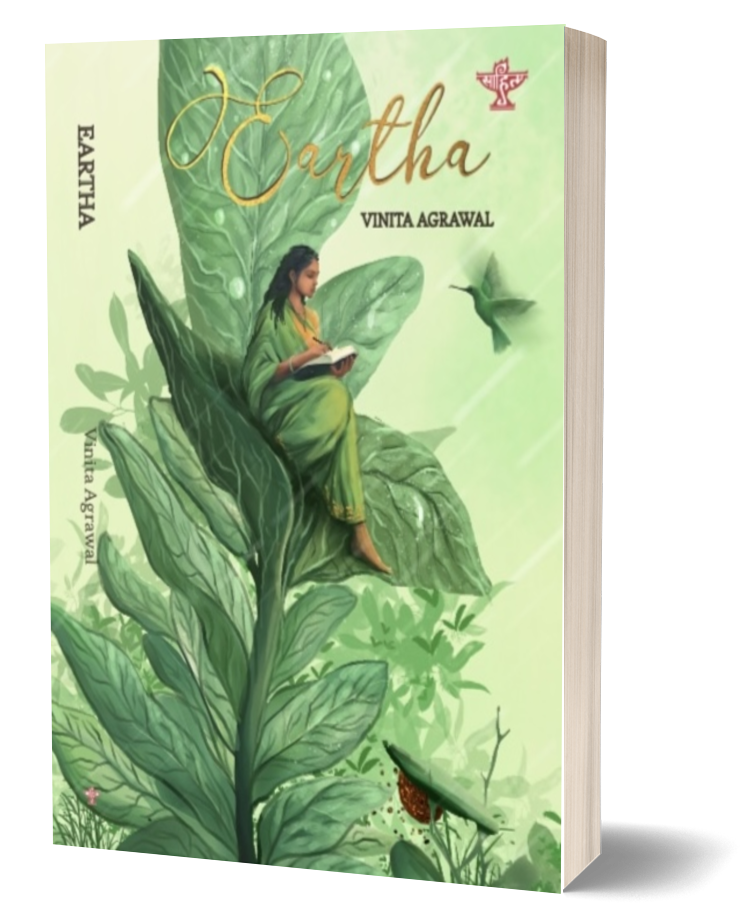
Eartha, Vinita Agrawal, Sahitya Akademi Publications.
