






In Amitav Ghosh’s Shadow Lines, the protagonist’s grandmother observes: “I could come home to Dhaka whenever I wanted.” She is referring to the time she had spent in Moulmein and Mandalay in Burma, where her husband worked as an engineer. However, in her journey from Burma to Dhaka to Calcutta, only Dhaka and Calcutta remain in memory.
In 1937, Burma was split from British India. Ten years later, India and Pakistan – with two wings, west and east – became separate countries. But now, the first partition all but been forgotten.
Shifting borders
In Shattered Lands: Five Partitions and the Making of Modern Asia, Sam Dalrymple sheds light on this the historical amnesia imposed upon Burma and Aden, both of which were part of the British Indian Empire, before their partitions in 1937. Until the time when Gandhi led his Salt March against the British, many Burmese identified themselves as Indian, and participated in movements against the partition of India and Burma.
“Of all the things to protest about British rule, the Salt Act was an unexpected one, raising eyebrows even among Gandhi’s most devoted followers,” Dalrymple writes. “But it proved to be an act of political genius and one of the last major political movements to unite Burmese and Indian nationalists.”
With the partition of 1937, the British Indian Administration demarcated the geographical and cultural lineages of both places, and eventually, the public memory of these earlier partitions was subsumed within the recent ones.
Over the decades, the people of South Asia have constantly been shifting between the possibility and impossibility of borders. The many partitions of India attest to the unnatural oddity of imposing such borders, with a few stakeholders having their own separate spheres of influence, unaware of the grassroots situation.
For instance, the British considered the Patkai Hills (now located in the Arunachal Pradesh, Nagaland, and the Upper Burma region) largely un-surveyed and un-administered; therefore, they qualified as a “far away” land impossible to reach. The new border was thus demarcated here, without considering the sensitivities of the land and its people. This left communities that had lived together for centuries on opposite sides of the border, their home on one side and work on the other.
During the Partition of 1947, Muslim Rohingyas living in the Patkai Hills found themselves as a part of the Burmese nation, and challenged the border with armed insurgency. From then on, Burma considered the Rohingyas “foreigners” and “immigrants”, belonging to Bengal.
Never a fixed entity
Similarly, even after independence, Angami Zapu Phizo, a prominent Naga leader, appealed to Gandhi for Nagaland’s independence. In 1937, when Burma was separated from India, roughly a fifth of the Naga population had ended up on the Burmese side of the border, and the other four-fifths in India. Phizo had then launched the biggest movement against the India-Burma partition and demanded a separate Naga colony. With another partition ten years later, Phizo found himself neglected and felt unheard by Indian and Pakistani nationalists alike.
The constant envisioning of a “Greater Bharat” shows that it has never been a fixed entity. More so, with more than 500 princely states having their own independent rulers, India was a nation still in progress, not completely discovered. Dalrymple tells us about the frantic decisions, last-minute signing of the Instrument of Accessions, and plebiscites with respect to India’s many princely states that didn’t seamlessly merge into a “Greater Bharat”.
In today’s volatile political environment, this forces us to question: How has the vision of “Greater India” changed over time? When was the ideal vision of “Bharat” invented? “As late as 1930 it had still been possible for anti-colonial activists in Aden, Rangoon, Lahore and Dacca to conceive of themselves as part of a future Indian nation,” writes Dalrymple.
While the saga of princely states such as Kashmir, Junagadh, Hyderabad, and others remains in the public imagination, extensively researched and written about, Dalrymple’s narrative strength is depicted through the latest envisioning of India with respect to the Northeastern states of India and Burma.
It is a stark reminder that public memory is created, and is an active act of consciously remembering and connecting what has been lost. Understanding the making of Modern Asia holistically paves the way for a reparative reading of the Partition, enabling us to find different manifestations of cultural and geographical continuities.
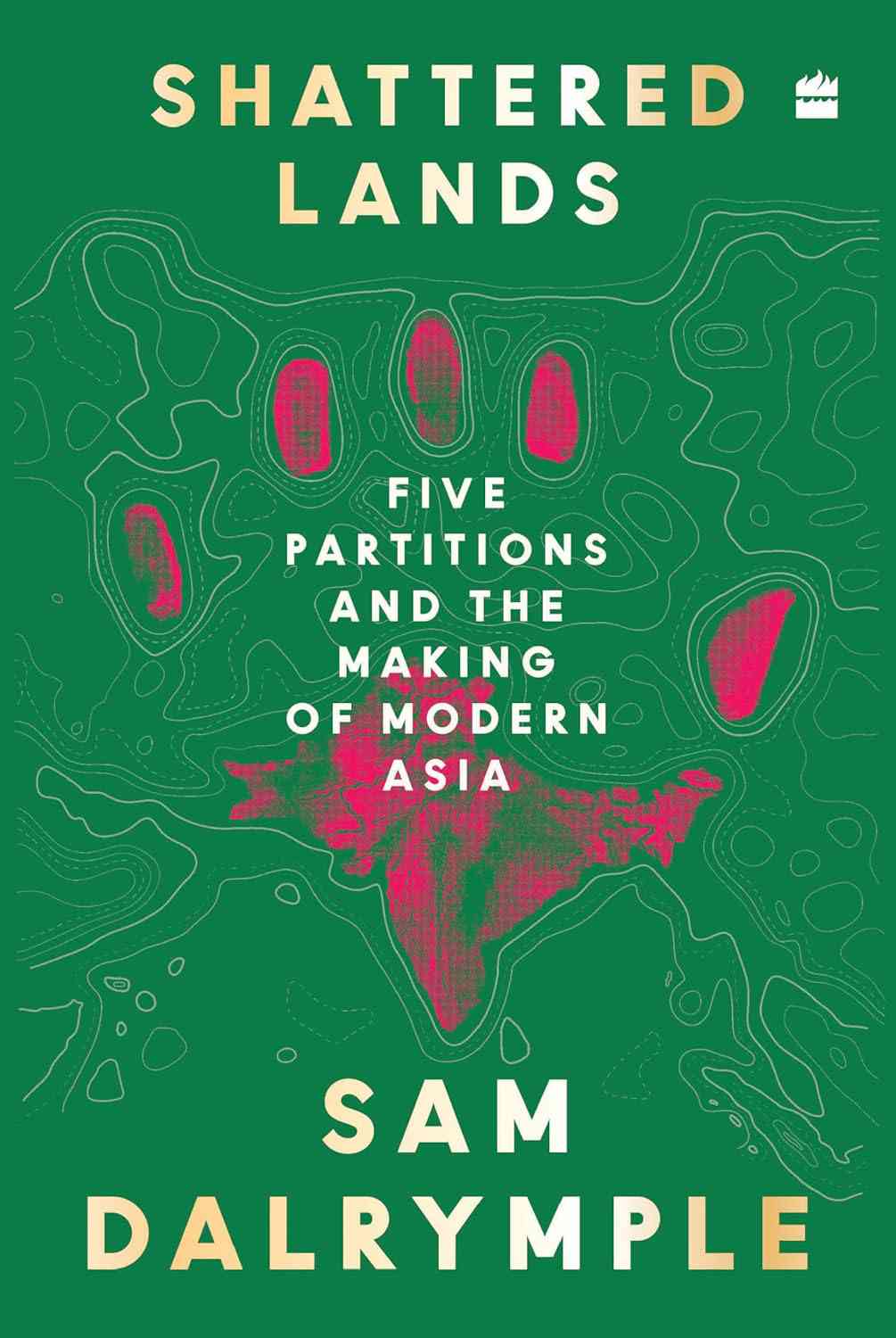
Shattered Lands : Five Partitions and the Making of Modern Asia, Sam Dalrymple, HarperCollins India.
