











In mid-August, the town of Sehore in Madhya Pradesh made news for an arrest under the state’s anti-conversion law.
Jabbar Khan, in his late 40s, was arrested by the police on charges that he was forcibly converting people to Christianity.
A day before the police had filed a case against him and his wife Tahira, after members of the Bajrang Dal had barged into their house while Khan was leading a Sunday prayer meeting.
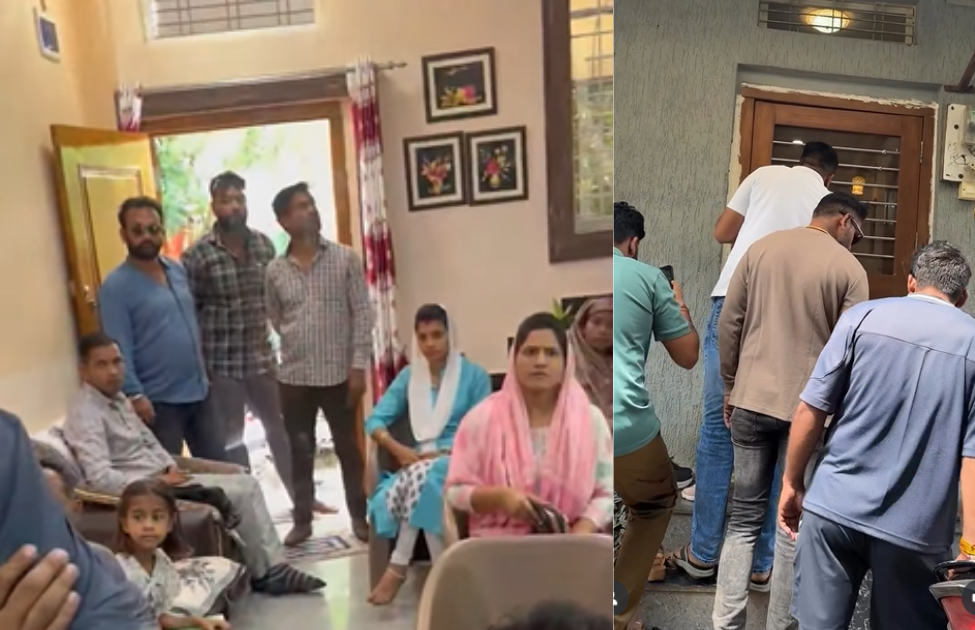
A video that one of the Bajrang Dal workers recorded on his phone shows them walking around the room, interrogating those seated there on plastic chairs with copies of the Bible on their laps.
Most of the attendees – numbering about 15 – were women who did not say much. But one of the attendees was emphatic as he spoke about why he was praying to Jesus Christ. “Earlier I was an alcoholic, I would create problems for my parents, beat my wife, flirt with women,” said the man. “Lord Jesus saved me… he changed my life. It is for Lord Jesus I come here to pray every week with my family.”
This attendee, Scroll has found, is a police constable named Virendra Ahirwar. Contrary to the police case against Khan, Ahirwar maintains that there was no forced religious conversion taking place in Khan’s house.
“It is difficult to make a person eat something without their wish, how can one be forced to change their religion?” he told Scroll.
Ahirwar said he was born Hindu and remains so, even as he has followed “Christ’s teachings” for the last eight years. “None of us have converted to Christianity,” he said. “It is a very personal belief.”
But the police appear to have disregarded Ahirwar’s testimony.
On September 16, municipal authorities in Sehore demolished the second floor of Khan’s house claiming that it was illegal. An official claimed that the terms of allotment of the house also did not allow religious gatherings to be hosted there. Scroll examined the terms and could not find any reference to this.
Allegations of ‘forcible conversion’
Not much is known about how Jabbar Khan, born and raised Muslim, turned to Christianity. On his Facebook page, all that Khan states is that he is originally from Ujjain.
According to the police first information report, Khan and his wife Tahira formally converted to Christianity a few years ago, and moved to their present house in Sehore in the last decade. The Hindi daily Amar Ujala reported that Khan had bought the house from a man named Ashok Dabi in 2018 and constructed a second storey. In the video, Khan mentions that he has been holding prayer gatherings at his home for the past two years.
While Khan is behind bars, his wife Tahira is on the run, according to the police. His bail application was rejected by a local court on August 21. Despite repeated attempts, Scroll was unable to speak to their sons.
The police case against the couple has been filed under Section 3 and 5 of the Madhya Pradesh Freedom of Religion Act, 2021, which make religious conversion carried out using coercion, fraud, allurement or through marriage, punishable with a maximum of ten years of imprisonment.
The FIR is based on a complaint by Govind Masure, a 43-year-old resident of Bijori, a village 6 km from Sehore town.
In his written complaint, seen by Scroll, Masure states that for three years, Khan had been threatening, harassing and forcing him to give up Hinduism and adopt Christianity.
Masure told the police that he first met Khan in November 2021. But he told Scroll that he met Khan three years ago at the college that Khan’s son attended and where he had previously worked as a clerk. After he lost the job, and suffered a partial loss of vision in one eye, Khan “offered to find me a job and help in my medical treatment”, Masure said.
Masure claimed he accepted Khan’s help and started attending the Sunday gatherings at his home – only to find himself pressured to convert to Christianity.
“I am from a Scheduled Caste and I live alone,” Masure said. “Probably he thought he could manipulate me.”
He claimed that he eventually decided to confide in a street-side food vendor who was an acquaintance. “He called a few local men [from the Bajrang Dal],” Masure said. “They were the ones who went to Khan’s house.”
In his statement to the police, Masure named two others – Mayank Bagvaiya and Naresh Mewada – who he claimed Khan had attempted to forcibly convert to Christianity. Scroll was unable to speak to them to corroborate Masure’s account.
Like him, neither of the two men had actually converted to Christianity, Masure clarified. When asked if he knew anyone who had undergone religious conversion under pressure from Khan, Masure said he did not.
A Sunday prayer meeting disrupted
Constable Virendra Ahirwar, who has served in the police for 11 years, painted a completely different picture of Khan’s work as a religious preacher.
He said people of various faiths gathered every Sunday at Khan’s house to read the Bible and talk about the life and teachings of Jesus Christ. “Those who came for these gatherings came voluntarily,” he said. “I have never seen anybody who came here being forced into it.”
In Madhya Pradesh, the anti-conversion law makes it mandatory for an individual wishing to convert to a religion other than the one they were born into to give notice to the district magistrate 60 days in advance. They must declare that they are adopting a different religion of their own free will.
This provision, experts say, deters religious conversions since public declarations are likely to attract Hindutva vigilantism.
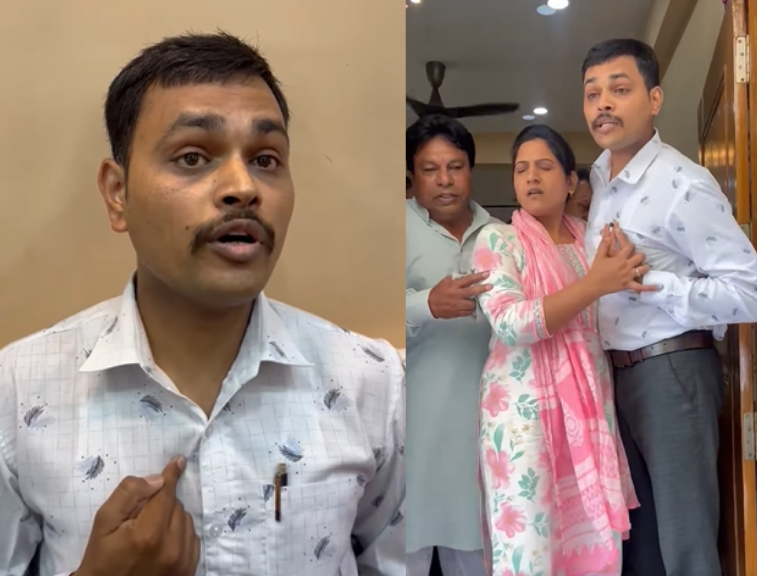
When the Bajrang Dal members disrupted the prayer meeting at Khan’s house and accused him of forcible conversion, not only did Ahirwar stand up to them, even his wife staunchly rebutted their arguments, as seen in another video posted on social media.
She told the Bajrang Dal members “do not touch my husband” and said that “this is our faith”. In the same video, Khan’s wife Tahira can be seen telling the men “to find any neighbours who have issues with prayers here”.
Pravesh Malvi, a resident of Sehore, and Shivkumar Bherve, a resident of Chanakyapuri in Sehore, were present at the prayer meeting. In the video, both can be seen saying they come to pray to parmeshwar, or god, voluntarily.
Soon after Khan was arrested, the Sehore police suspended Ahirwar, initiating a departmental inquiry against him for “misconduct” and “dereliction of duty”.
Sehore Police Superintendent Deepak Kumar Shukla said the suspension notice was issued after “videos emerged where Ahirwar was talking to media inappropriately about the issue”.
“If you look at the video, what he [Ahirwar] said does not merit how a police officer should behave,” Shukla said, referring to the August 17 gathering at Khan’s house where Ahirwar had refuted the allegations of the Bajrang Dal workers.
Ahirwar said the police action does not bother him. “I have done nothing wrong,” he said. “It is legal to follow the faith of our choice.”
Shukla also said the investigation into Khan’s case was underway. “Based on the complainant’s statement, there is evidence that Khan was forcing people to convert into Christianity,” he said.
House demolished
In the week after the FIR was registered against Khan, the local municipal body decided to scrutinise his property documents.
On September 4, the Nagar Palika Parishad of Sehore issued a letter summoning its members for a meeting on September 12. On the agenda was a discussion about cancelling the lease deed of a plot registered in Jabbar Khan’s name in Pandit Shyam Prasad Mukherjee Colony. The letter stated that Khan had carried out illegal construction on the leased land.
Prince Rathore, who heads the Nagar Parishad, told Scroll that Khan had permission to build a structure on the ground and the first floor. “But they had constructed a second floor,” he said. “And the house had encroached upon three feet of extra space.”
The “most important violation”, however, Rathore said, was that Khan was holding a religious gathering in the house. “This land was allotted under EWS [Economically Weaker Section] rules,” Rathore said. “Religious events or gatherings cannot be held.”
Land allotted under the EWS scheme is intended for housing and economic upliftment, and allottees must adhere to the terms and conditions of the allotment. But the terms do not specifically prohibit religious gatherings.
On September 16, on the orders of the Nagar Parishad, bulldozers tore down the second floor of Khan’s house.
In November 2024, the Supreme Court had ruled it unconstitutional to demolish a property merely because its owner was accused of a crime. The court had provided detailed guidelines for municipal authorities to follow while demolishing any property.
Rathore claimed due process had been followed: several notices were pasted outside Khan’s house and his sons, who lived there, were given ample time to respond. “We followed Supreme Court guidelines and waited for 15 days,” he said. “We did not receive a response and went ahead with demolition.”
No other house in the locality was targeted in the municipal drive. Rathore said that this was because the complaint pertained to Khan’s house.
Justifying the demolition, Rathore claimed Khan was treating the place “like a church” and “holding conversions in the house”.
“We took action only after an FIR was filed,” he said.
Rajeev Gujrati, the district head of the Congress, said, “Usually such demolitions are undertaken on the direction of the collector or magistrate. [But] the Nagar Parishad took up this issue to please the government in power.” Madhya Pradesh is ruled by the Bharatiya Janata Party, which is part of the same ideological network as the Bajrang Dal.
Gujrati is also a member of the Nagar Parishad. However, he skipped the meeting on September 4 during which the decision was taken to demolish the second floor of Khan’s house. He claimed he could not attend because he was in Ujjain.
Two other Congress members were present in the meeting. But the Nagar Parishad is dominated by BJP representatives, Gujrati said.
