






For indigenous communities, the forest is more than a home or a source of sustenance: it is a realm of reverence, reciprocity and deep belonging. The forest is not a resource to be plundered; it is an ancestral guardian that nurtures and protects. And in return, it must be honoured and safeguarded.
Indigenous communities have waged spirited battles to protect their forests and commons, often at great personal cost. The Chipko Andolan, the Narmada Bachao Andolan, the Jungle Bachao Andolan, the Niyamgiri movement, the Hasdeo Arand resistance, the Nyishi and Adi opposition to dams, and movements against palm oil plantations and deforestation in northeast India are among the many historical and ongoing indigenous struggles.
Some of their struggles, however, have remained largely unknown. For instance, when the British colonised the Andaman Islands in the 19th century and began clearing forests to establish a penal colony, the Great Andamanese did not stand by as their homeland was destroyed. Armed with little more than bows and arrows, they waged a fierce resistance against the mightiest empire – but at a terrible cost. Ruthless massacres and foreign diseases brought them to the brink of extinction.
After India became independent, this destruction only intensified. Ancient tropical forests were cleared for infrastructure projects and the resettlement of mainland settlers. The Jarawas, who had long defended their ancestral lands, fiercely resisted this encroachment. Their defiance, however, came at a tragic cost – many were electrocuted while opposing the Andaman Trunk Road, a project that cut through their forests, scarring not just the land but their very existence.
Such indigenous resistance is more than a fight for land, forests or resources; it is an assertion of identity, a stand against erasure. For indigenous peoples, the forest is not just essential to life; it is life itself – breathing through their way of living, enduring in their memories and flowing through their traditions. To sever this bond is to unravel the very fabric of their existence. The loss of the forest is not merely an ecological catastrophe; it is the annihilation of a people’s history, culture and way of being.
Ironically, the champions of the Great Nicobar megaproject refuse to learn from history: the destruction of both forests and indigenous people of the Andamans. Instead, they seem determined to repeat it in Nicobar.
Indigenous people have long been at the forefront of protecting the Earth. Though they comprise just 6% of the global population – about 476 million people – their territories span nearly 22% of the planet’s land surface and sustain 80% of its biodiversity. Their knowledge and practices, honed over generations, are vital to preserving fragile ecosystems.
For centuries, the Nicobarese have safeguarded Great Nicobar’s ecosystems, guided by the belief that all beings – living and nonliving – possess spirit and agency. This worldview is not merely an abstract idea but a way of life, shaping their relationship with nature.
During my fieldwork in Little Nicobar, I went fishing with my Nicobarese friend, Gilbert. Using only a hook and line, he spent hours catching just a few fish. Curious, I asked why he didn’t use a small-eye net. “If we use a net, we will catch plenty of fish in no time, more than we need. Some will surely go to waste. And the god of the ocean will not be pleased with that,” he replied. In an ocean teeming with fish – where they grow old and die, often untouched – his words offer an invaluable lesson in sustainable management.
The Nicobarese culture is rich with practices and taboos that have safeguarded nature for generations. Take, for instance, chatmat – a tree in the forests of Great Nicobar, believed to house a spirit. To harm it – by cutting its limbs or wounding its bark – is to invite a curse: swollen eyes and a body covered in eruptions like chickenpox. For the Nicobarese, this is not mere superstition but a sacred covenant with the forest – a reminder that it is alive, pulsing with spirits that watch over all who dwell within it.
Similarly, Great Nicobar’s forests hold an enigmatic black stone, tirah, that lies in silent vigilance—believed to be alive. To disturb its peace—by shouting, cutting wood or showing any sign of disrespect—is to invite grave consequences: a raging fever, blood vomiting, even death. This belief is not merely rooted in fear but in a deep understanding of the interconnectedness of all things— where even a stone holds power, purpose and a place in the sacred balance of life.
Beyond the forests, in the restless waters of the sea, another creature commands deep reverence: the hiput, dugong. To spear a hiput is to shatter the harmony of the elements, unleashing chaos. The sea itself is believed to mourn the loss, its grief manifesting in violent storms and cyclones (labifui), punishing those who dare spill the blood of an innocent creature.
Even entire islands in the Nicobar are imbued with spiritual significance and fiercely protected by the Nicobarese. Menchal and Meroë Islands – known to them as Pingaeyak and Piruii – are officially recorded as uninhabited in government documents. Yet, for the Nicobarese of Great and Little Nicobar, these islands are vital lifelines, serving as crucial resource repositories over which they hold traditional rights.
Menchal, or Pingaeyak, is believed to be the dwelling place of a powerful spirit that watches over the island. For the Nicobarese, it is not merely an island but a sacred realm, alive with forces that demand reverence and care. Similarly, Meroë, or Piruii, is steeped in legend, said to be home to a mythical islander community. The protection of these islands is enshrined in spiritual belief systems and upheld through age-old practices of sustainable natural resource management, ensuring their sanctity remains untouched.
In the Nicobarese worldview, the social, natural and spiritual realms are inseparable, reflecting a deep connection to nature – one rooted not in ownership, but in stewardship. In a world increasingly driven by exploitation, Great Nicobar offers a profound lesson: some places are not meant to be conquered or commodified but cherished and preserved.
To the Nicobarese, nature is not to be tamed or exploited. As a sentient, interconnected being, it listens, watches and responds. This belief lies at the heart of their worldview, shaping a code of ethics – an ecological wisdom passed down through generations. To harm the forest, land or sea is not merely an act of destruction; it is an act of defiance against the very forces that sustain life. And what happens when these forces are defied? A Nicobarese folktale offers a telling answer: Long ago, trees were not bound to the earth – they roamed freely, heeding the commands of humans. People harnessed them as living vehicles, tying bundles of goods to their branches and guiding them from the jungle to their villages. Some even rode upon their sturdy limbs.
But one day, as the trees carried the heavy loads, they swayed and bumped into one another. Amused, the people laughed mockingly, wounding the trees’ pride. Angered, the trees refused to take another step. From that day on, they stood still, leaving humans to bear their own burdens—forever reminded of the nurturing bond they once shared with trees and the cost of taking it for granted.
As the spectre of the megaproject looms over the Great Nicobar, we must ask: What dies when a forest falls? What does felling 10 million trees in an ancient tropical forest mean for India? The answer lies in the lessons we refuse to learn – the storms we summon, the fragile ecological balance we shatter – all in the name of development. Climate change, droughts, floods, landslides, species extinction – each a cost of our recklessness – is already upon us.
The Great Nicobar megaproject isn’t just a local catastrophe; it’s a national crisis. It threatens to erase one of India’s last great biodiversity hotspots, obliterate carbon sinks that shield us from climate chaos, and sever the sacred bond between indigenous communities and nature.
Progress built on nature’s ruins isn’t progress; it’s a reckless gamble with the future. And it’s one we can no longer afford.
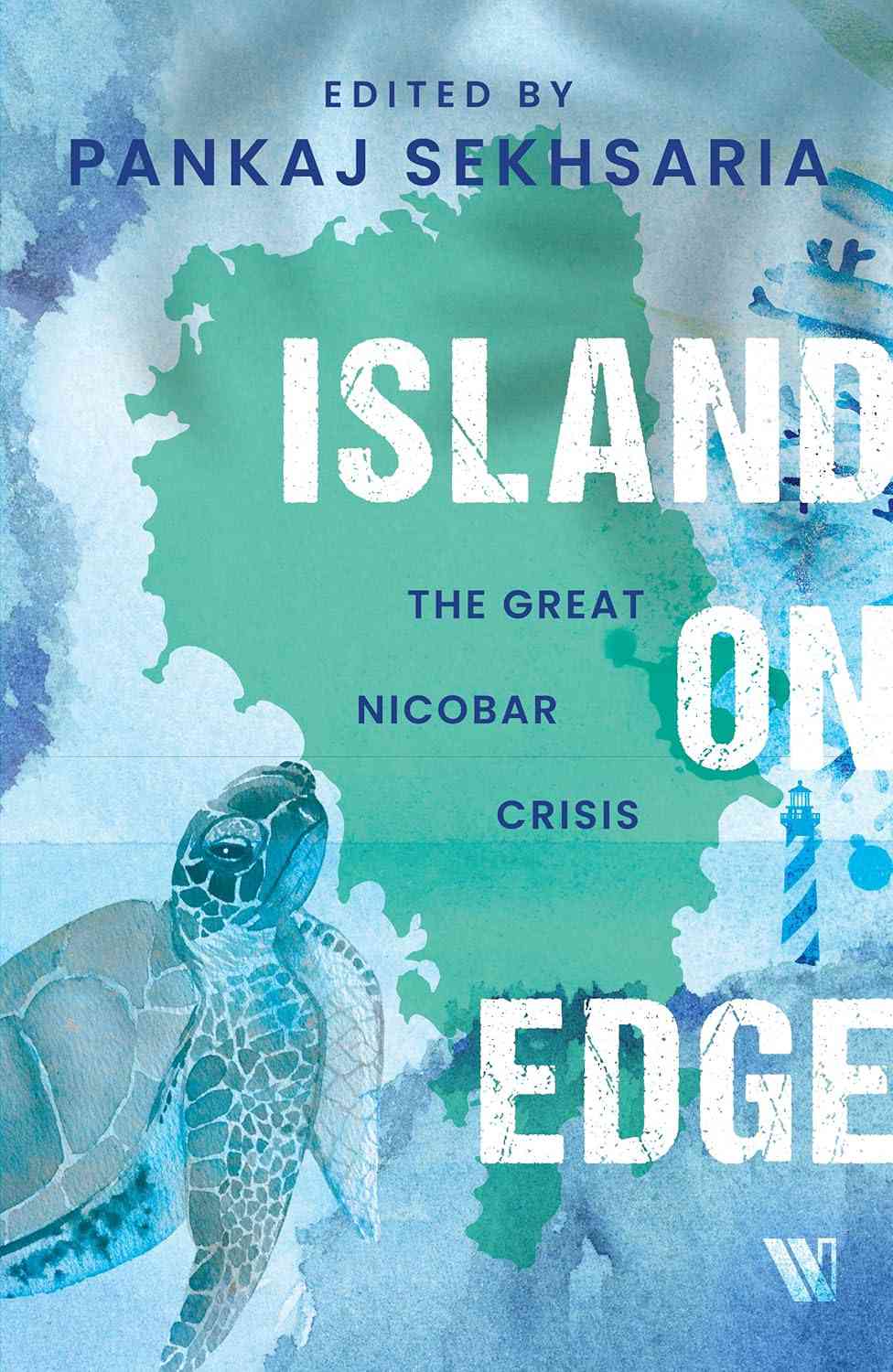
Excerpted with permission from ‘The Death of Life’ by Ajay Saini in Island on Edge: The Great Nicobar Crisis, edited by Pankaj Sekhsaria, Westland.
