




One of the things that struck me while reading Being Modern: A Biography of Ananda Ram Dhekial Phookan is how history often shines a spotlight on leaders, leaving those who quietly prepare the path for them in the shadows. It made me think about the people who tried to make a difference long before our time, about their struggles, their hopes and dreams, and the quiet courage that kept them going.
This biography is part of the “Chronicles” series published by Penguin Random House India in collaboration with Ashoka Centre for Translation, and has been written by Gunabhiram Barua and translated from the Assamese by Banani Chakravarty. Being Modern was a revelation for me. As a lay reader, I had never known of Phookan or the depth of his contributions to Assam and India. This book allowed me to connect with his vision and legacy in a way that felt both intimate and inspiring.
Post-Colonial education and the marginalisation of Assamese
When I picked up this book, I did not know who Phookan was. By the time I finished, his life felt less like distant history and more like a quiet, lingering presence. I even found myself revisiting my old history lessons from school, seeing them in a new light. Growing up, the only 19th-century social reformer I knew was Raja Rammohan Roy, widely celebrated as the “Father of the Bengal Renaissance.” And I often wondered if anyone else could ever match his influence. Reading Being Modern changed that for me. I discovered Phookan, whose contributions shaped history just as quietly and powerfully, despite the brevity of his life. He left the world far too soon – his life ending at just 30.
One detail that particularly struck me was how Barua, Phookan’s cousin and biographer, was drawn to the Brahmo Samaj founded by Rammohan Roy during his time in Calcutta, just like Phookan himself, though his support was subtle and largely behind the scenes.
Phookan’s legacy and contributions have been overlooked or underrepresented in mainstream Indian history textbooks. While his story continues to resonate in Assam, the land of his birth and death, it is hard not to wonder why such a remarkable life remains so little known beyond its borders.
This may be because colonial and post-colonial education systems tended to marginalise Assamese and certain other regional languages, particularly in comparison with dominant ones, such as its close neighbour, Bengali, which crucially shaped, and was shaped by, colonial modernity. As a result, reformers who were not aligned with pan-Indian movements or major caste and gender struggles often faded from broader historical narratives. That is why the publication of this book feels so special – it brings Phookan’s remarkable life and legacy into the light, allowing readers like me to discover and celebrate a story that might otherwise have gone unnoticed.
Phookan owed his unique life to his shrewd great-grandfather Laksminarayan Brahmachari, a wandering ascetic from southern India who settled in Assam and started a chosen family by adopting orphans and destitute children, one of whom was Parashuram, Phookan’s grandfather. If one stops to think about the enormity of this move, it is remarkable how a wanderer arrived in a distant part of the country not just to start a family but to pass on values that would lay the foundations of a modern Assamese consciousness.
It was at the crossroads of two worlds, the fading grandeur of Assamese royalty and the rising tide of the British East India Company, where Phookan’s life unfolded. Although a devout follower of the Vedic faith, he drew influence from Christian teachings and even attended a few Sunday services at a local church. In his diary, he recorded reflections such as “Keep track of the prayer schedules of Christians, Muslims, and Hindus. Fast on Ekadashi” and “Do not forget to pray at these times: after waking up, before bed, while in bed and whenever you read this.”
On his deathbed, he said in English, “I have done my best for the country and never harmed anyone. People may presume me to be a Christian, but I am not a Christian; I believe in God.”
By drawing the British East India Company’s attention to Assamese, Phookan helped turn it into a language of literature and learning. His contributions to reviving Assamese began with his writings for Orunodoi, a monthly journal that was first published in 1846. Phookan wanted Assamese to replace Bengali, which by then had already been declared as a language of the region. He also wrote Asamiya Lorar Mitra, or “The Friend of Young Assam” which was eventually published in 1849 with support from British and native patrons. This book is also regarded as the first Assamese work authored by an Assamese writer. But it was not until 1873, long after Phookan’s death, that Assamese was reinstated as a court language as well as a medium of instruction in schools.
Phookan approached learning with the curiosity and courage of an explorer, always venturing into new ideas. He was also a shrewd learner. He knew exactly what skills to acquire to stand out in certain circles. When he realised being versed in Persian poetry would increase his chances of being recognised in society, he appointed a munshi to teach him Urdu and Persian, wherein he studied medieval Persian texts like the Gulistan, Bostan and Pand Nama. Not just Persian, Phookan also learnt Tantra from a renowned tantric. He recognised the importance of promoting local art and culture, and often organised kirtan and jatra at locations across Assam.
A challenging, yet inspiring read
Even though Being Modern captures an important era in Assamese history, it is not an easy read, particularly for a non-scholarly reader. It demands patience and careful attention. Some of this could have been smoothed by a more attentive translation and more careful editing. The text’s rendition into English often feels unwieldy.
According to the translator’s notes, a major challenge in the translation arose from the lack of standardised spelling and dictionaries when the biography was written, causing the biographer to spell many words phonetically. The task of standardising and correcting these spellings thus fell to the translator.
When Barua wrote Phookan’s biography in the 19th century, theoretical aspects of Assamese lexicography were not yet developed. It was only during the latter part of the 20th century that it incorporated modern lexicographical principles and developed theoretical understanding.
The profusion of footnotes – an astonishing 441 – soon turned from helpful to visually exhausting. The perpetual shuttling between text and annotation turned my reading into an ordeal of focus and endurance, raising the question of whether the publisher’s ambitions were better suited to an academic monograph than to a book aimed at general readers. While annotations are crucial for such difficult translations, the translator’s inclusion of tangential information sometimes blurred the sharpness of the book’s central thread.
In her notes, Chakravarty writes, “My aim was to translate every word without omission, remaining as faithful as possible to the original. I sought to retain Assamese idioms, expressions, and rhymes as closely as possible.” Some of this might have been alleviated if the footnotes were added as endnotes, as the latter is less jarring on the reading experience. Phookan’s intricate family tree, appended by the translator, only added to the confusion rather than clarifying it.
Yet, even with its dense passages, I can only admire the effort Chakravarty must have put into translating the text. I also want to applaud Chakravarty for piecing together contexts, idioms, and nuances that would otherwise be lost to readers unfamiliar with 19th-century Assam. Her work ensures that both Phookan’s ideas and Barua’s prose reach a wider audience without losing their original depth and texture.
Diya Sengupta works in Strategy and Consulting. She is the founder and co-curator of Juhu Reads and the co-curator of Pint of View Mumbai.
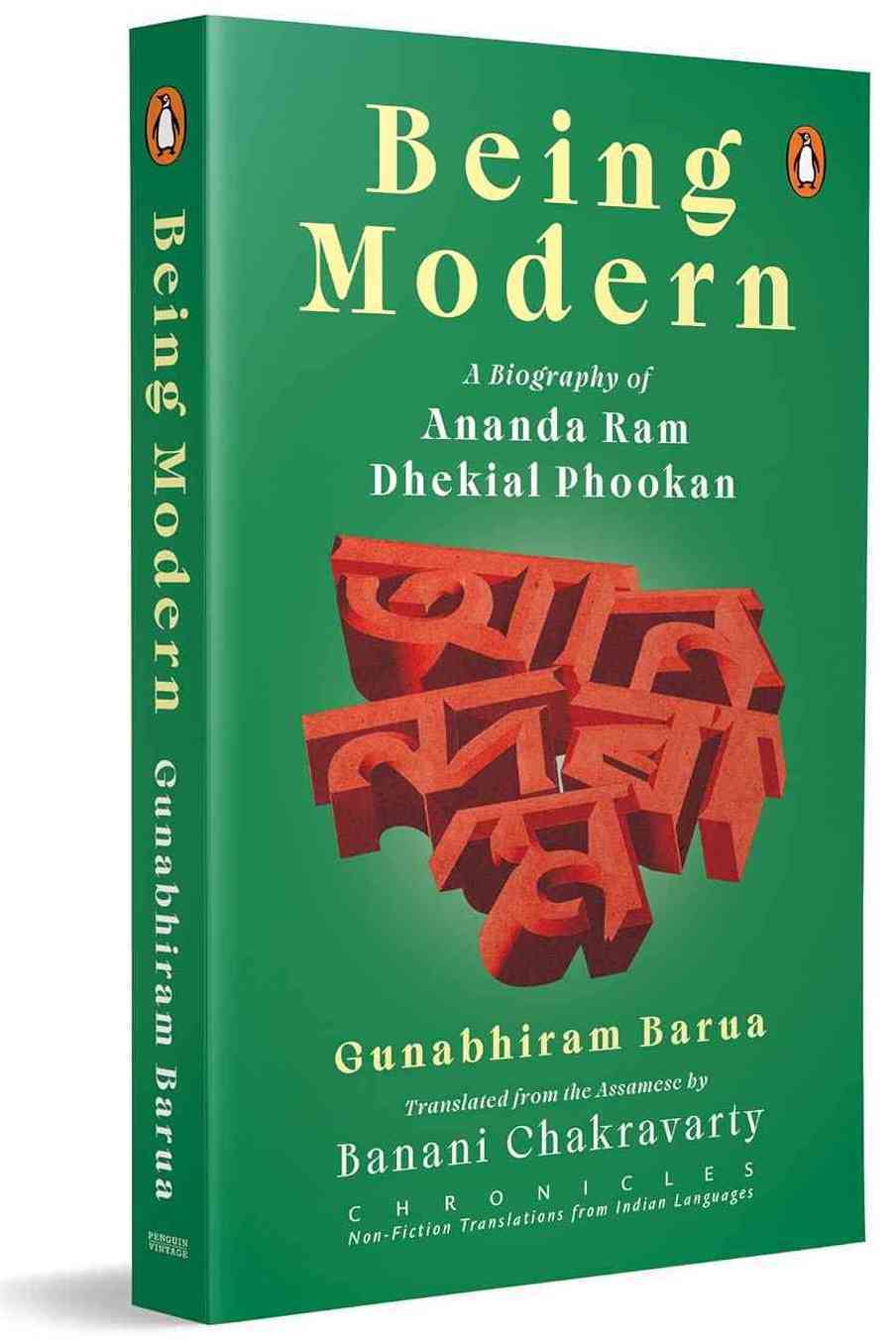
Being Modern: A Biography of Ananda Ram Dhekial Phookan, Gunabhiram Barua, translated from the Assamese by Banani Chakravarty, Penguin India.
