







As the world’s most populous nation, changes in the way India is growing deeply affect the world. Yet these key shifts are not adequately documented or discussed, both within India and globally.
At Data For India, we track these changes closely, using high-quality Indian and global data sources. Through this three-part series, we attempt to pull together vital Indian data on demographic shifts, place them within the context of other socio-economic changes taking place in India, and set them against a global backdrop. With this, we identify new areas of research as well as directions for policy and discussion.
In Part I, we brought together the data to describe the current moment, and the key recent data points that we argue have gone relatively unnoticed. In Part II, we examined data around falling birth rates, and shared research that suggests India is both an outlier and a part of a global trend. In Part III, we look at the data on demographic differences between Indian states and how it feeds into current socio-economic and political tensions.
India’s demographic dilemmas are, in many ways, shared challenges for the country – the end of the demographic dividend, the progress of an epidemiological transition, the steady fall in birth rates, and the specter of aging. Based on an accurate reading of high-quality data, policy and politics will need to come together to take on these challenges.
However, deep schisms divide the country’s demographics on several key issues, putting India at risk of splintered political responses. In this piece, we look at these schisms and their implications.
The determinants of change
Three broad processes drive demographic changes: births, deaths, and migrations. We first look at these three determinants to understand their impact on the populations of Indian states.
We use the United Nations World Population Prospects, 2024 Revision, for global data for past years and projections up to the year 2100. We use India’s Sample Registration System and the National Family Health Survey for data on Indian states up to the year 2023, the most recent year for which there is data.
For data beyond 2023, as well as projections up to 2036 for Indian states, we use population projections made by India’s Registrar General of India based on the 2011 Census. One important caveat is that India has not had a decennial Census since 2011.
i) the fertility differential
Even as the broad story of fertility – the number of children an average woman in a region has – is one of steady decline, as we saw in Part II of this series, the differential rates of this change between India’s richer and poorer states lie at the heart of this schism.
Historically, India’s southern and western states have been richer and have achieved better development outcomes, including on women’s education and women’s health. As a result, these states have significantly lower fertility rates than the eastern and northern states, which are poorer and less developed, and hit the key milestone of “replacement fertility” much earlier.
The Total Fertility Rate (TFR) is the average number of children that a woman is likely to have in her lifetime. As countries get richer and women get better access to healthcare and education, fertility rates begin to fall – a phenomenon seen across the world.
When a country’s TFR drops to 2.1, meaning that women will have an average of 2.1 children over their lifetimes, demographers say that the country has reached “replacement fertility.” What this means is that if two adults have a notional 2.1 children between them, then, accounting for some likelihood of death during childhood or adolescence, that couple will produce two adults, and the size of the population will remain the same. This is a key milestone in a country’s demographic journey. If fertility falls below that level, the population will begin to decline in absolute numbers.
Despite the fact that fertility has fallen in all Indian states, their trajectories differ by decades. Of the four Indian states that are yet to reach replacement fertility, all of them lie in India’s impoverished center and north. Uttar Pradesh is projected to reach this milestone in 2025 and Madhya Pradesh by 2028.
Bihar is the sole remainder, expected to be the last state to achieve replacement fertility only in 2039. (By 2023, the most recent year for which there is data, Chhattisgarh had not yet achieved replacement fertility despite the projections for the state estimating that it would reach this milestone in 2022).
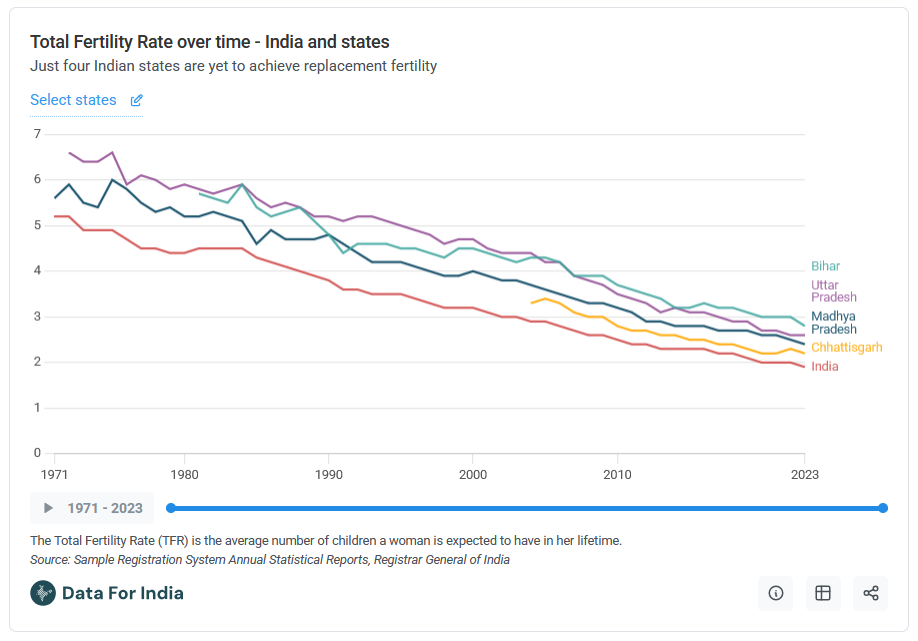
The immediate impact of this fertility differential is the extra years of high birth rates in the northern and eastern states. One in every three Indian children (under the age of 14) lives in two states alone – Bihar and Uttar Pradesh. Bihar’s child population is not expected to decline in absolute terms up until 2036, the furthest year for which we have projections, while all of the southern states are seeing their child populations decline.
This difference in fertility and the impact that it will have on population growth in these states is a growing cause of conflict between India’s richer and poorer states.
ii) Changes in mortality
Despite doing better on health indicators than poorer states, India’s richer states face not only lower birth rates, but also higher mortality rates as a result of their age structures.
Communicable diseases and conditions around childbirth and infancy are responsible for far fewer deaths in India’s richer states than in its poorer states. In Kerala, for instance, the Infant Mortality Rate (IMR) has now fallen to 5 (five infant deaths for every 1,000 live births in a year), which is comparable to northern European countries, while the relatively poorer states of Uttar Pradesh, Madhya Pradesh, and Chhattisgarh have an IMR of 37, similar to that of Sudan.
Yet, the relatively low share of the elderly in the populations of these poorer states keep their overall mortality rates down. The Crude Death Rate – the number of deaths for every 1,000 people – in Kerala, for instance, has surpassed that of Madhya Pradesh’s. What’s driving it up is the relatively large share of the elderly in its population.
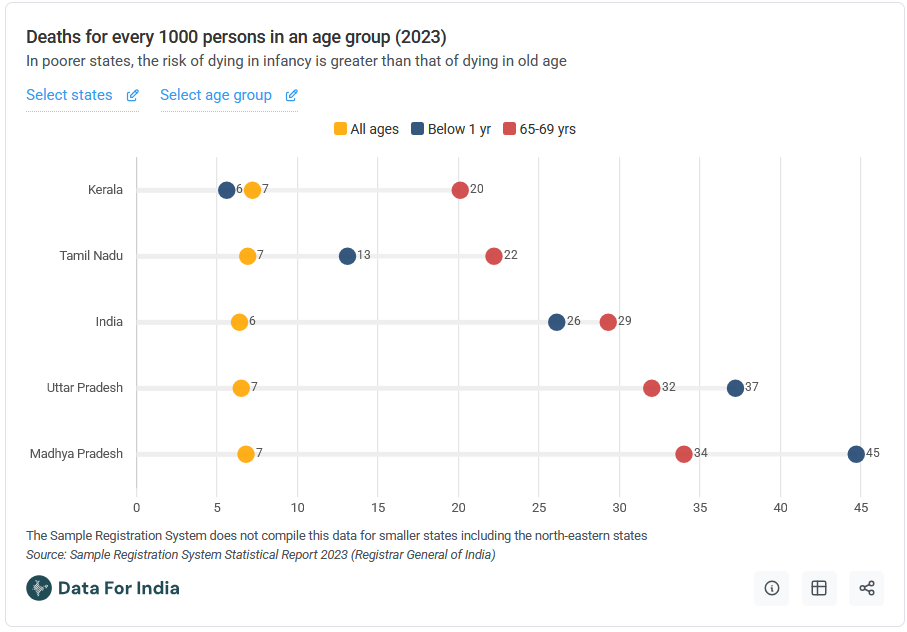
These relatively high mortality rates contribute, alongside lower birth rates, in driving down the population of India’s better developed states.
iii) Low inter-state migration
Alongside fertility and mortality, the movement of people is another factor that affects the size of the population. In the developed world, as birth rates fall, the immigration of working-age adults into the country is seen as an important factor that helps counterbalance the impact on the economy (including on the care economy) of an aging population.
The level of international migration into and out of India is too small in relative terms to affect the population. Fewer than one in every 1,000 people had migrated out of the country as of 2023, according to the World Bank, compared to neighboring Sri Lanka where more than three in every 1,000 have migrated out.
Internal migration within India is, on the other hand, an order of magnitude higher. Three in ten Indians report that they now live somewhere different from their last residence for at least six months at a stretch. This data is from India’s National Sample Survey’s 78th round “Multi Indicator Survey” (2020-’21).
Yet these high rates of movement do not have the impact of significantly altering the population or demographic structure of India’s more prosperous states that are labour magnets.
The vast majority of India’s internal migrants have not moved very far from where they were earlier – migrants are most likely to move within their own district (nearly 60% of all migrants), followed by those who move to another district in the same state (nearly 30% of migrants), and last of all, to another state. Only a little over 10% of Indian migrants currently live in a different state from the one they last lived in for a six-month stretch.
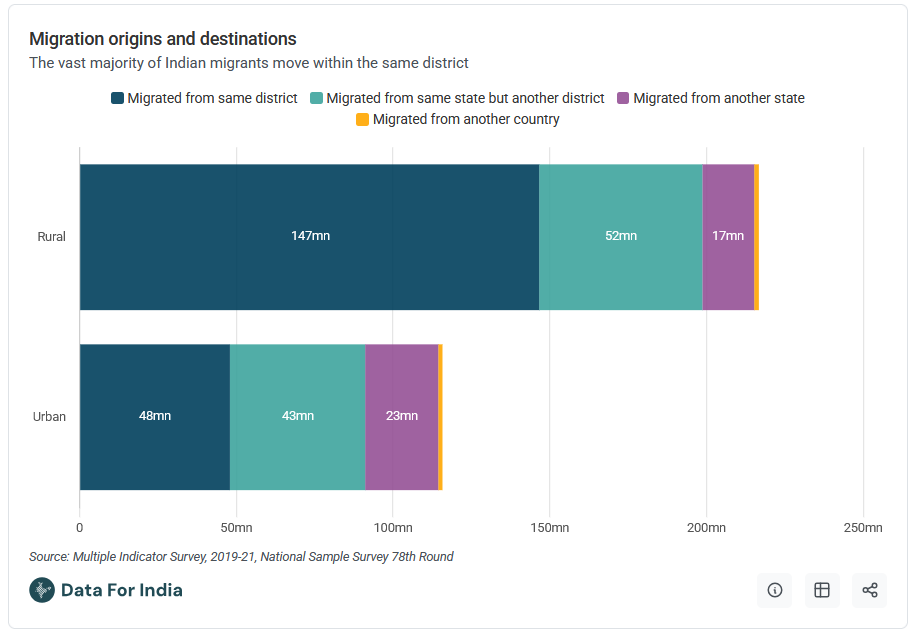
Driving the majority of these intra-district movements are women. Female migrants make up the majority of Indian migrants as a result of social norms around caste and marriage that lead to the marriages of Indian women being arranged outside the villages they were born, and the convention that married women move to live with their husband and his family.
While just over 10% of Indian men report being migrants, that figure is nearly 50% for Indian women. Marriage is the most common reason for migration for women, while for men, it is the search for jobs.
Migration of this variety in India appears to have grown very little in the last 15 years for which there is data – in 2007-’08, 28.5% of Indians were migrants, a share which rose only slightly to 29.1% in 2020-’21.
Impact of these processes
As a result of these three demographic trajectories, India’s states are moving in somewhat divergent directions, driving conflict over resource allocation and political representation. This impacts two areas in particular: the relative sizes of Indian states by population and the age structure of the populations of these states.
i) State populations
Until the 1970s, population growth rates across Indian states were quite similar. However, since the 1980s, India’s southern states have been growing far slower than the central, northern, and eastern states.
As a result, over one-third of the total increase in India’s population between 2011 and 2036 will have come from two states alone – Uttar Pradesh and Bihar – while all of the southern Indian states will have seen their share in the population declining.
Rajasthan is estimated to have grown bigger than Tamil Nadu in 2017, and Bihar is estimated to have surpassed Maharashtra to become India’s second most populous state after Uttar Pradesh by 2023. People from the four most populous southern Indian states will account for fewer people than from Uttar Pradesh alone over the next five years.
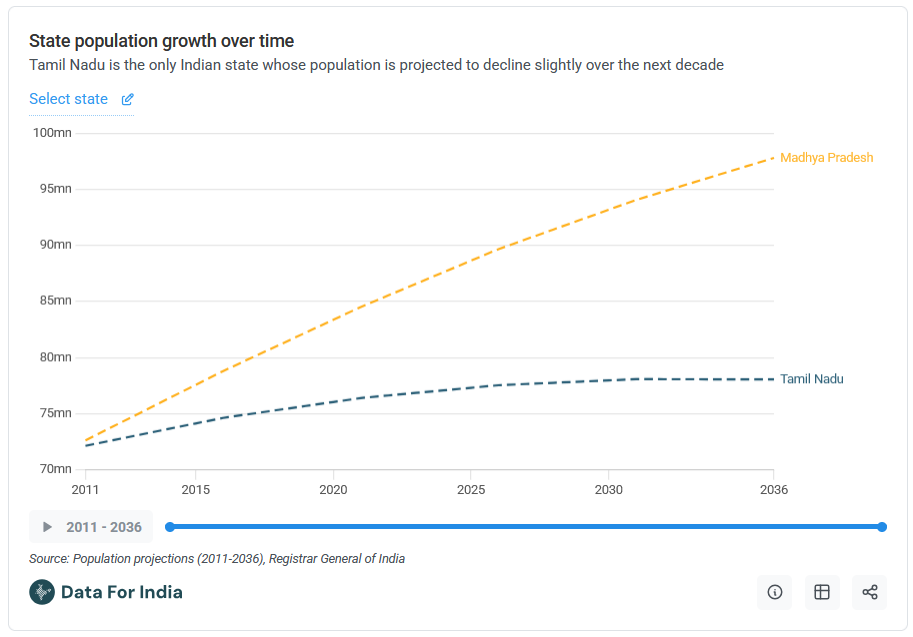
The southern and western states are not just growing more slowly than the northern and eastern states. Some states will stop growing entirely. Even while India’s population is expected to continue to grow until 2060, Tamil Nadu’s population is projected to start to decline in absolute terms over the next decade.
ii) A generation gap within India
Not only will the southern and western states grow more slowly, they will also age more rapidly.
When fewer children are born every year and life gets safer, a country starts to age. The median Indian is just over 28 years old, while the median age of the world is over 30. By 2050, however, the median Indian will be over 38 years old.
Within India, a decade separates some of the northern and southern states, with Kerala and Tamil Nadu being India’s oldest states and Bihar its youngest. Kerala, for instance, has twice the share of elderly people (age 60+) in its population that Bihar or Uttar Pradesh have.
By the mid-2030s, Tamil Nadu is projected to be India’s oldest state. Given the differences in birth rates and mortality rates in the two regions, this gap will grow. At 40, the median Tamil man will be over 12 years older than the median Bihari man.
These figures are based on a Technical Group on Population Projections that was set up in the office of the Registrar General of India to provide the country with population estimates for the period of 2011-2036, using data on fertility, mortality, migration, and urbanisation.
When countries or states have either a very large child population or elderly population – meaning they are either very young or very old – it affects the way their economies are structured. In economic terms, the working age population is seen as productive, while dependents – whether they are children or the elderly – need household and state support in the form of welfare.
By 2031, over a quarter of the population in Tamil Nadu and a third in Kerala will be dependent elderly persons, and even the absolute number of people of working-age in these two states will have started to decline.
In the northern and eastern states, on the other hand, the working-age populations (aged 15-59) are still growing. In the decade ahead, the southern states will see their working-age populations begin to shrink, even as the north-central states will see their working-age populations grow.
One key indicator tracked by demographers and economists is the dependency ratio: the ratio of dependents (those who cannot work as they are either children or the elderly) to the working-age population. In states or countries with a higher dependency ratio, there is a greater financial burden on the working-age population and the state to provide welfare.
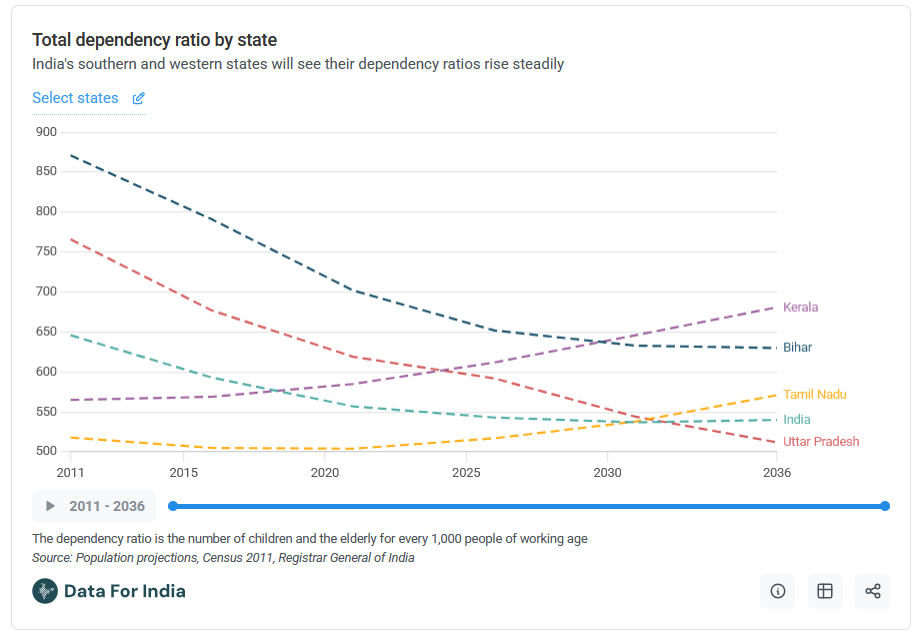
Since the northern and eastern states are seeing a gradual aging with birth rates now declining, their dependency ratios are poised to fall, as the working-age population grows and is more able to support dependents. However, the southern and western states will see their dependency ratios rise steadily as their populations age, and their workforces shrink.
Implications for the Indian Union
This growing schism between two broad halves of the country has spilled over into two key areas of policy and politics in India – redistribution and representation.
The relatively small populations of the southern states alongside their relative economic progress has resulted in sustained friction over how revenues generated from the southern states should be put to use by the Indian union government for redistributive policies that would result in larger shares to the more populous and poorer northern and eastern states.
Southern states argue that the devolution formula – which determines how centrally collected taxes are distributed to the states – of India’s Finance Commission, particularly under the 15th Finance Commission (2020–26), penalises them despite being major revenue contributors.
A core complaint is that the heavy reliance on population and income-distance parameters – states with higher population and lower per-capita income get a larger share – results in the southern states receiving proportionally less. The combined share of the five southern states in devolution declined from 18.6% under the 14th Commission to 15.8% under the 15th Finance Commission.
Another flashpoint is the growing weight of cesses and surcharges in central tax revenue. The Union Government in New Delhi does not share these levies (which can be over 10%-15% of gross tax collections) with the states. Southern leaders claim this disadvantages them, since despite their large contribution to the Goods and Services Tax and direct taxes, they do not receive commensurate redistributed funds.
There is also the question of political representation. According to Article 81 of India’s Constitution, each state must receive seats in proportion to its population and allocate those seats to constituencies of roughly equal size. The Constitution also regulates the total number of seats in the Lok Sabha, India’s lower house of Parliament, currently at 545.
To divide these seats proportionally, seats are to be reallocated after every census based on updated population figures, according to Article 82 of the constitution. In 1976, when civil liberties were suspended during India’s Emergency, the Forty-Second Amendment was enacted, pausing the revision of seats until after the 2001 Census. In 2002, parliament delayed reallocation even further, passing the Eighty-Fourth Amendment and extending this freeze until the next decennial census after 2026. The next Census is scheduled to be conducted in February 2027.
When the next delimitation takes place, the southern states are likely to see a significant reduction in their political representation to accommodate the growth in population in the northern states, and have begun to voice strong objections to such a realignment, calling it once again a penalisation of their relative success in developmental and demographic terms.
Apart from these challenges to the Indian union, the southern states will also have to confront the prospect of their growing dependency ratios and the pressure this will put on state finances and the care economy. In particular, the southern states may need to rethink some of their more strident rhetoric on inter-state migrants, given that the working-age population of the future is more likely to come from the north than the south. Simultaneously, the need to better equip the workers and potential workers of India’s northern states with the skills they will need for the workplaces of the future has never been more important.
India’s demographic dilemmas come at a grave time. They could present an opportunity for foundational thinking around reproductive freedoms, women’s rights, and labour markets of the future – shared challenges that ought to animate citizens across the country. But the massive divergences can also be manipulated to create ethnic divisions in pursuit of political fortune. The possibility that these schisms will be pried further open to cause lasting harm is also dangerously apparent.
How India – and Indians – treat these demographic dilemmas will also determine the trajectory of its democracy.
Rukmini S is the founder of Data For India (where she leads research and writing) and a CASI Non-Resident Fellow. Her areas of focus include demography, health, and household economics. She has previously led data journalism in Indian newsrooms and is the author of Whole Numbers & Half Truths: What Data Can and Cannot Tell Us About Modern India (Westland, 2021).
The article was first published in India in Transition, a publication of the Center for the Advanced Study of India, University of Pennsylvania.
