










“Her eyes are bright, her voice brimming with excitement. ‘What do you know,’ she says, grabbing Munia by the elbow and steering her into a corner, ‘there’s been a murder!’”
What is crime, really? A violation of the law, certainly. But whose law? A breach of morality, perhaps. But whose morality? The concept has always been slippery, defined less by universal truth and more by the prevailing power structures of a given time and place. You can rape your wife in India and remain law-abiding. You can feed pigeons in Venice and face fines. You can be 12 and still be married in parts of the United States. You can love someone of your gender and receive the death penalty. Crime, then, is not an absolute but a moving target, its definition shaped by those who write the rules.
Crime fiction is no static category; it’s a shapeshifter, adapting to the canonical anxieties of whichever society spawns it. The whodunits of Doyle and Christie made certainty their creed, for the world was knowable, justice could be achieved. The genre, like society, has since grown suspicious of easy answers. Today, the best crime writing traffics in ambiguity, drawing its power from the blurred line between victim and perpetrator, system and subversion. The Hachette Book of Indian Crime Fiction, edited by Tarun K Saint, is both a homage to that tradition and a sharp turn away from it.
As Saint writes in the introduction, “These stories continue to refract the dilemmas and conundrums faced by many, whether those belonging to the burgeoning middle class or the subaltern classes afflicted by rampant inequality and indifferent systems of redressal of injustices in society, whether inherited from the colonial era or of recent vintage as a result of our relentless drift into mimicry of the worst tendencies in neoliberal capitalism as seen in the West.”
The hustlers, the desperate, and the damned
In some stories, crime is a rational response to an irrational system. Like the scam artist of RV Raman’s “King Phisher”, who understands the game he’s playing. “Deception has always come easily to me. I am as much a natural at it as it is natural for my targets to be gullible.” After all, the world does reward the ruthless. “I had no so-called ethical reservations. We live in a dog-eat-dog world, and I would be a fool if I were to let sentimental considerations get in my way.”
The narrator of Tanuj Solanki’s “Crime and Crime” follows the same route from a different angle: “…it revealed to me two things that I had not known about myself, two very essential things: firstly, that I was a man who loved his tools as much as anything, and, secondly, that I was, at heart, a bad person, one of those who don’t need the shadows to do their dark work, one of those who are unafraid, who can go to any lengths to grab what is yours and make it their own…”
Some crimes can't be separated from the societies that produce them. Crime and politics, in many stories, bleed into each other here, indistinguishable. The most politically conscious is Tabish Khair’s “Murder by a Raised Eyebrow”, drawing from the Aaftab Poonawala–Shraddha Walkar case, which revolves around a Muslim man killing and chopping his Hindu lover’s body. “I suppose he had never read a book, nothing more than cheap thrillers in any case, and film and fashion magazines. His idea of the world had largely come to him through his smartphone.”
The lawyer narrating the case indicts everyone – friends who crack misogynistic jokes, mothers who raise incompetent sons to believe they deserve the world’s devotion, fathers who blame women’s “looseness” for everything, a society primed to see terrorism in anything remotely Islamic.
In “Society Murder” by Madhulika Liddle, as an elderly recluse is found dead in his apartment, all hands (and fingers) point toward the Muslim househelp. “That great sprawl right beside our society, just outside the walls – you see them, don’t you, every time you drive in at the gate? – It’s them. Bloody beggars.” The slum dwellers are referred to as “Bangladeshis,” a convenient proxy for Muslims, a shorthand for disposability.
In “The Baraat” by Meeti Shroff-Shah, the absurdity that is the Great Indian Wedding is on display. “The groom has been shot. But nobody seems to have noticed. The baraat band is so loud that even the groom’s great-grandaunt whose hearing failed more than a decade ago, is tapping her foot to the beat of the music’s vibrations.” The demands for dowry masqueraded as “gifts” and “caretaking,” the casual sexual harassment that is part and parcel of the arranged marriage setup, the macho masculinity and glamour spread everywhere, the gendered performances disguised as tradition, and the fate of an Indian woman, no matter her caste or class, no matter her accomplishments, form the heart (and mystery) of the story.
Then there are the gritty urban stories situated within starkly unequal and unfair power dynamics, where crime becomes a quick hack to subvert those hierarchies. Like the cybercriminal protagonist in RV Raman’s “King Phisher” or the ill-fated murderer in Tanuj Solanki’s “Crime and Crime”, illegal shortcuts become pathways to take what won’t be given. Similarly, Arnab Ray’s “STRIDE” has a middle-aged woman who has hit her glass ceiling in the world of crime and takes it upon herself to shake those hierarchies.
The term “incel” may be recent, added to our dictionaries only in the last few years, but the entitlement it embodies is old. These men, produced by a culture that teaches them women owe them attention, affection, sex, and devotion, have turned that resentment into violence. Ajay Chowdhury’s “The Mermaid” Song exists in that world of such delusions.
Then there are the cosier mysteries, reminiscent of classical mysteries. Vaseem Khan’s “The Librarian” is less the story of who or what or how and more the story of why, a confessional journey, where the protagonist narrates his life journey to frame the murder as inevitable, even justified. “The Leopards’ Leap Crime Fiction Workshop” by Manjula Padmanabhan, in contrast, is genre fiction aware of its own tropes. A group of pretentious writers, an isolated mountain retreat, mounting tensions – it’s the setup for every locked-room mystery ever written. Padmanabhan knows this and uses it, using the genre’s familiarity to lure you right in.
But when it comes to crime, why should only the mystery genre have all the fun?
Otherworldly mysteries
Some stories in this anthology push past mystery into stranger, more speculative territory.
Anil Menon’s “A Divine Madness”, written in the style of a reportage, posits religiosity as a parasitic infection. Researchers discover that faith – immune to evidence or reason – is the result of a biological parasite. “The parasite finds this useful. Combined with the human tendency to mightily resist cognitive dissonance, people will cling like koala bears to the tree trunks of the craziest beliefs.” It’s a premise as provocative as it is darkly comedic, situated right at the fault line between rationalism and superstition.
Sumit Bardhan’s “In the Poisoned Entrails” operates in a dystopian near-future where AI and genetic engineering are ubiquitous, surveillance absolute. A woman’s murder sets off a chain reaction – more murders, extortion – as corporate greed metastasises into systemic violence while an assassin decides to solve the mystery.
Anuradha Kumar’s “The Lamplighter”, a historical fantasy set in colonial Bombay, lies at the cusp of a changing world. There is a Tsarist prince, an old blind woman who can see everything, a dancer, and a lamplighter. In this world of change and magic (both literal and figurative), the one constant thing is that mystery tying all of humanity: love.
In the end, crime fiction is less about solving mysteries than about asking why they exist in the first place. Why does this person kill? Why does that system permit it? Why do we, as readers, find ourselves drawn to stories of transgression? The Hachette Book of Indian Crime Fiction offers a panorama of voices that, together, form a portrait of contemporary India, mirroring the anxieties and attitudes of the changing world we occupy. To quote Saint from the introduction again, “as a dark lens into the murky side of our present moment, Indian crime fiction offers the possibility of critique and the inference of more hopeful ways of being.”
Crime here is never just crime. It’s a lens that forces us to see what we’ve normalised, what we’ve accepted. Sometimes, crime is the system. Sometimes it’s the only rational response to the system. And sometimes, it’s the mirror we need to see ourselves clearly.
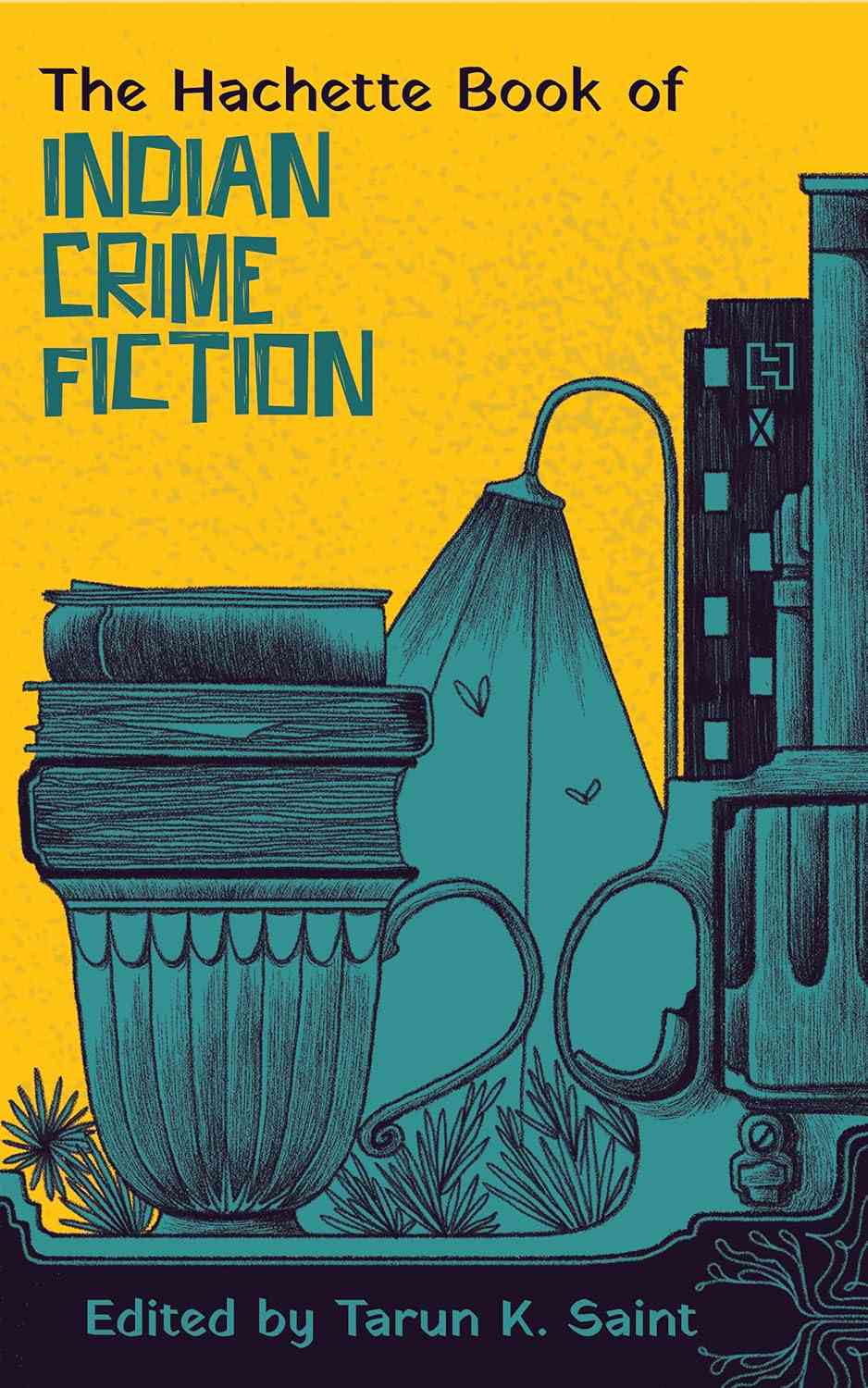
The Hachette Book of Indian Crime Fiction, edited by Tarun K Saint, Hachette India.
